
Best Time for RC Car Racing: Optimal Seasons and Conditions
Discover the best time for RC car racing with tips on ideal temperatures, seasons, and regional factors for outdoor events.
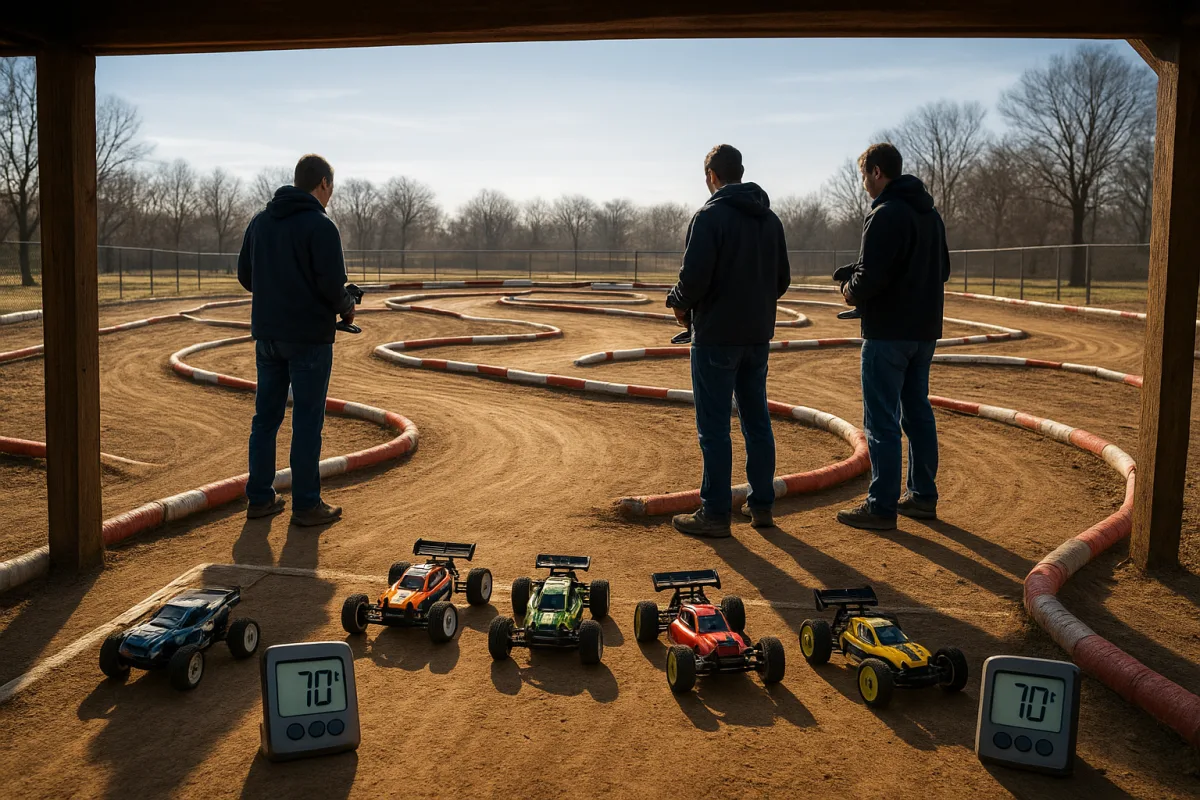
The shift is from “summer racing” to temperature-window racing
The useful change for an RC race organiser is straightforward: stop building the calendar around summer weekends alone. More clubs and facilities now publish schedules, timetables and indoor programmes that fit racing around usable conditions, not just the traditional warm-weather season.[4][5][6][7]
That is not proof of a sudden industry-wide revolution. There is no clean historical dataset showing that every club has moved dates, nor formal research identifying a universal “wrong” race month. Still, independent club schedules point toward the same practical answer: manage time, surface and temperature.
For an organiser, that is a better way to think than chasing a magic month. A 1/10 electric buggy meeting on a prepared outdoor dirt track, a 1/8 nitro truggy day, and a 1/10 carpet touring-car round all ask different things of the weather.
I would not schedule a 1/8 truggy final the way I would schedule a 17.5T 2WD buggy club night. The truggy has bigger rotating mass, longer mains and often hotter engines or motors. The buggy may be more sensitive to a cold, hard tire and a green track.
The best months depend on where the drivers live
For much of the Northeast, the most useful outdoor event windows are May through June, then late September through October. Those months avoid much of the cold-grip problem early in the year and the high-heat problem common in the middle of summer.[1]
Southeast organisers generally have a broader spring and autumn opportunity. March through May and September through November are the most favourable broad windows in the regional guidance, which makes them sensible anchors for points series and larger events.[1]
California is not one climate, so organisers still need to check the local forecast and track. May is highlighted as a favourable general outdoor-events month, but a dusty hardpack track and a coastal asphalt lot can behave like entirely different venues.[1]
Arizona calendars deserve even more care. January, March, November and December are identified as favourable outdoor-event periods, which tells you why blindly placing a desert race in peak summer can be harder on equipment and turnout than a winter date.[1]
That regional spread is the important planning trend. A national manufacturer release, school holiday or traditional race weekend should not outweigh the local operating window. A fast track with a poor date is still a poor event.
South Florida is another reminder that “winter” does not always mean downtime. Coral Springs RC Track operates in a warm-climate market, but the available evidence does not provide a quantitative humidity or rain threshold that tells organisers precisely when racing becomes unsafe.[2]
In tropical or subtropical climates, dry versus wet season is a more useful first filter than spring versus fall. However, the research is thin on exact precipitation, humidity and track-safety cutoffs, so do not pretend a percentage forecast produces a universal go or no-go decision.
Temperature matters more than most calendar traditions
The practical outdoor target is 59-82°F, or 15-28°C. That is a broad working band, not a guarantee of traction, but it gives an organiser a useful thermal target for tires, batteries, motors and driver comfort.[3]
Once ambient temperature climbs past about 86°F, 30°C, asphalt and tire behavior can become less predictable. Tires soften, and drift control can fall away, especially on a high-grip surface where the car was already close to traction rolling.[3]
Below 50°F, 10°C, tires stiffen and grip drops. On a 1/10 touring car, that may mean your normal additive, tire compound and sweep setup no longer work. On a 2WD buggy, it can turn a stable rear end into a loose entry problem.
That does not mean a cold race cannot be run. It means the organiser should shorten expectations, allow practice, and expect drivers to change setup. The expensive option is not automatically the answer. Often the fix is tire choice, shock package and a calmer driving style.
A car that was planted in 32.5-weight shock oil at 75°F may skate over braking bumps at 48°F. Before someone buys aluminum hubs or a carbon tower, they should look at tire temperature, ride height, piston choice and whether the diff is too free for reduced grip.
The same goes for gearing. If the afternoon heat turns a 1/10 13.5T buggy into a motor-temperature problem, dropping a tooth or two on the pinion is usually more sensible than buying a hotter motor. Setup and thermal management beat shiny parts most days.
Batteries and motors should help set the timetable
LiPo and lithium-ion packs perform best and should be stored around 59-77°F, 15-25°C. Outside that range, capacity drops and internal resistance rises, which is a bigger concern than a racer merely feeling uncomfortable at the driver stand.[3]
For a race director, that means a very cold morning can slow the whole programme. Packs need time to reach a reasonable temperature, drivers may need more warm-up laps, and the first qualifier can become a tire and battery experiment.
Hot weather has the opposite issue. A 2S shorty pack with a big claimed C-rating is not immune to heat soak, especially after repeated 1/10 off-road runs with little turnaround. The printed C-rating is not a weather plan.
Motor temperature deserves the same attention. Electric motors operate efficiently below 140°F, 60°C, while temperatures above 158°F, 70°C, raise the risk of overheating and damage.[3]
That is why early starts are not just convenient. They give 1/10 stock and modified classes a chance to run before the track and pit area get hot. They also reduce the chance that a long main becomes a contest in who owns the biggest fan.
A sensible organiser can build in a midday reset: water the dirt, check the racing line, inspect exposed wiring and give drivers time to cool packs. If the event is on asphalt, inspect grip and tire wear rather than assuming the morning setup survives unchanged.
Early starts are normal because race days are long
Published club operations show how wide the day can be. Zoomers RC Car Club lists events running about one to two hours, while RC3 Racing notes race days that can stretch to eight or 10 hours.[4][7]
Outdoor events commonly begin between 7:00 and 11:00 AM, although exact timetables vary by venue and class structure.[4][5][7] The long end of that range matters when planning multiple qualifiers, lower mains, trophy presentations and inevitable transponder or marshal delays.
For a compact club programme, a late-morning start may be perfectly sensible. If you are running two qualifiers and mains for a handful of 1/10 classes, there is little value in opening gates at dawn just because a national-level event does.
For a larger meeting, earlier is usually safer. The first qualifier should not be scheduled so late that the A-main lands at the day’s hottest point. That is especially true if you expect 1/8 electric truggies, high-current modified classes or long nitro mains.
Swindon RC Off-Road Club’s published race-day timetable is another example of the formal scheduling now expected at organized meetings.[5] A clear timetable is not bureaucracy for its own sake. It lets racers plan charging cycles, tire prep, food and marshal duties.
Rain and humidity need caution, not fake precision
Rain is a valid reason to reassess an outdoor programme. Water changes dirt-track consistency, creates drainage and electrical concerns, and can make an asphalt event impractical. But the available research does not establish a universal rainfall number for cancelling RC racing.
Humidity is similarly under-documented. It can affect comfort, drying time and track conditions, but there is no robust RC-specific dataset saying that a particular humidity percentage makes a meeting unsafe or uncompetitive.
So publish a weather policy before entries open. Say who makes the call, when the call is made, whether practice-only running is possible, how refunds or rain checks work, and whether a shortened programme still counts for points.
Do not invent certainty where it does not exist. “We cancel above 80 percent humidity” sounds precise, but it is not supported by the research brief. A track inspection, local forecast, drainage knowledge and electrical safety check are more defensible.
Indoor racing turns the off-season into a programme
Indoor facilities are the clearest sign that racing no longer needs to vanish when outdoor conditions turn poor. R/C Madness in Enfield, Connecticut runs indoor carpet off-road racing, while Mahoning Valley RC in Lehighton, Pennsylvania offers an indoor dirt track.[6][8]
The research brief also identifies 400 RC Compound in Ontario as a heated clay-track option and RC Excitement in Fitchburg, Massachusetts as a winter indoor dirt venue. Those are useful models for organisers in colder markets: change the surface and scale focus, rather than cancelling the whole season.
Indoor is not simply outdoor racing under a roof. A 1/10 buggy on carpet often wants tighter diff control, lower ride height and a very different tire decision than it used on loose outdoor dirt. The same chassis can race, but the setup sheet should not be copied blindly.
A 1/8 truggy programme is usually a poor fit for a small indoor layout. Space, noise, safety and marshal access matter. Indoor calendars are generally better suited to 1/10 electric off-road, touring, drift, mini classes and other lower-space formats.
For a home or small-project venue, the brief suggests at least 10 by 13 feet for 1/10-scale loops. That is enough to think about a compact practice course, not enough to promise a proper multi-class race circuit with safe passing and meaningful lap traffic.
The supplied brief names the Traxxas XRT Ultimate alongside mini and micro indoor options, but gives no price, dimensions or evidence that it suits a 10 by 13-foot indoor loop. It should not be used as a planning benchmark for a compact indoor programme.
Build the calendar around the class, not the poster date
Start by choosing your primary format. A spring 1/10 outdoor buggy series in the Northeast can sensibly target May and June. A fall companion series can use late September and October, with an indoor dirt or carpet backup once conditions deteriorate.[1][6][8]
For a Southeast club, use spring and autumn as the backbone, then avoid treating midsummer as mandatory. For an Arizona event, favor the cooler listed months and be realistic about whether a summer date will produce fair motors, usable tires and willing marshals.[1]
Finally, leave room to adjust. RC racing is still a mechanical sport where track prep, temperature, turnout and class mix matter. The best time is the date where your surface, equipment and drivers can all work, not the date that looks best on a flyer.
Frequently Asked Questions
What is the best temperature range for rc car racing?
The optimal ambient temperature range for outdoor RC car racing is between 59°F and 82°F (15°C to 28°C). Within this window, tires, batteries, motors, and driver comfort are generally well supported. Temperatures above 86°F (30°C) can soften tires and reduce drift control, while temperatures below 50°F (10°C) stiffen tires and reduce grip.
When is the ideal season for outdoor rc car racing?
Ideal outdoor racing seasons vary by region. In temperate U.S. areas like the Northeast, late spring (May–June) and early fall (late September–October) are best. The Southeast has a broader range from March to May and September to November. Desert regions like Arizona favor cooler months such as January, March, November, and December.
How does weather affect rc car racing performance?
Weather impacts tire grip, battery efficiency, and motor temperature. High heat softens tires and can reduce control, while cold temperatures stiffen tires and lower traction. Batteries perform best when stored and operated between 59°F and 77°F (15°C to 25°C), and motors risk overheating above 158°F (70°C).
What time of day is best for rc car racing events?
Starting races early in the day, typically between 7:00 AM and 11:00 AM, is recommended. Early starts help keep motors, tires, and batteries within their optimal temperature ranges throughout the event, preventing performance issues caused by heat buildup during long race days.
How do regional climates influence rc car racing schedules?
Regional climate strongly influences race scheduling. Temperate zones rely on spring and fall months to avoid extreme temperatures, while desert and tropical areas schedule races in cooler or dry seasons to protect equipment and maintain turnout. Organizers should prioritize local weather conditions over traditional summer race calendars.
How we researched this
This article was assembled from 8 cited references.
Nothing here is based on hands-on testing. Where a figure or finding appears, it belongs to the source cited beside it, and the writing says so rather than implying otherwise. Every source is listed below so you can check it.
Sources
- Optimal Times to Visit U.S. Regions for Outdoor Events | Clime Blog
- Coral Springs RC Track | South Florida Off & On Road RC Racing
- Indoor vs Outdoor RC Drift: Setup Differences, Surfaces & Tips (2026) | RC Cars Guide
- RC3 Racing - FAQ
- Race Day Timetable – Swindon RC Off-Road Club
- Racing And Practice Information - R/C Madness.com
- Racing Schedule – Zoomers RC Car Club
- RC Racing | Mahoning Valley Speedway Park | Lehighton, pa
Related Articles
Best RC Car for Racing: Arrma Limitless V2 vs Traxxas XO-1
Compare the best RC car for racing with detailed setup, tuning, batteries, motors, and kit choices for high-speed 1/7 scale brushless RC cars.

Unveiling the AW911 Airwolfed Arm Helicopter: Stability and Precision in Flight
Discover the impressive AW911 airwolfed arm helicopter from RC Tanks and Trucks 24/7. This 134-scale model features GPS positioning, a brushless motor, and optical flow for stability in windy conditions. The package includes spare blades, a USB charger, and a user-friendly 2.4 GHz transmitter. Experience smooth flights with features like figure-eight and circle auto modes, showcasing the drone's agility and precision. Explore the drone's advanced capabilities and find purchase links in the description.

Ultimate RC Car Unboxing: Speed, Durability, and Challenges
Kevin Talbot unboxes a new RC car, testing its speed, durability, and handling. The team gears up for speed tests, challenges, and comparisons with other models in the same price range. Viewers are invited to participate in giveaways and contests to win RC cars.

Vanquish VRD Carbon: Enhanced Crawler Performance Upgrades
AMain Hobbies upgrades the Vanquish VRD Carbon crawler for optimal performance on rocks. Enhancements include liquid gravity, shock adjustments, and premium upgrades, resulting in exceptional stability and crawling capabilities.