
Best RC Car Scale: Choosing the Right Size for You
Discover the best RC car scale for beginners and enthusiasts, balancing size, speed, cost, and space for optimal performance and fun.
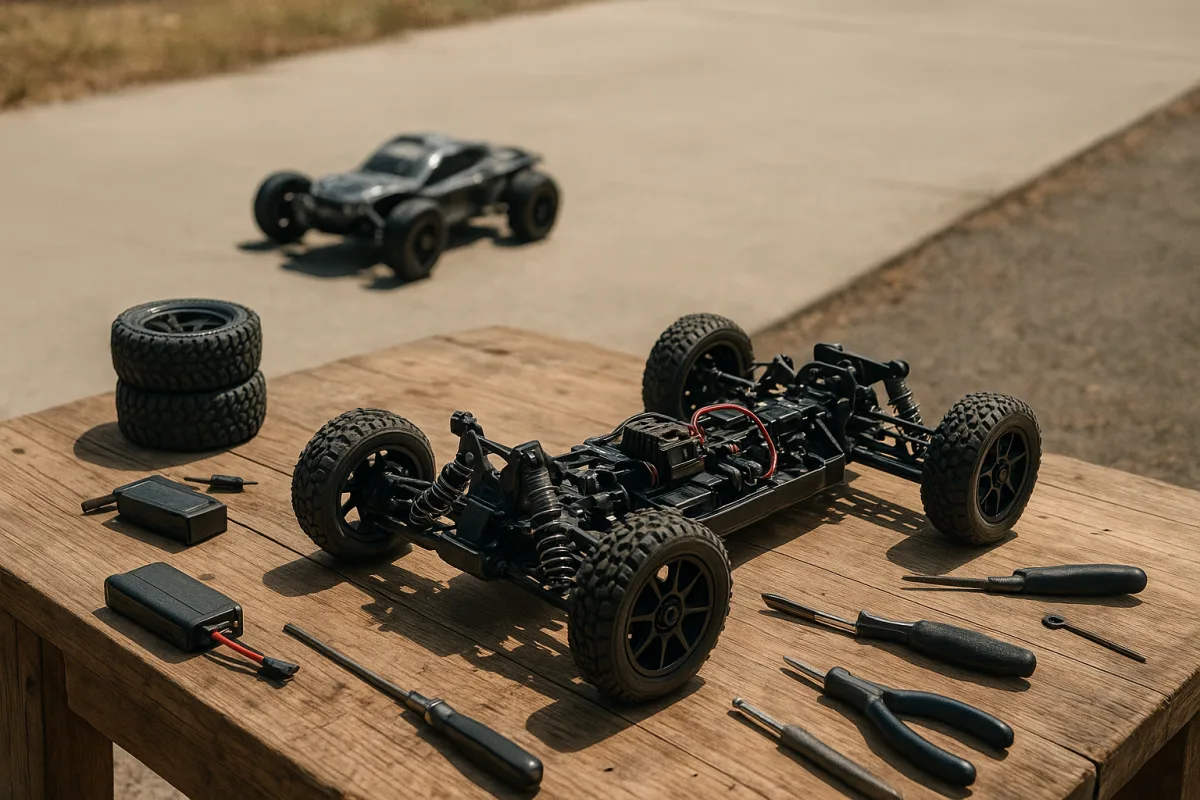
The number that matters: what scale actually means
When somebody asks for the best RC car scale, they usually mean, “What size car should I buy?” That is the right question, but scale is more useful than a simple size label.
A scale is a ratio between the model and the real vehicle it represents. A 1/10 model is nominally one tenth of full size, while a 1/8 model is larger because one eighth is larger than one tenth.
That sounds obvious until you are comparing boxes in a shop. The smaller denominator is the larger vehicle. A 1/5 truck is huge beside a 1/10 stadium truck, while a 1/28 car is small enough for indoor racing layouts. [1][9]
Scale is not an exact physical standard across every RC category. A 1/10 short-course truck, buggy, monster truck, touring car, and crawler do not share identical wheelbases, widths, or tyre diameters, because their full-size inspirations differ.
Still, the ratio gives you a useful first estimate of the car’s footprint, the room it needs, battery class, likely operating cost, and where it makes sense to run. That is why scale should be your first filter.
The most practical answer for many buyers is 1/10 scale. It is widely popular globally, covers on-road and off-road categories, and is large enough for outdoor driving without demanding the field-sized space of faster 1/8 machinery. [1][8]
A typical 1/10 RC car measures roughly 17 to 23 inches, or 43 to 58 cm, in length. The Traxxas Slash 4X4 is one commonly cited 1/10-scale example, although the useful point is its class rather than its badge. [1][3]
I have not run every vehicle named in the supplied research, and no single model can settle the scale question anyway. The important decision is whether the size fits your driving area, terrain, budget, and local support.
Why 1/10 is usually the sensible default
A 1/10 car occupies the middle ground. It is large enough to handle rougher outdoor surfaces than the smallest scales, yet it can still work in a reasonably sized driveway, car park, garden track, or club circuit.
That middle ground matters more than headline speed. The research places 1/10 performance around 30 to 60 mph or more, generally using 2S or 3S LiPo packs. [2][3]
A 2S LiPo is a two-cell lithium-polymer battery, while 3S has three cells. More cells raise voltage, which can raise motor speed, current demand, heat, and the consequences of a poor setup.
That is why scale does not determine speed by itself. Motor KV, pinion and spur gearing, battery voltage, tyre diameter, vehicle weight, drivetrain condition, and electronic speed controller settings all change the result.
A well-sorted 1/10 can embarrass a larger car that is overgeared, underpowered, fitted with tired batteries, or simply hard to put down cleanly. More scale gives potential for stability and larger power systems, not an automatic advantage. [2][4]
This is the point beginners often miss. They see a 1/8 model rated for 4S or 6S and assume it must be better. Better for what? On a tight driveway, more speed often means shorter trigger pulls and more broken steering parts.
For off-road bashing, 1/10 remains a sensible compromise because it is big enough for dirt, grass, and loose surfaces, but not so large that every mistake needs a long walk and a large repair bill. [5][8]
The 2026 price range also supports that middle-ground choice. Entry to hobby-grade 1/10 models typically sit around $150 to $500, while 1/8 models are commonly listed from $300 to $750 or more. [1][2]
Those ranges overlap. A basic 1/8 can start near $300, close to some hobby-grade 1/10 cars, so scale alone does not tell you whether a vehicle is cheap or expensive. [2][8]
Price is also more than the car. The published figures are vehicle prices, not necessarily the full first-day spend on a LiPo charger, battery packs, connectors, tyres, tools, spare gears, and replacement parts.
What changes when you go bigger
Moving from 1/10 to 1/8 is not merely adding a few inches. It changes the operating environment. A 1/8 platform is usually intended for larger power systems, commonly 4S to 6S LiPos, and speeds in the 50 to 100 mph-plus range. [2][3]
The attraction is obvious: a bigger car generally looks more planted over rough ground and has more physical presence at distance. On a proper open area, that extra stability can make sense. [2][5]
The trade-off is agility and space. The research characterises 1/8 cars as more stable but less agile than smaller alternatives, which matters if your normal driving spot is narrow, bumpy, or lined with kerbs. [2]
A fast 1/8 needs run-off. You need enough room to brake, turn, and recover from a mistake without sending a several-kilogram vehicle into parked cars, fences, people, or your own ankles.
That does not mean 1/8 is only for experts. It means the location has to match the machine. A large field, dedicated off-road track, or expansive bash site suits the scale far better than a suburban driveway.
The bigger scale also raises the cost ceiling. A 1/8 car may require larger batteries and can consume tyres and drivetrain parts under higher loads, although the research does not provide a complete scale-by-scale maintenance comparison.
That missing evidence is worth stating plainly. There is no solid comparative data here showing that one scale is universally harder to tune, maintain, or build than another, so it would be wrong to pretend otherwise.
A 1/5 model takes this logic further. Common hobby-grade scales extend up to 1/5, with typical prices around $500 to $800 or more, before batteries, charger, spares, and running costs. [1][9]
For most first-time buyers, 1/5 makes sense only when storage, transport, driving area, and budget are already sorted. It is not the automatic “best” choice merely because it is the biggest machine in the shop.
Small scale is not a lesser scale
At the other end, 1/28 and 1/24 cars exist for tight indoor spaces and compact race layouts. Indoor racing particularly favours these small formats because you can build a course where a 1/10 would barely complete a turn. [1][9]
A 1/18 car sits between micro RC and the common 1/10 classes. The research puts it around 15 to 30 mph, generally using smaller 2S LiPo or NiMH battery packs for indoor or casual driving. [2][3]
NiMH batteries are still common in entry-level and smaller RC cars. They are generally simpler for a newcomer, while LiPos are preferred where performance, lighter weight, and stronger voltage delivery matter. [6]
Small scale works when your available space is genuinely small. A 1/28 car in a living room can be more satisfying than a 1/10 truck that only gets two seconds of throttle before it reaches the fence.
Do not mistake small for maintenance-free, though. Tiny hardware is still hardware. A stripped gear, damaged steering link, or lost body clip remains annoying, and parts availability can matter even more with niche miniatures.
Battery capacity explains runtime better than scale
Runtime is where the scale label causes the most confusion. Buyers assume that a large 1/8 with a large pack must run much longer than a 1/10. Sometimes it will, but the number on the battery matters.
Battery capacity is measured in milliamp-hours, written mAh. A 5000 mAh pack nominally stores more charge than a 4000 mAh pack, assuming comparable voltage and battery condition. [6][7]
Typical 1/10 LiPo packs in the research sit around 4000 to 5000 mAh. Typical 1/8 packs are around 5000 to 6000 mAh, so the capacity gap is often much smaller than the physical size difference suggests. [6][7]
As a result, a 1/10 can commonly deliver roughly 20 to 35 minutes, overlapping with the 1/8 range. The broader quoted range for 1/8 LiPo use is approximately 25 to 45 minutes. [7]
A 1/24 NiMH vehicle may run around 15 to 25 minutes. Those figures are guides, not promises, because loose dirt, tall grass, cold weather, hard acceleration, worn batteries, and high gearing all increase power demand. [6][7]
C-rating adds another layer. It describes the battery’s claimed discharge capability, not its capacity. A higher C-rating may better support high current demand, but it does not make a 5000 mAh pack magically hold more energy.
For a beginner, the useful habit is to buy batteries that match the car’s specified voltage and physical tray size, then budget for two packs rather than chasing one theoretical marathon pack. That makes more difference to a day’s driving.
The scale choice should start with your venue
If you have an indoor course, a small room, or a temporary track made from foam barriers, look first at 1/28 or 1/24. That is what those scales are for. [1][9]
If you have mixed outdoor space and want a broad range of vehicle types, 1/10 is the sensible place to begin. It is the scale most consistently identified as globally popular, although detailed regional data for every other scale is limited. [1][8]
If your use is primarily rough off-road ground with room to spare, 1/8 deserves serious consideration. It offers stability and larger power-system options, but you should choose it because the venue supports it, not because larger sounds more serious. [2][5]
Finally, check parts before choosing any scale. A locally stocked 1/10 class with tyres, arms, gears, bodies, and batteries readily available is usually a better ownership proposition than an unusual scale with no nearby support. [8][10]
Most handling problems are not solved by buying a bigger car, a hotter motor, or an expensive upgrade. Start with a scale that fits your space, then learn the car’s battery, gearing, tyres, and driving limits before spending money.
Frequently Asked Questions
What is the best RC car scale for beginners?
For most beginners with access to outdoor spaces like driveways, local tracks, or parks, 1/10 scale is the best all-round starting point. It balances size, speed, battery cost, and parts availability, making it practical and widely supported. Choosing a scale that fits your available space and local parts support is also important.
How does RC car scale affect performance?
Scale influences potential speed and stability but does not guarantee performance. For example, a well-tuned 1/10 scale car can outperform a poorly set-up 1/8 scale car. Factors like motor tuning, gearing, battery voltage, and vehicle setup have a major impact on actual performance beyond scale alone.
Which RC car scale is best for outdoor use?
1/10 scale cars are generally well-suited for outdoor use because they are large enough to handle rough surfaces but still manageable in typical outdoor spaces like driveways or parks. Larger scales like 1/8 offer higher speeds and stability but require more space and run-off area.
Why is 1/10 scale considered the best all-round RC car size?
1/10 scale occupies a middle ground that fits many users’ needs: it is big enough for outdoor driving without requiring large fields, offers moderate speeds (30–60+ mph), and uses reasonably priced batteries and parts. Its global popularity also ensures good local support and parts availability.
How do battery and space requirements vary by RC car scale?
Larger scales typically use higher-voltage and higher-capacity batteries (e.g., 1/8 scale often uses 4S–6S LiPo packs), which need more space to run safely. Smaller scales require less room but may have shorter runtimes. However, battery runtime depends on capacity, voltage, terrain, temperature, and driving style as much as scale.
How we researched this
This article was assembled from 10 cited references.
Nothing here is based on hands-on testing. Where a figure or finding appears, it belongs to the source cited beside it, and the writing says so rather than implying otherwise. Every source is listed below so you can check it.
Sources
- RC Car Scale Sizes Explained — Complete Size Chart (2026 Guide) | RC Cars Guide
- RC Car Scales Explained (1/10 vs 1/8 vs 1/16) | RC Car Compare
- RC Car Sizes Explained: The Ultimate Guide to RC Scale Sizes (1/8, 1/10, 1/16, 1/18, 1/24) - Riverhobby Tech (Shenzhen) Co., Ltd.
- RC Car Scale Sizes Explained (1/10, 1/8, etc.): A Beginner-Friendly Guide - TRVBABY
- Best Off-Road RC Cars in 2026: Top Bashers & Crawlers
- RC Car Batteries 101: Types, Sizes, Prices, and Chargers – RaceNRCs
- How Long Does RC Car Battery Last? LiPo Guide 2026 | FUNYAT
- RC Car Scale Explained: A Beginner’s Guide to Choosing the Right Size
- RC Car Scales Explained — 1:8, 1:10, 1:12, 1:18, 1:24 | RCUK
- RC Model Shop | Best RC Car for Beginners: What to Buy
Related Articles
Best RC Car Type for Beginners: Choosing the Right Model
Discover the best RC car type for beginners, including scale, chassis, motor, and battery choices to fit your terrain and skill level.
Beginner RC Car Comparison Under 200: Crawler vs Off-Road
Compare beginner RC cars under 200 to find the best crawler or 4WD off-road model with setup and tuning tips for new drivers.
RC Car Kit Selection Guide for Beginners
Explore our RC car kit selection guide to learn how to choose the right scale and components for your first rc car.
How to Set Up RC Car for Beginners: Complete Starter Guide
Learn how to set up your RC car for beginners with tips on battery, tires, suspension, and motor for a smooth first drive.