
2S vs 3S RC Car Batteries: Which Offers Longer Runtime?
Compare 2S and 3S RC car batteries to learn which provides longer runtime and better performance for your vehicle's needs.
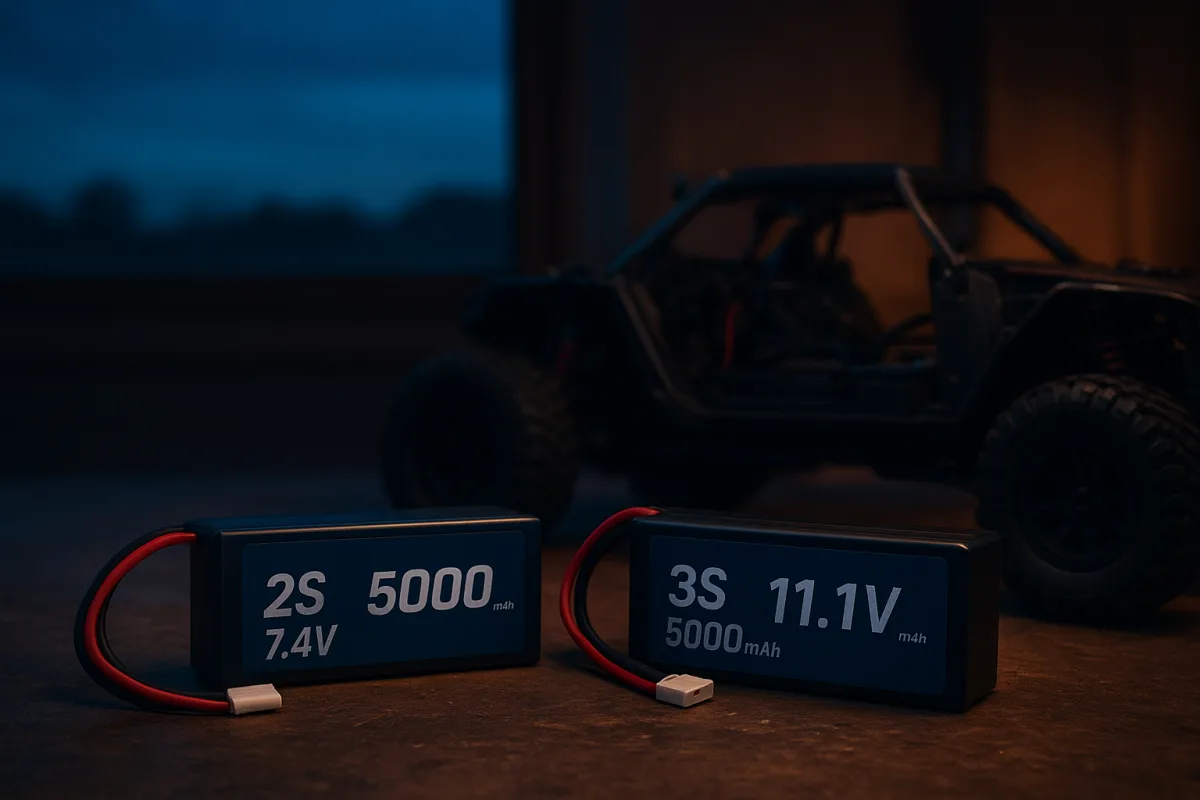
The decision: 2S wins for maximum usage
For long run time, I would choose the Traxxas Power Cell 7.4V 5000mAh LiPo Battery, not the Traxxas Power Cell 11.1V 5000mAh LiPo Battery. This is a choice between two otherwise similarly sized 5000mAh packs, not a vague claim that one brand is always better.
The 2S Traxxas pack is the sensible choice for a standard 1/10-scale vehicle where the goal is more driving between pit stops. The 3S Traxxas pack is the better choice only when the vehicle is rated for 3S and the owner accepts that added speed usually costs usable minutes.
I have not handled or tested either pack. This decision rests on their stated voltage and capacity, plus the well-established relationship between voltage, current draw, heat, and runtime in electric RC cars.[1][2]
A 2S LiPo is nominally 7.4V, while a 3S LiPo is 11.1V. That extra cell gives the motor and ESC more potential power, but it also makes it easier to use full throttle more often, pull more current, and turn stored energy into speed and heat instead of elapsed driving time.
On a 1/10 stadium truck or basher, fitting 3S can feel like a free performance upgrade until the tires balloon, the motor temperature rises, and the driver spends half the pack correcting wheelspin. Most handling problems are not fixed by a hotter battery.
Head-to-head: Traxxas 2S versus Traxxas 3S
| Criterion | Traxxas Power Cell 7.4V 5000mAh LiPo Battery | Traxxas Power Cell 11.1V 5000mAh LiPo Battery |
|---|---|---|
| Voltage and cell count | 7.4V, 2S | 11.1V, 3S |
| Capacity | 5000mAh | 5000mAh |
| Primary aim | Consistent, longer casual runtime in standard RC vehicles | More speed and punch in 1/10-scale vehicles rated for 3S |
| Typical runtime context | A 2S LiPo commonly delivers about 20 to 35 minutes in moderate use, though conditions can shift that range substantially.[[1]](https://www.eurorc.com/news/334/rc-battery-life?utm_source=openai "How Long Do RC Car Batteries Last: Complete Guide to Runtime, Lifespan & Optimization Tips | EuroRC.com")[[2]](https://funyat.com/blogs/rc-car-drone-reviews/how-long-does-rc-car-battery-last-lipo-guide-2026?utm_source=openai "How Long Does RC Car Battery Last? LiPo Guide 2026 |
| Power delivery | Lower peak speed, easier throttle control, less temptation to overgear | Higher speed potential and stronger acceleration, but greater load on the power system |
| Effect on drivetrain and temperatures | Usually the less demanding option when a vehicle is designed around 2S | Can expose weak gearing, marginal cooling, worn bearings, and unsuitable tires |
| Best scale and class fit | Standard 1/10 touring cars, 2WD buggies, brushed-to-brushless upgrades, and casual 1/10 bashers that are 2S-rated | 1/10 4WD bashers, short-course trucks, and stadium trucks specifically rated for 3S |
| Connector and fit check | Must match the vehicle’s connector and battery compartment | Must match the vehicle’s connector and battery compartment, plus the ESC and motor must be 3S-capable |
| Cost position in this field | Entry-level | Mid-range |
| Where it falls down | It will not give the speed or hard acceleration some 3S-capable vehicles are built to deliver | It is the wrong choice if long, calm sessions are the priority, or if the car is only rated for 2S |
The key point is that 5000mAh does not mean the packs will run for identical time. Capacity tells you how much charge is stored. Voltage changes the way the power system uses that charge, and a faster car generally spends it faster.
EuroRC places a typical 2S LiPo run around 30 to 35 minutes, while FUNYAT estimates 20 to 35 minutes.[1][2] That is a wide enough disagreement that I would treat 20 to 35 minutes as a realistic planning range, rather than promise a particular number.
The 3S estimates are also uneven. FUNYAT puts a 3S LiPo at roughly 15 to 25 minutes, while the broader evidence consistently supports the basic point that more voltage and speed often reduce runtime when drivers use that performance.[2]
Why the 2S pack is the better long-runtime tool
The Traxxas Power Cell 7.4V 5000mAh LiPo Battery makes sense because it limits performance to a level where a typical 1/10 car can stay composed. Less wheelspin means less wasted energy, especially on loose dirt, grass, gravel, and cold pavement.
For a 1/10 2WD buggy, a 2S pack is also usually easier on the rear tires and differential. If the buggy is traction rolling or lighting up the rear tires, changing shock oil or rear toe may be relevant, but adding 3S is not a runtime fix.
The same applies to gearing. A sensible pinion and spur combination that keeps motor temperatures under control will normally outlast an overgeared setup, regardless of the battery label. Long runtime comes from making the whole system efficient, not merely fitting the highest-voltage pack that physically fits.
The reported consistent voltage delivery of the 2S Traxxas Power Cell is useful for casual driving because the car should remain predictable through most of the discharge cycle. Its limitation is straightforward: a driver looking for dramatic top speed will outgrow 2S performance before they run out of battery.
Where the 3S pack earns its place
The Traxxas Power Cell 11.1V 5000mAh LiPo Battery is not a bad long-run option. It is simply a performance-first choice. In a 1/10 platform designed for 3S, it offers the speed and acceleration that make a heavier 4WD truck or short-course truck feel properly lively.
It also suits a driver who has a large open area and prefers shorter, faster sessions. A 3S pack can be the better use of a 5000mAh capacity when the goal is not minutes, but hard launches and higher straight-line speed.
Where it falls down is in a vehicle built around 2S electronics, conservative tires, or marginal cooling. Never treat 3S as a plug-in upgrade without confirming ESC, motor, servo, receiver supply, drivetrain, and gearing limits.
In a 1/8 truggy or 1/8 buggy, this comparison is less useful because those classes commonly use larger 4S systems. A 5000mAh 2S or 3S pack may not match the voltage, physical space, or connector requirements of that larger-scale vehicle.
The rest of the field: where each one sits
The Venom 7.4V 5000mAh 2S LiPo Battery Pack is another entry-level 2S option for casual RC drivers wanting a balance of durability and relative affordability. Like the Traxxas 2S pack, it suits standard 1/10 vehicles where runtime is more important than headline speed.
The Gens Ace 7.4V 5000mAh 2S1P LiPo Battery Pack sits in the mid-range and suits intermediate 1/10-scale users seeking reported higher-quality construction and reliable output. Its 2S specification makes it a more direct long-runtime alternative than any of the 3S choices.
The Zeee 7.4V 5000mAh 2S LiPo Battery Pack is a mid-range option for 1/10 hobbyists balancing cost and consistent power delivery. It belongs in the same use case as the Traxxas 2S, Venom 2S, Gens Ace 2S, and MaxAmps 2S packs.
The MaxAmps 7.4V 5000mAh 2S LiPo Battery Pack is also mid-range, aimed at 1/10 enthusiasts who value reported durability and consistent performance. It is suited to the same maximum-usage brief, assuming its dimensions and connector work with the particular chassis.
The Venom 11.1V 5000mAh 3S LiPo Battery Pack is a mid-range 3S option for 1/10 drivers who want more performance than a 2S pack supplies. It suits 3S-rated vehicles, but it gives up the 2S pack’s advantage when longer sessions are the main target.
The Gens Ace 11.1V 5000mAh 3S1P LiPo Battery Pack is positioned as a premium 3S choice for advanced 1/10 users. It suits drivers prioritising strong performance and reliable construction, rather than someone trying to stretch every run as long as possible.
The Zeee 11.1V 5000mAh 3S LiPo Battery Pack is another premium-positioned 3S option, intended for 1/10 hobbyists seeking a cost-to-performance balance. It is appropriate for a 3S-rated car, but does not change the underlying runtime trade-off.
The MaxAmps 11.1V 5000mAh 3S LiPo Battery Pack is the premium 3S choice for enthusiasts wanting reported high quality and consistent output. It suits an owner who values acceleration and power-system performance, not the absolute longest possible session.
The Traxxas Power Cell 14.8V 5000mAh LiPo Battery is the premium 4S option in this field. It suits higher-speed vehicles specifically designed for 4S, but it is not a sensible battery for a typical 1/10 car and should not be bought as a generic runtime upgrade.
Getting the claimed runtime in the real world
Capacity is only one part of the equation. A 5000mAh pack driven gently on smooth pavement can last far longer than the same pack run wide open through tall grass, mud, or a rough field. Both EuroRC and FUNYAT identify driving style as a major runtime variable.[1][2]
The exact penalty is contested. EuroRC suggests aggressive use can reduce runtime by two to three times, while FUNYAT suggests reductions up to about 50 percent.[1][2] Those figures differ, but the practical advice does not: if you want minutes, limit full-throttle bursts.
Cold weather is another quiet runtime killer. Below 10°C, LiPo performance can fall by about 20 to 30 percent, so a pack that seems weak on a winter morning may not be defective.[1] Keep batteries dry, avoid leaving them in a cold car, and do not charge a cold pack immediately.
Check connector compatibility before choosing any battery. XT60, Deans or T-Plug, EC5, Traxxas, and XT90 connectors are all common, but matching the battery, ESC, charger lead, and vehicle connector matters more than internet arguments over connector preference.[13]
Do not use an adapter as a casual answer to an undersized connector or a battery tray mismatch. On a hard-running 1/10 4WD truck, resistance and poor connections make heat, and heat is lost runtime before it becomes a reliability problem.
Finally, use a balance charger, set the correct cell count, and storage-charge LiPos near 3.8V per cell. Do not discharge below 3.0V per cell, charge straight after a hot run, or leave packs fully charged for long periods.[15]
Who each option suits
The Traxxas Power Cell 7.4V 5000mAh LiPo Battery suits beginners and casual 1/10-scale drivers who want the most usable driving time from a straightforward 5000mAh pack. It is the better decision for a 2S-rated buggy, touring car, stadium truck, or mild basher where controlled speed, cooler running, and longer sessions matter.
The Traxxas Power Cell 11.1V 5000mAh LiPo Battery suits drivers with a confirmed 3S-capable 1/10 vehicle who want more acceleration and top speed. It falls short for the long-runtime buyer because the added voltage makes it easier to consume the same 5000mAh capacity faster.
If the vehicle is 2S-only, the decision is not close: buy the 2S pack. If the vehicle is genuinely built for 3S and speed is as important as session length, the two are close, but they serve different priorities rather than competing for the same job.
Frequently Asked Questions
Which lasts longer, 2S or 3S rc car battery?
A 2S LiPo battery generally lasts longer than a 3S LiPo battery of the same capacity. Typical 2S runtimes range from about 20 to 35 minutes, while 3S runtimes are shorter, around 15 to 25 minutes under moderate use. The higher voltage of a 3S pack encourages greater current draw, which reduces overall runtime.
How does voltage affect rc car battery runtime?
Higher voltage batteries like 3S (11.1V) provide more power and speed but usually result in shorter runtimes due to increased current draw and heat generation. Lower voltage packs like 2S (7.4V) deliver less peak power but tend to run longer because they draw current more moderately.
What are the pros and cons of 2S vs 3S LiPo batteries for rc cars?
2S batteries offer longer, more consistent runtimes, easier throttle control, and less stress on the drivetrain, making them suitable for standard 1/10-scale vehicles focused on longer driving sessions. 3S batteries provide higher speed and acceleration but increase load on the power system, generate more heat, and typically shorten runtime. Using 3S also requires compatible ESC, motor, and vehicle rating.
Is a 2S battery better for longer rc car run times?
Yes, a 2S battery is better suited for longer run times compared to a 3S battery of the same capacity. It encourages lower current draw and heat buildup, which helps extend driving time, typically delivering 20 to 35 minutes under moderate use.
Can using a 3S battery reduce rc car runtime?
Yes, using a 3S battery often reduces runtime because its higher voltage leads to increased current draw and heat, which drains the battery faster. Typical runtimes for 3S packs are about 15 to 25 minutes, shorter than comparable 2S packs.
How we researched this
This article was assembled from 18 cited references.
Nothing here is based on hands-on testing. Where a figure or finding appears, it belongs to the source cited beside it, and the writing says so rather than implying otherwise. Every source is listed below so you can check it.
Sources
- How Long Do RC Car Batteries Last: Complete Guide to Runtime, Lifespan & Optimization Tips | EuroRC.com
- How Long Does RC Car Battery Last? LiPo Guide 2026 | FUNYAT
- RC Car Battery Guide: NiMH vs LiPo Basics
- Helios RC 2S 6000mAh 100C Racing LiPo Battery – High Power & Runtime – RC Addict
- RC Car Batteries for Long-Lasting Power | RC Visions
- RC Car Batteries – Mike's Hobby
- RC LiPo Battery Guide: Sizes, Safety & Best Picks (2026) | RC Cars Guide
- RC Battery mAh Explained: Runtime, Size and Weight | RC Setup Lab
- Higher Capacity Battery In My RC Car - RC Tech Tips
- RC Car Batteries 101: Types, Sizes, Prices, and Chargers – RaceNRCs
- RC LiPo Battery Guide: All You Need to Know | AllRCGuide
- Traxxas TRX Connector - Male + Female - High Current for Batteries | RC Model Making \ Electrical Connectors \ DEAN-T, TRX
- Battery Connectors: XT60, Deans, and Why You Standardize
- How Long Does RC Car Battery Last? Essential Maintenance Tips
- RC LiPo batteries: charging and storage
- Traxxas Power Cell 7.4V 5000mAh LiPo Battery
- EC5 IC5 Male & Female Connector Plug Pairs (Long Version) 4 Pack – OZRC
- RC - How Long Do RC Batteries Last? (2026) - MAD Toys and Hobbies
Related Articles
Best Batteries for RC Cars: A Detailed Comparison
Discover the best batteries for RC cars with our detailed comparison of top options, including voltage, capacity, and performance insights.
Common RC Car Motor Mistakes: KV, Battery & Setup Tips
Learn common RC car motor mistakes including KV misunderstandings, battery matching, and setup tips to avoid overheating and poor performance.
How to Store RC Car for Winter: Essential Preparation Tips
Learn how to store your RC car for winter safely with tips on cleaning, battery care, and maintenance to protect your car during off-season.
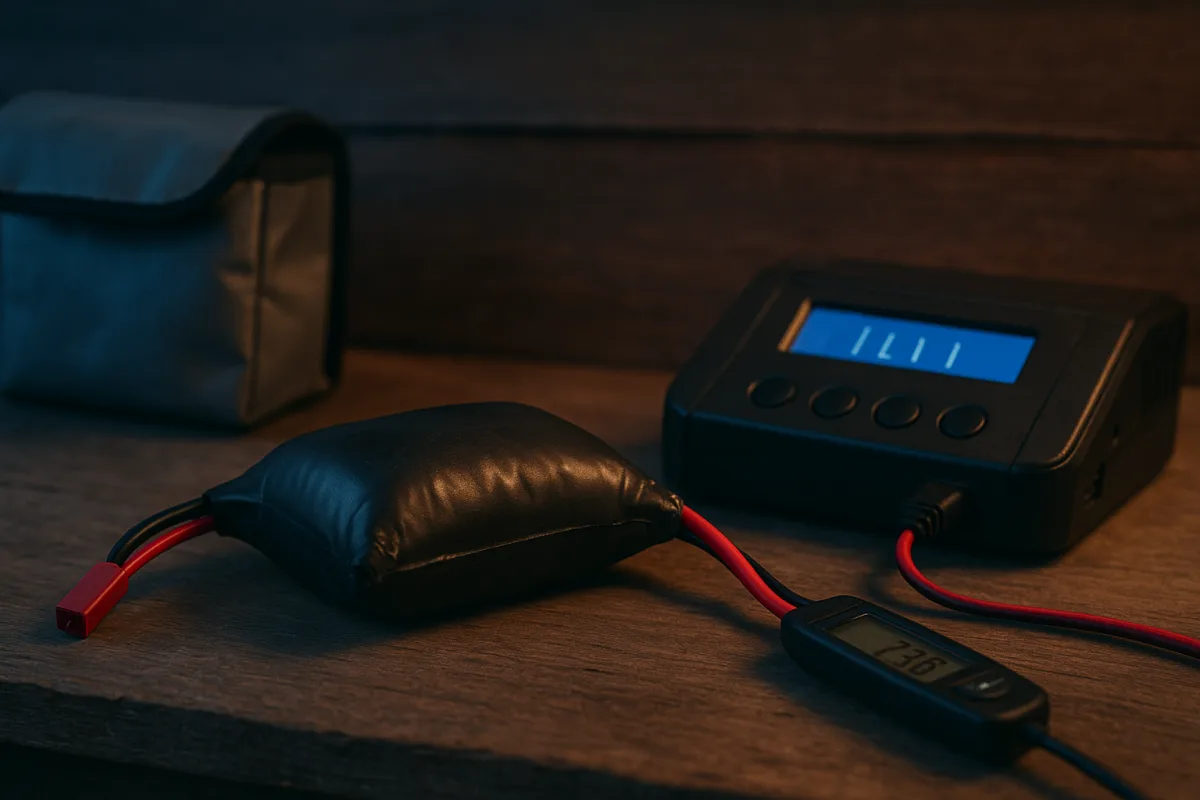
Prevent RC Car Battery Swelling
Learn how to prevent RC car battery swelling with safe charging, proper storage, and maintenance tips to extend your LiPo battery life.