
Best RC Car for Off Road: ARRMA Granite vs Traxxas Slash
Compare the best RC car for off road use: ARRMA Granite vs Traxxas Slash. Get expert advice on terrain fit, battery, and maintenance.
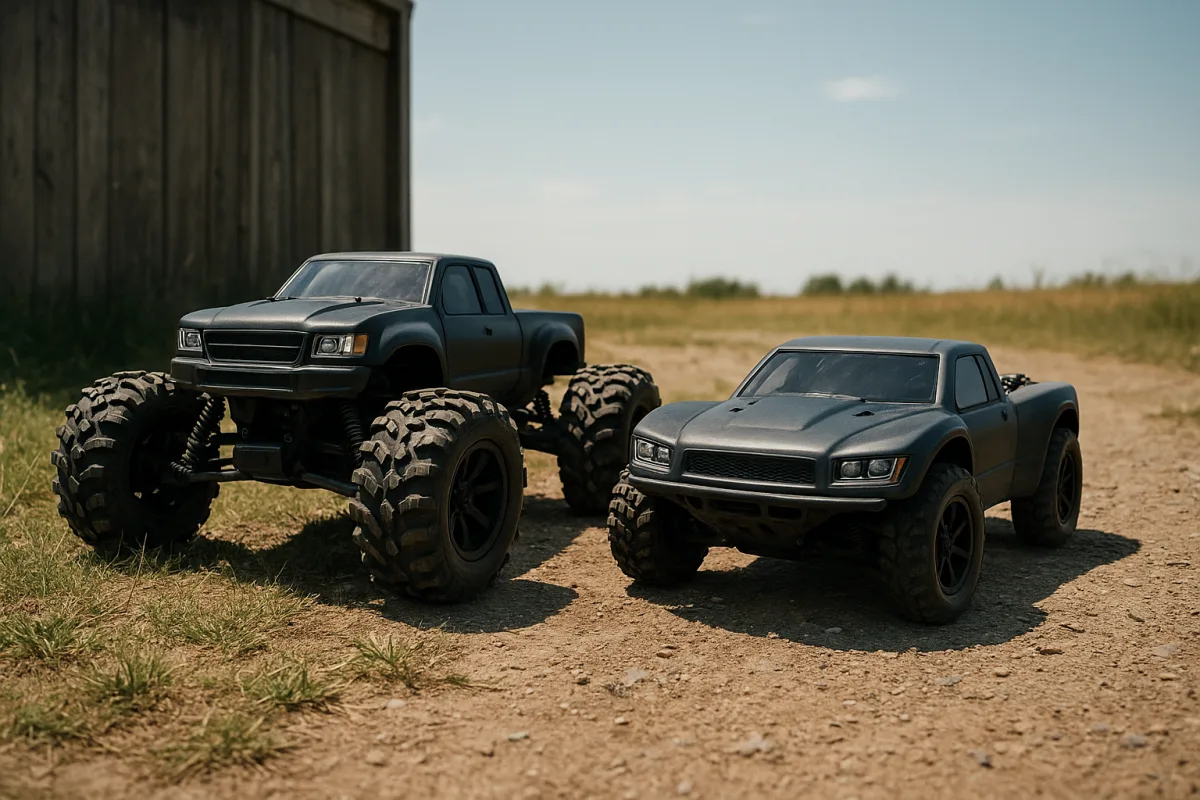
The decision: ARRMA Granite 4X4 or Traxxas Slash 4X4?
For a single off-road RC car, I would put the ARRMA Granite 4X4 and Traxxas Slash 4X4 head to head. They sit in the same mid-range part of the supplied field, both use four-wheel drive, and both target drivers who want speed beyond a toy-grade backyard truck.
This is not a made-up win for one badge. These are different layouts for different ground. The Granite is a monster truck, built around large wheels and a high-riding attitude. The Slash is a short-course truck, lower and wider-looking, aimed at stability and sporty running.
I have not driven either model, so this is a buying decision based on the supplied specifications and model positioning, not a fabricated personal test. The Granite is described with large wheels, shock absorbers and a reinforced chassis for rough terrain, while the Slash is described as having all-wheel drive, a powerful motor and robust suspension for challenging ground. [11]
| Criterion | ARRMA Granite 4X4 | Traxxas Slash 4X4 | Better fit |
|---|---|---|---|
| Vehicle type | Monster truck | Short-course truck | Choose by terrain, not brand |
| Ground clearance approach | Large wheels give it the more useful shape for rough, uneven ground | Lower body shape favors stability over clearing tall obstacles | Granite for grass and ruts |
| Surface stability | More body roll is the normal trade for monster-truck clearance | Lower, more planted format should be easier to place at speed | Slash for hard-packed dirt and gravel |
| Rough-terrain tolerance | Reinforced chassis, shocks and large wheels are the reported focus [11] | Robust suspension and 4WD are the reported focus [11] | Granite on rougher casual terrain |
| High-speed driving | Capable, but its taller monster-truck layout is not the obvious stability choice | Short-course layout better suits fast, flowing open spaces | Slash |
| Mud and water expectations | 4WD helps, but “waterproof” should be treated as splash resistance unless the manufacturer specifically states otherwise | Same warning applies, especially around bearings, connectors and cooling areas | Neither, without careful preparation |
| Beginner friendliness | Good for a driver who will hit rough ground and occasionally misjudge a landing | Good for a driver who values predictable direction changes and speed control | Granite for terrain, Slash for driving precision |
| Best use | Grass, loose dirt, uneven vacant-lot terrain, casual bashing | Packed dirt, gravel, open parks and short-course-style running | Terrain decides it |
| Main compromise | Less scale realism and potentially less calm behavior at speed | Body and tires are less suited to deep grass or pronounced ruts | Both have clear limits |
Why the Granite gets the nod for general off-road use
The ARRMA Granite 4X4 is my pick for the broadest definition of off-road. A monster truck’s useful advantage is not merely looking aggressive. Bigger wheels and a taller chassis shape help it cross holes, scattered stones, grass clumps and loose soil that can stop a lower truck.
That matters because many new buyers call a lawn “easy terrain.” It rarely is. A smooth, closely cut lawn is one thing. Tall, uneven grass drags on the chassis, loads the drivetrain and exposes a low truck to hidden roots and holes.
The Granite’s reported reinforced chassis, large wheels and shock absorbers make its intended use clear: rough-terrain bashing rather than scale realism or tidy race-track lines. [11] For someone who has one local field, a dirt pile and an uneven garden, that is a sensible starting point.
Its weak point is the same feature that makes it attractive. A high-riding monster truck is not automatically the most composed option when the surface becomes fast and smooth. Before buying aluminum parts, I would look at driving inputs, tire condition and shock setup.
Most handling complaints start with setup or surface mismatch, not with a lack of expensive upgrades. If a truck bounces across hard-packed ground, excessive spring preload, worn shocks or unsuitable tires can be bigger causes than the stock chassis.
Why the Slash can still be the better purchase
The Traxxas Slash 4X4 is the better choice for a driver who thinks “off-road” means fast laps on dirt, gravel paths, packed earth and open spaces. Its short-course form is inherently more focused on stability than the Granite’s tall monster-truck stance.
The supplied field identifies the Slash 4X4 as a four-wheel-drive performance truck with a powerful motor and robust suspension. [11] That does not make it superior everywhere, but it does make it better suited to a driver who wants to carry speed through turns.
A short-course body also gives the Slash a different visual appeal. The ARRMA Granite 4X4 looks like a bash truck because it is one. The Slash 4X4 looks closer to a full-size off-road race truck, which matters if scale-inspired driving is part of the attraction.
Its limitation is ground clearance in practical terms. Short-course trucks can run very well off-road, but deep grass, sharp ruts and chunky terrain demand more from tires, driveline and driver. Do not expect a lower truck to float across terrain meant for a monster truck.
If the truck feels loose or traction-starved, start with the tires and the surface. For mud, aggressive V-lug or paddle-style patterns with tall lugs are the relevant direction, while sand calls for paddle tires and a strong four-wheel-drive system. [12][14]
Battery, water and maintenance reality
Neither the Granite nor the Slash should be chosen on a vague runtime promise. Runtime depends heavily on battery chemistry, capacity, driving style, terrain and whether the driver spends the pack at full throttle. Reports across the category range from under 10 minutes for some budget NiMH setups to 40 or 50 minutes for LiPo-equipped vehicles. [21]
The useful question is not “how long does it run?” Ask what batteries are included, what chemistry they use, whether a charger is included, and how long that charger takes. Charging can range roughly from 40 minutes to two hours in the broader off-road category. [21]
A LiPo pack’s C-rating is also not a runtime number. Capacity, expressed in mAh, is the primary runtime clue, while C-rating indicates the pack’s claimed discharge capability. A high C number will not rescue a small-capacity pack driven hard through grass.
Waterproof claims need similar skepticism. Many RC vehicles described as waterproof are realistically water-resistant against splashes, not safe for deep-water running or submersion. Water can still reach bearings, connectors and places where mud turns into abrasive paste. [21]
After a wet or dusty run, brush away dirt, inspect wheel nuts and suspension hardware, check driveline wear, and make sure the drivetrain turns freely. Cleaning and lubrication are routine ownership jobs, not optional chores after something breaks. [20]
Where the rest of the supplied field fits
The supplied field contains more than the two trucks chosen for this decision. They are not equal substitutes, so it is worth placing each by class and intended buyer rather than pretending every brushless truck solves the same problem.
The premium WIAORCHI 9522 Brushless RC Truck suits an enthusiast chasing very high speed and durability. Majesty Racing reports over 50 mph, an aluminum chassis and dual batteries for longer running, making it a more serious performance proposition than the mid-range Granite or Slash. [22]
The premium HYPER GO H16BM Brushless 4WD RC Truck suits someone wanting speed with a metal-geared drivetrain. Its reported 2845 4200KV motor points toward hard acceleration, but raw KV numbers do not tell you whether it fits your terrain or driving ability.
The premium HYPER GO H14BM V3 Brushless RC Car suits another high-speed, durability-focused buyer. It belongs in the same performance-minded part of the field as the WIAORCHI and H16BM, not in the beginner category where low-speed control and spare support should lead the decision.
The premium 1/10 Brushless RC Monster Truck suits a driver who specifically wants a high-performance monster-truck format. Its name gives less detail than the branded alternatives, so verify battery requirements, spare-part availability and actual included equipment before treating it as equivalent to the Granite.
The mid-range Tamiya Wild One suits a hobbyist who wants to build and customize a buggy. It is the choice for kit-building satisfaction and classic buggy character, not the obvious answer for a buyer seeking an assembled rough-terrain basher.
The mid-range ARRMA Senton 4X4 suits a driver who likes realistic short-course styling with four-wheel drive, suitable tires and a sturdy chassis. It sits closer in purpose to the Slash 4X4 than to the Granite, favoring the short-course look and general off-road capability.
The entry-level HAIBOXING 1:18 Scale All Terrain RC Car suits a beginner who needs a smaller, cheaper route into off-road RC. Its compact scale can make it practical for limited space, but “all terrain” should not be mistaken for equal capability in grass, mud and rocks.
The entry-level DEERC 9309E All Terrain RC Monster Truck suits a newcomer seeking a simple, fun truck for varied surfaces. It is a sensible category for learning throttle control and basic maintenance, while accepting that entry-level durability and battery equipment may have limits.
Who each option suits
The ARRMA Granite 4X4 suits the buyer who wants one mid-range truck for genuinely uneven ground. Pick it for grass, loose dirt, rough open spaces and casual jumping, where wheel size and a monster-truck layout are more useful than track-like precision.
The Traxxas Slash 4X4 suits the buyer whose off-road running is faster and flatter. Pick it for compacted dirt, gravel, park paths and open areas where stability, steering accuracy and short-course style outweigh the need to clear grass and deep ruts.
They are close if your terrain is mixed but not extreme. In that case, buy the Granite if your site is rougher than it is fast, and buy the Slash if your site is faster than it is rough.
Frequently Asked Questions
Which is the best RC car for rough off-road terrain?
The ARRMA Granite 4X4 is the better choice for rough off-road terrain such as tall grass, loose dirt, and uneven ground. Its large wheels, high chassis, reinforced frame, and shock absorbers make it more capable of handling holes, roots, and rough surfaces than lower trucks.
Should I choose ARRMA Granite or Traxxas Slash for off-road?
Choose the ARRMA Granite 4X4 if you prioritize rough terrain clearance and monster-truck style bashing on grass and uneven surfaces. Choose the Traxxas Slash 4X4 if you want a lower, more stable truck suited to packed dirt, gravel, and faster, smoother runs.
What terrain suits monster trucks vs short-course RC trucks?
Monster trucks like the ARRMA Granite 4X4 excel on rough, uneven terrain with tall grass and ruts due to their large wheels and high clearance. Short-course trucks like the Traxxas Slash 4X4 perform better on packed dirt, gravel, and open, smooth surfaces where stability and speed are priorities.
How do battery type and maintenance affect off-road RC cars?
Battery runtimes vary widely; LiPo batteries typically offer longer runtimes (up to 40–50 minutes) compared to NiMH batteries, which may provide under 10 minutes. Proper battery choice, charging, and throttle management are important for durability and longer driving sessions.
Are off-road RC cars truly waterproof or just water-resistant?
Most off-road RC cars marketed as waterproof are actually only water-resistant or splash-proof. Full submersion can damage electronics, especially bearings and connectors, so realistic water expectations and careful preparation are necessary to avoid damage.
How we researched this
This article was assembled from 23 cited references.
Nothing here is based on hands-on testing. Where a figure or finding appears, it belongs to the source cited beside it, and the writing says so rather than implying otherwise. Every source is listed below so you can check it.
Sources
- Best RC Trucks & Bashers for Off-Road (2026 Buyer's Guide) | RC Cars Guide
- Best Rc Cars (2026): top picks ranked by value
- DEERC 9500E 1:16 Scale All Terrain RC Car, 4x4 High Speed 40 KPH RC Truck, 2.4Ghz Remote Control Truck with 2 Batteries, Off-Road Monster Truck for Adults Kids for sale | Katy, TX | Nellis Auction
- The 8 Best RC Cars of 2026 | Graded Picks
- GUOKAI 1:16 4WD RC Truck 35KM/H Shark OFF-Road Climbing Vehicle 866-16 – URGENEX RC Hobby
- WLtoys 064308 Big Shark Review 2026 — 1/6 4WD RC Truck Dual 775 Motors | FUNYAT
- Crawling kit - EMOX NT Wildboar 1/8 ARTR kit
- NT WILD BOAR 1:8 Scale 4WD Off-Road RC Crawler - High-Performance Brushless Mud Racing Truck RTR | CROSSRC EMOX 2026 NEW – AT 99 MODEL
- 58065: Clod Buster from mersey_mike showroom, Clod Buster - Tamiya RC & Radio Control Cars
- Best RC Crawlers (2026) — Top Picks Compared | RC Car Compare
- Best Off-Road RC Cars in 2026: Top Bashers & Crawlers
- Best RC Car Tires for Off-Road: Complete Buyer's Guide 2026
- L.O.T Cars | Off-Road RC Cars: Built Tough for Mud, Rocks & Trails
- Can RC Cars Be Used On Sand? Here's The Truth -
- 1/10 Scale RC Crawler Trail Setup Guide – FMS Hobby
- WLtoys 104026 1/10 Rc Car 4x4 Off-Road Crawler, 2.4G 4WD, Electric Win – RCDrone
- 12 Best RC Trucks for Off-Road (September 2026) Expert Reviews
- PINECONE Model SG1601 1/16 2.4Ghz 4WD Brushed RC Truck RTR
- Best RC Cars for Beginners of 2026: Top 5 Models Compared | EuroRC.com
- How to Clean Your RC Car: Complete Maintenance Guide - RC Tech Tips
- RC Off-Road Car Buying Guide: Avoid Costly Mistakes
- WIAORCHI 9522 Brushless RC Truck
- Azeon Hstar (2026) R12-01Q F150 Raptor Four-wheel Drive Full Scale Climbing Car RC Pickup Truck Crawler SUV Off Road 1/12 4WD RTR, Black | R12-01Q Buy, Best Price. Global Shipping.
Related Articles
2S vs 3S RC Car Batteries: Which Offers Longer Runtime?
Compare 2S and 3S RC car batteries to learn which provides longer runtime and better performance for your vehicle's needs.
How to Store RC Car for Winter: Essential Preparation Tips
Learn how to store your RC car for winter safely with tips on cleaning, battery care, and maintenance to protect your car during off-season.
Best Terrain for RC Cars: Matching Surface to Your Setup
Learn the best terrain for RC cars and how to match your car’s setup for optimal performance on different surfaces.
Best RC Car for Racing: Arrma Limitless V2 vs Traxxas XO-1
Compare the best RC car for racing with detailed setup, tuning, batteries, motors, and kit choices for high-speed 1/7 scale brushless RC cars.