
RC Car Weight Distribution Tips for Better Handling
Learn RC car weight distribution tips to balance corner weights, lower center of gravity, and improve handling and stability on various surfaces.
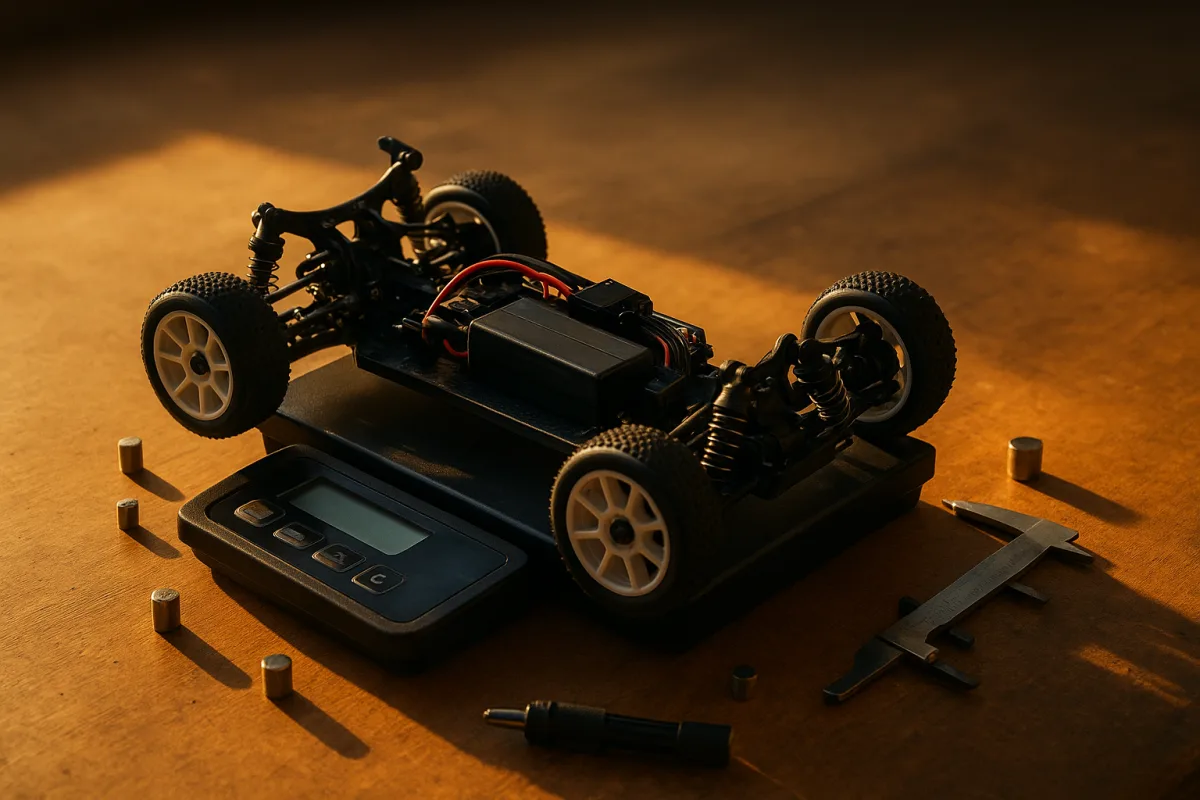
When the car feels nervous before the first corner
A car that wanders on the straight, snaps when you lift, or changes personality between left and right turns is usually asking for setup work, not an aluminium option part. Start by defining the class and surface.
A 1/10 electric buggy on loose dirt, a 1/10 touring car on carpet, a 1/8 truggy on rough outdoor dirt and a rear-wheel-drive drift car do not carry weight or transfer load in the same way. Advice without that context gets expensive fast.
The first temptation is to ask for the ideal front-to-rear percentage. There is not one universal number for 1/10-scale electric cars. Track grip, layout, driving style, tire condition and the rest of the setup all change what works. [2][8]
What is consistent is the need for balanced corner weights. HobbyKing’s TrackStar Corner Weight System is intended to show the load at each wheel on 1/8, 1/10 and 1/12 chassis, because individual imbalance can create a rolling bias that feels like random instability. [1]
Do the simple checks before chasing numbers. Use the same wheels and tires you race with, confirm the suspension moves freely, set ride height, and make sure the battery is secured exactly as it will be on track.
A battery that can slide in its tray is a moving ballast weight. That is not tuning. It means the car can enter one corner with one balance and the next corner with another, especially after a hard landing or curb strike.
First problem: it turns differently left and right
This is where corner-weight scales earn their place. Put the complete car on four scales on a level bench, with the race battery, body shell if used, transponder and normal wheel-and-tire package installed. [1][8]
You are not hunting a magic percentage. You are looking for obvious disagreement between the four corners, then working methodically to remove it. A large mismatch can make the chassis more willing to roll or lose grip in one direction. [1]
For on-road racing, the normal aim is close left-to-right balance, roughly a 50/50 split in principle rather than a prescribed gram figure. That lets the car load its tires consistently through both left and right corners. [2]
Do not invent a gram target from somebody else’s setup sheet. The available guidance does not establish a standard acceptable left-right difference in grams or percentage. Measure, change one thing, and compare the car’s behavior. [2][8]
Dirt oval is the important exception. Oval cars commonly use left-side weight bias to help counter the repeated cornering load of a circuit that turns predominantly one direction. That is a class-specific setup, not a baseline for a 1/10 buggy. [2]
If your 2WD or 4WD buggy is inconsistent side-to-side, first look at where the battery, receiver, ESC and wiring sit. Move what can be moved toward the centreline, then recheck the scales before adding lead. [3][8]
The same rule applies to a 1/10 touring car. A receiver mounted high on one side, loose wires piled beside it, and an ESC shifted outward may not look dramatic on the bench. Together, they can make a precise car feel reluctant one way.
Second problem: the car bicycles, traction-rolls or feels top-heavy
Before adding chassis weight, lower the weight already on the car. R/C Tech setup guidance recommends mounting the battery and electronics low in the chassis, because a lower centre of gravity improves stability. [3]
This is especially relevant in a 1/10 electric platform, where the LiPo is one of the largest movable items. Keep it low, secure it firmly, and avoid stacking accessories or unnecessary wiring above the chassis deck.
There is no documented millimetre figure for how far a particular battery move lowers the centre of gravity. Do not claim that a forward or rearward battery position lowers CG by a fixed amount. The supported guidance is qualitative. [3][6]
A high centre of gravity makes the chassis more sensitive to lateral load transfer. In plain racer language, the car leans harder and asks more of the outside tires. Once that tire is overloaded, the result can be a traction roll or abrupt breakaway. [6]
Ballast can lower the effective centre of gravity if it is mounted low, but it still adds total mass. That means it can calm a twitchy chassis while also making acceleration, braking and direction changes more demanding. Use it sparingly.
On carpet, brass chassis ballast of about 10 g is a commonly cited way to reduce oversteer. That is a starting adjustment for a high-grip situation, not a rule that every 1/10 carpet car needs. [4][5]
If the car is traction-rolling, do not automatically bolt on more brass. Check ride height, shock condition, tire choice and whether the battery is mounted as low as the chassis permits. Weight may disguise the actual fault.
Third problem: the front pushes, then the rear suddenly steps out
This is the front-to-rear balance problem, and it is where battery placement is useful. Moving the battery forward increases front traction and steering response, but it can reduce the rear traction that keeps the car stable on power. [3]
That move can help a 1/10 buggy that will not enter a corner or a touring car that refuses to load the front tires. Make the smallest packaging change available, then run enough laps to separate a genuine improvement from one fast corner.
Move the battery rearward when the rear lacks drive traction or the car is loose under power. The trade-off is reduced front grip, so the car may become safer on exit while requiring more patience at turn-in. [3]
For stability, avoid treating forward placement as universally better. Too much front bias can make the rear light, particularly when braking or lifting. The car may initially feel sharper, then become less predictable when the rear tires unload.
On low-bite tracks, centering the battery can improve forward bite. On high-bite tracks, shifting it left can alter turn-in behavior. Those are tuning directions to test, not fixed prescriptions, because surface grip and the rest of the car matter. [3]
A 1/8 truggy needs the same thought process, but do not copy the position from a 1/10 short-course truck. The heavier rotating parts, larger tires and rougher terrain change how aggressively the platform reacts to each adjustment.
Motor location matters as well, particularly in specialist chassis. Esek RC’s rear-wheel-drive drift guidance treats motor placement as a major factor in weight transfer, which is relevant to drift setup but should not be transplanted blindly into off-road racing. [9]
Fourth problem: it was stable yesterday, now the track has changed
Weight distribution does not operate separately from tires and shocks. If a chassis is skating on a dusty dirt track, adding nose weight may create a little initial steering while leaving the real issue, insufficient tire and damping compliance, untouched.
For dirt, the cited surface guidance favors softer tires and thinner shock oils. That lets the tires and suspension conform to lower-grip, uneven ground rather than forcing the chassis to skate across it. [4][5]
For asphalt, medium-hard slick tires are the recommended direction in the available tire guidance. That is a tire choice, not a promise that a medium-hard slick will solve every stability problem regardless of temperature, compound and track preparation. [4]
Make tire and shock changes before using ballast to cover a mismatch. A 1/10 buggy on loose dirt that is too stiff can feel nervous because the wheels are not following the surface. Extra weight is rarely the clean fix.
Likewise, a high-grip carpet touring car that is too eager to rotate may benefit from low-mounted brass ballast, but only after confirming that the chassis is level, the corner loads are sensible and the shocks are working consistently. [1][5]
The research does not establish how ambient temperature or humidity should change weight-distribution targets. Track conditions absolutely change handling, but there is no supported rule saying to add a defined amount of weight for a certain temperature or humidity level.
Keep notes instead. Record the class, surface, tire, battery position, ballast location, shock oil and the symptom you were correcting. That turns the next setup decision into a comparison rather than a guess.
Fifth problem: every adjustment fixes one corner and ruins another
This is the point where racers often add parts. Resist that urge until the scales and baseline setup are right. CompetitionX identifies moving components and adding or removing ballast as practical ways to tune both axle and lateral balance. [8]
Change one variable at a time. If you move the LiPo forward, do not simultaneously add rear ballast, switch tire compounds and change shock oil. You will not know whether the extra stability came from the battery or merely hid another issue.
A productive test sequence starts with a centred, low battery and balanced corner loads. Next, make one small battery-position change for front or rear traction. Only then consider a low ballast adjustment if the chassis still needs calming.
Run several representative laps, including the worst braking zone, the fastest sweeper and the corner where the car usually breaks loose. Stability is not a single fast lap. It is repeatable behaviour when the tires and driver are under pressure.
For a crawler, the priorities differ again. RC Tech Tips discusses weight distribution primarily as a traction tool, so its methods should be treated as crawler-specific rather than a blueprint for a racing buggy or touring car. [7]
The expensive upgrade is often not the answer. A secure low battery, centred electronics, sensible corner weights and a tire-and-shock package matched to the surface will usually teach you more than another machined part ever will.
Frequently Asked Questions
How do I balance corner weights on my RC car?
Use four scales to measure the weight at each wheel with the car fully assembled and ready to race. Look for large mismatches between the four corners and adjust component placement or add ballast to reduce these differences. Aim for close left-to-right balance to ensure consistent tire loading through corners rather than targeting a specific front-to-rear percentage.
What is the best way to lower the center of gravity in an RC car?
Mount the LiPo battery, receiver, and speed control as low as possible and close to the chassis centerline before adding ballast. Lowering these components reduces the center of gravity height, which directly improves the car’s stability and reduces tendencies like rolling or traction loss.
When should I move the battery forward or backward for better grip?
Move the battery forward if you need more front grip, which improves steering response. Move it backward if the car lacks rear traction. Each adjustment improves grip at one end of the car but reduces it at the other, so changes should be made based on which end of the car needs more traction.
How does uneven weight distribution affect RC car handling?
Uneven corner weights can cause the car to pull or roll differently left-to-right, leading to instability and inconsistent handling. This rolling bias makes the car feel unpredictable, especially when cornering, because the tires do not load evenly.
Can adding ballast improve RC car stability?
Adding ballast should be used as a fine-tuning adjustment rather than a solution for fundamental setup problems like poor shocks or tires. On carpet, about 10 grams of brass ballast is commonly added to reduce oversteer, but ballast needs vary by surface and should complement proper tire and damping choices.
How we researched this
This article was assembled from 9 cited references.
Nothing here is based on hands-on testing. Where a figure or finding appears, it belongs to the source cited beside it, and the writing says so rather than implying otherwise. Every source is listed below so you can check it.
Sources
- TrackStar Corner Weight System - for 1/8, 1/10, 1/12 Car Chassis
- What Is Weight Distribution on an RC Car? Setup & Tuning Guide | So Dialed
- General setup tips - R/C Tech Forums
- Best RC Car Tires for Different Surfaces (What Actually Works) - TRVBABY
- RC Shock Setup Guide for Different Track Conditions | Hearns Hobbies
- RC Center of Gravity Tuning (Simplified) | RCGuided
- RC Crawler Weight Distribution: How to Improve Traction - RC Tech Tips
- RC Weight Distribution Explained
- RC Drift RWD Weight Distribution: Motor Placement & Weight Transfer Guide - .: Esek RC :.
Related Articles
Prevent RC Car from Flipping: Setup and Tuning Tips
Learn how to prevent RC car from flipping with setup tips on ride height, suspension, weight distribution, and driving techniques for better stability.
Common RC Car Motor Mistakes: KV, Battery & Setup Tips
Learn common RC car motor mistakes including KV misunderstandings, battery matching, and setup tips to avoid overheating and poor performance.

How to Charge RC Car Batteries Safely and Effectively
Learn how to charge RC car batteries safely with correct settings, balance charging, and tips for NiMH and LiPo packs.
Best RC Car for Off Road: ARRMA Granite vs Traxxas Slash
Compare the best RC car for off road use: ARRMA Granite vs Traxxas Slash. Get expert advice on terrain fit, battery, and maintenance.