
Common RC Car Motor Mistakes: KV, Battery & Setup Tips
Learn common RC car motor mistakes including KV misunderstandings, battery matching, and setup tips to avoid overheating and poor performance.
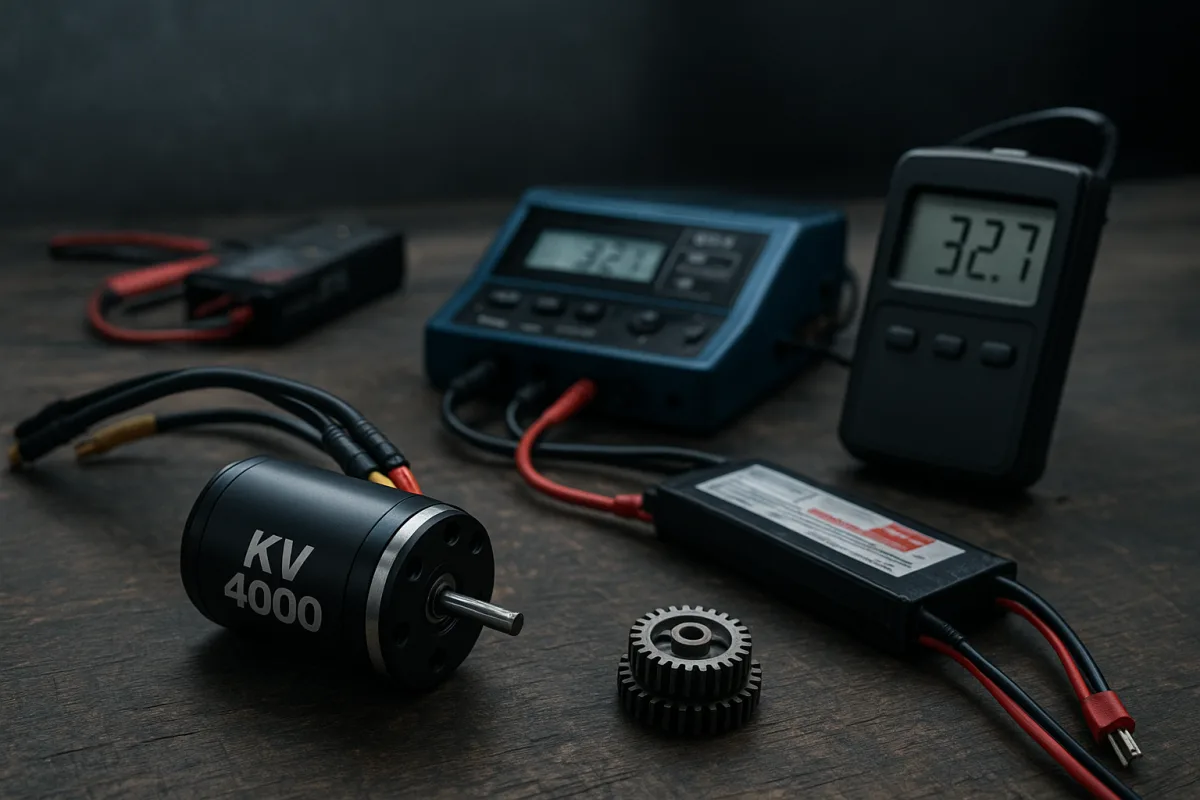
The common mistake: treating KV as a speed rating
KV is probably the most misunderstood number on an electric RC car box. New racers often read a larger number as a faster motor, then install it without changing anything else. That is how a perfectly usable car becomes a hot, inconsistent and expensive one.
KV describes how many no-load RPM a brushless motor theoretically turns for each volt supplied. Battery voltage matters immediately, so a 3S pack at 11.1V nominal spins a given KV motor much faster than a 2S pack at 7.4V nominal. [2][5]
That word, no-load, is the important bit. A motor does not run without load once it is turning a spur gear, transmission, driveshafts and tires. Put the same motor into a heavy truck, and the current draw and heat can climb hard. [8][9]
At the bench, KV looks simple: multiply it by voltage and expect speed. On the track, the final result depends on gearing, tire diameter, grip, vehicle mass, drivetrain drag and how much full-throttle time the layout demands. [2][8]
This is why high KV is not automatically better. A high-KV motor can make sense in a lightweight 1/10 modified buggy on the right gearing. The same approach is wrong for a 1/8 e-truggy that needs torque to launch heavy wheels and survive long pulls. [7][8]
Most handling complaints I hear blamed on “not enough motor” are really setup or system-matching problems. Before buying power, check that the car rolls freely, the gear mesh is correct, the slipper or centre differential is set sensibly, and the battery is healthy.
KV, turns and motor size are not interchangeable
Motor turns and KV are two ways people describe electric motor windings, but they do not erase the need to match the motor to the class. A lower-turn motor is generally more aggressive than a higher-turn motor, but the whole specification still matters. [2][8]
For stock 1/10 touring classes, the guidance collected by RC Cars Guide places brushless motors around 1,800 to 2,500KV, with 21.5T brushed motors also listed for stock running. [7] That is a restrained power range for controlled racing rather than a speed-run build.
A 1/10 2WD stock buggy is commonly paired with a 2,450 to 2,800KV brushless motor, or a 17.5T brushed motor under the cited class guidance. [7] That makes sense because a 2WD buggy is relatively light but still needs smooth drive off loose corners.
A 1/10 4WD stock buggy can use more motor, around 3,200 to 3,600KV brushless or 13.5T brushed. [7] Four driven wheels give more traction, but the front drivetrain, bigger rotating load and dense electronics layout also make heat management important.
Modified 1/10 touring cars are listed around 3,600 to 4,600KV brushless, or 10.5T brushed, while modified buggies move as high as 7,000KV or more with a 5.5T brushed equivalent. [7] Those are class-specific figures, not universal upgrade recommendations.
That last distinction saves money. A 7,000KV motor is not “seven times better” than a 1,000KV motor, and it is not a sensible default for a 1/10 stadium truck, 4x4 short-course truck or 1/8 buggy. It serves a particular application. [8][9]
For a 4x4 short-course truck, the recommended brushless range is 3,300 to 4,700KV in a four-pole motor. [7] Those trucks carry heavier bodies, larger tires and more drivetrain load than a slim 2WD buggy, so torque and thermal capacity matter as much as RPM.
For 1/8 electric buggies and truggies, the cited range drops to 1,700 to 2,200KV in four- or six-pole brushless motors. [7] A lower KV figure here is not a downgrade. It reflects the use of larger motors, taller tires, higher voltage and much greater vehicle mass.
Voltage changes the answer
A motor choice cannot be separated from the battery. The common LiPo choices are 2S, rated at 7.4V nominal, and 3S, rated at 11.1V nominal. [5][6] Jumping from 2S to 3S raises available voltage by 50 percent before gearing changes.
That does not mean every 2S-ready car should receive 3S power. The ESC must be rated for it, the motor must suit it, and the manual’s battery limits still apply. Motor and ESC mismatch is specifically identified as a common cause of poor performance and overheating. [2][9]
Take a 3,500KV motor as a simple comparison. On 2S nominal voltage, its theoretical no-load speed is about 25,900 RPM. On 3S nominal voltage, it is about 38,850 RPM, before the drivetrain applies any load.
That extra RPM can be useful if the car, gearing and electronics are built for it. It can also turn a mild gear ratio into an over-geared one. The motor then works too hard to reach RPM, draws more current, and turns battery energy into heat. [8][9]
This is why racers should change one thing at a time. If you install a higher-KV motor and also move from 2S to 3S, fit taller gearing and add heavier tires, you will not know which change created the heat problem.
The sensible order is to establish a safe baseline, make short runs, and inspect temperatures and drivability. The research brief does not provide a universal safe motor-temperature number, so I would not invent one. Follow the motor, ESC and vehicle manufacturers’ limits.
Gearing is the load you choose
Pinion and spur gearing are the leverage between the motor and wheels. A larger pinion gear or smaller spur gear makes the overall drive taller. The car may gain top speed, but the motor has less mechanical advantage and sees more load. [2][8]
A smaller pinion or larger spur makes the drive shorter. Acceleration improves, motor load usually falls, and top speed drops. That is often the correct move for hot weather, deep grass, a tight track, heavy tires or a motor that is already running too warm.
Over-gearing is a classic false economy because the car may look quick for one straight. Then power fades, the ESC thermal protection intervenes, or the motor suffers damage. Sources on motor selection repeatedly identify ignored gear ratios and overheating as connected mistakes. [8][9]
Do not confuse a taller gear with a better gear. On a low-grip dirt layout, a 2WD buggy may be faster with shorter gearing because it gets to usable RPM sooner and spends less time spinning. The stopwatch decides, not the pinion’s tooth count.
Gear mesh belongs in this conversation too. Mesh that is too tight adds drag and heat. Mesh that is too loose strips spur gears. Check it after a crash and whenever you alter pinion size, because a fresh motor will not overcome a bad mechanical setup.
ESC capacity is part of motor choice
The ESC is not just an on-off switch between battery and motor. It has to process the battery voltage and motor current without overheating, while delivering smooth throttle response. An unsuitable ESC and motor pairing is a known setup error. [2][9]
Sensorless and sensored systems also need compatible components and wiring. Before ordering a motor, verify the ESC’s supported motor type, voltage range and any stated KV or turn limits. Do not assume that a connector fit means an electrical match. [2]
ESC calibration matters because the controller must understand your transmitter’s throttle endpoints. Improper calibration can leave you with reduced throttle travel, abrupt braking, or a car that behaves as though it has a motor issue when the signal setup is wrong. [1][2]
This is one of those jobs where decent tools and patience beat an upgrade. Calibrate throttle, inspect solder joints, make sure the drivetrain is free, and verify gearing before declaring the existing motor weak. Cheap tools and rushed assembly cause plenty of avoidable faults. [1][3]
Battery C-rating: useful, but not a magic horsepower number
C-rating is another number that gets treated as a performance promise. It describes the rate at which a battery is claimed to deliver current relative to its capacity. A 5,000mAh pack is 5Ah, so 1C charging equals 5A.
The practical safety rule is clearer than the marketing number: charge LiPos at no more than 1C and use balance charging. Sources warn that exceeding that rate can damage packs and create a fire risk. [5][6][7]
Storage matters just as much as discharge performance. LiPos should be stored near 3.8V per cell and should not be discharged below 3.0V per cell. [5][6][7] Leaving a pack full after practice or empty after a long run shortens its useful life.
Cold weather reduces battery voltage and runtime, so a setup that feels fine on a warm afternoon can feel soft in winter. [5] Do not immediately fix that sensation with more pinion or higher KV, especially before checking the pack’s condition and temperature.
Spend on the system before chasing more motor
There is a genuine cost to getting this wrong. RTR cars commonly fall around $150 to $500, while kits start around $250 to $500 or more before electronics. [10][16] A motor experiment can become an ESC, battery, pinion and connector replacement.
The Traxxas Slash 4X4 is listed at $299.95 as an RTR 4x4 short-course truck, a category typically suited to four-pole brushless motors in the 3,300 to 4,700KV range. [7][10] That price is for the RTR vehicle, not a guarantee of every future battery or upgrade cost.
At the other end, the Losi Super Baja Rey 8S is listed at $949.99 as a high-end model. [10] Its price illustrates why a motor choice must follow vehicle scale and intended use, rather than copying a 1/10 buggy power recommendation.
Entry-level batteries start around $30, while high-capacity packs can exceed $200. Basic chargers are listed around $30 to $60, with advanced chargers around $120 to $300. [7][16] Those prices cover the equipment, not replacement parts, shipping or regional taxes.
A better charger and a proper setup routine usually make more sense than treating batteries as disposable. Balance charge every LiPo, use storage mode after running, and remove the pack from the car after each session. [5][7][11]
A repeatable motor-selection routine
Start by naming the car properly: 1/10 2WD buggy, 1/10 4WD buggy, touring car, 4x4 SCT, 1/8 e-buggy or truggy. Scale alone is not enough, because a 1/10 touring car and 1/10 short-course truck carry radically different loads.
Next, confirm battery voltage and the ESC’s supported limits. Then choose a motor range appropriate to the class, not the highest available KV. For racing, brushed motors remain available but are widely considered unsuitable for competitive use because of wear and inefficiency. [2]
Fit conservative gearing first. Check the gear mesh, run briefly, and inspect the motor, ESC, connectors and battery condition. If the car lacks punch but electronics are cool, gearing may be too short. If it is hot, lower the load before adding power.
Finally, keep the rest of the car maintained. After every run, remove and store the battery, clear debris, inspect tires and check screws. [11][12] Every three to five runs, inspect bearings and gear mesh, because drag can masquerade as a motor problem. [11][12]
The expensive motor is rarely the first fix. A correctly matched KV, sensible gearing, calibrated ESC and healthy LiPo make an ordinary RC car predictable. Predictable is what lets you tune shock oil, diff fluid and tires with confidence instead of chasing a moving target.
Frequently Asked Questions
What are common mistakes when choosing an RC car motor KV?
A common mistake is treating KV as a simple speed rating and choosing the highest KV motor without considering the rest of the system. This often leads to overheating, inconsistent performance, and increased costs. Many issues blamed on insufficient motor power are actually due to poor setup, such as incorrect gear mesh, heavy vehicle weight, or incompatible ESCs.
How does battery voltage affect RC car motor performance?
Battery voltage directly influences the motor’s RPM since KV is defined as revolutions per minute per volt. For example, a motor on an 11.1V (3S) pack will spin faster than the same motor on a 7.4V (2S) pack. However, the actual speed also depends on load factors like vehicle weight and gearing, so voltage alone doesn’t determine performance.
Why is a higher KV motor not always better for RC cars?
Higher KV motors spin faster at no load but can draw excessive current and overheat under load, especially in heavier vehicles. A high KV motor may work well in a lightweight 1/10 buggy with proper gearing but is unsuitable for heavier 1/8 e-buggies or truggies that require more torque. Matching motor KV to vehicle type and system components is crucial to avoid damage and poor performance.
How should I match my RC car motor to battery and gearing?
Motor KV should be chosen as part of a system including battery voltage, vehicle weight, gearing, and ESC capacity. For example, a 1/10 2WD stock buggy typically uses a 2,450 to 2,800KV brushless motor, while a 1/8 e-buggy needs a lower KV (1,700 to 2,200) for more torque. Adjusting gear ratios and ensuring the ESC can handle the motor’s current draw are essential for optimal performance and heat management.
What causes overheating in RC car motors and how to avoid it?
Overheating often results from mismatched motor KV, excessive load due to heavy vehicle weight, improper gearing, or an ESC that cannot handle the motor’s current. To avoid overheating, select a motor KV appropriate for your vehicle and battery, check gear mesh and drivetrain setup, and monitor motor temperatures during use. Avoid simply increasing KV to gain speed without addressing these factors.
How we researched this
This article was assembled from 17 cited references.
Nothing here is based on hands-on testing. Where a figure or finding appears, it belongs to the source cited beside it, and the writing says so rather than implying otherwise. Every source is listed below so you can check it.
Sources
- How to Build an Electric RC Car from Scratch: A Complete Guide for Hobby-Grade Performance - Riverhobby Tech (Shenzhen) Co., Ltd.
- RC Motors & ESCs – Complete Guide for Beginners and Upgraders | TECH1RC
- Beginner RC Car Basics. What you are actually buying.
- RC Drift Cars: Beginner's Guide | Drift Manji RC
- 10 Best RC Car Batteries (September 2026) Complete Guide - fccj
- RC Drift Car Battery Basics - Understanding 1S, 2S, 3S and C-Ratings | RC Drift Parts Upgrade Guides
- Best RC Car Battery Chargers in 2026 (LiPo & NiMH) | RC Cars Guide
- Choosing a Motor and ESC: KV, Turns, Size — and Heat
- Five Consequences of Choosing the Wrong RC Motor: Noise, Overheating, and Lack of Power - X-TEAM Brushless DC Motors
- Best Rc Cars (2026): top picks ranked by value
- How do I maintain an RC car?
- RC Car Maintenance: Essential Checklist for Beginners – ToylandEU™
- RC Car Maintenance and Cleaning: A Beginner's Guide – RC Models Hub
- Redcat RC Car Maintenance Basics Every Owner Should Know - TRVBABY
- RC Car Maintenance Tips: Keep Cars Running Strong | EuroRC.com
- How Much Does an RC Model Car Really Cost?
- RC Model Shop | How to Repair RC Car Problems Fast
Related Articles
How to Set Up RC Car for Beginners: Complete Starter Guide
Learn how to set up your RC car for beginners with tips on battery, tires, suspension, and motor for a smooth first drive.
Best RC Car Type for Beginners: Choosing the Right Model
Discover the best RC car type for beginners, including scale, chassis, motor, and battery choices to fit your terrain and skill level.
Upgrade RC Car Speed Controller: How to Choose and Install
Learn how to upgrade your RC car speed controller with tips on matching ESC to motor, battery, and calibration for better performance.
RC Car Weight Distribution Tips for Better Handling
Learn RC car weight distribution tips to balance corner weights, lower center of gravity, and improve handling and stability on various surfaces.