
Upgrade RC Car Speed Controller: How to Choose and Install
Learn how to upgrade your RC car speed controller with tips on matching ESC to motor, battery, and calibration for better performance.
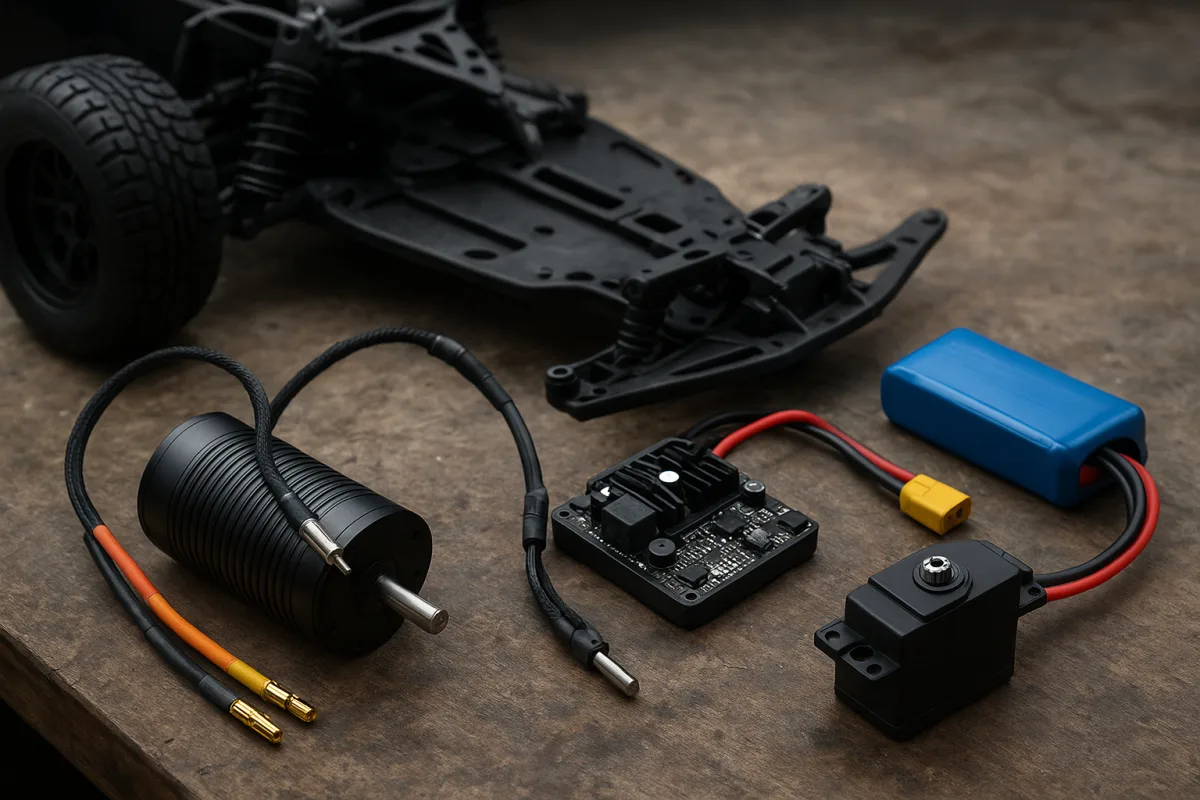
Start by finding the actual restriction
Most “my car needs a faster ESC” problems are not really ESC problems. If the current controller is not overheating, is already rated for the battery voltage, and supplies the motor’s required current, changing it may do almost nothing for top speed. [11][17]
The speed ceiling is a system problem: motor KV, pack voltage under load, battery current capability, pinion and spur ratio, tyre diameter, drivetrain drag and temperature all matter. An expensive ESC cannot turn a low-KV motor on a tired 2S pack into a 3S speed-run setup. [11][13][17]
That distinction matters by class. A 1/10 two-wheel-drive buggy on 2S needs clean low-speed throttle and manageable heat over a five-minute race. A 1/8 truggy pulling big tyres on 4S or 6S needs far more voltage headroom, cooling and current capacity. [2][3][11]
Brushless equipment is often the meaningful performance step if the car is currently brushed. Industry guides put brushed efficiency around 75 to 80 percent and brushless around 85 to 90 percent, with typical speed examples rising from 15 to 20 mph to 35 to 40 mph. [5][6]
Treat those numbers as a direction, not a promise. A restrictive stock gear ratio, weak battery, hot summer track, or conservative ESC thermal protection can keep the result well below that doubling figure. [11][19]
Confirm whether you need brushed or brushless control
A brushed ESC uses two motor wires. A brushless ESC uses three phase wires and must be paired with a compatible brushless motor. This is not a connector-adapter job, it is a different electrical system. [16][21]
For a basic brushed replacement where weather resistance matters, the Carson Dragster Brushed ESC is a 70A waterproof unit. The research brief does not provide a current price, so do not assume it belongs in the roughly $25 entry-level bracket without checking the retailer. [4]
The Hobbywing QuicRun 1060 is the cited entry-level brushed reference at about $25. It suits a modest 1/10 brushed car where reliability and a straightforward replacement matter more than extracting brushless-level speed. [7]
If speed is the aim, moving from brushed to brushless needs both a brushless ESC and motor. Do not buy the ESC first and hope the existing two-wire can motor will work with it, because it will not. [16][21]
Match voltage first, then current capacity
Read the LiPo count on the ESC before looking at its amp number. A 2S LiPo is 7.4V nominal and 8.4V fully charged, while a 3S pack is 11.1V nominal and 12.6V fully charged. [13]
That fully charged figure is what the controller sees at the start of the run. A controller rated only for 2S can be damaged by a 3S pack, even if the model runs briefly before the smoke appears. [11][13]
For a moderate-power setup, guidance cited in the research brief uses 20A continuous and 25A burst as an example of matching controller output to demand. Faster 1/10 systems, especially geared aggressively, can need much more. [11]
The Team Corally TOROX 185 is a brushless ESC rated for 2S through 6S LiPo operation. That broad voltage range makes it relevant to larger or high-voltage applications, but it does not make 6S automatically sensible in a chassis, drivetrain or motor designed around 2S. [2]
The MGM Controller X2-Serie TMM 16026-3 is a 160A, 6S-capable controller with dual fans. That specification points it toward high-load applications where a small 1/10 club buggy ESC would be out of its depth, not toward a casual upgrade just because the amp number is large. [3]
Continuous current is the number to prioritise. Peak or burst current can help with launch punches, but it does not tell you how the ESC will survive a full run in deep grass, on high-grip carpet, or geared too tall. [11][12]
Your battery needs to keep up as well. LiPo C-rating and capacity determine how much current the pack can theoretically provide, but voltage sag under load still limits motor rpm and can make a new ESC feel no quicker than the old one. [13]
Buy the controller that fits the car, not the biggest one
Physical fit is a real selection criterion in 1/10 scale. The Ruddog Racing RXB measures 31.5 x 39.7 x 16 mm and weighs 28g, so it suits a tight electronics bay where a larger heat-sink-and-fan unit may interfere with the receiver box or body. [7]
The research brief does not list a price for the Ruddog Racing RXB. Its value is compact packaging, not a documented claim that it will make a particular buggy, touring car or crawler faster. [7]
For a waterproof brushless option, the Surpass Hobby V2 Supersonic 110A is listed at about $170. That places it in the mid-range 1/10 brushless category, where it suits a driver needing water resistance and substantially more capacity than a budget brushed ESC. [8]
The Tekin RSXpro is cited from $66, making it a potentially lower-cost route into high-performance control. The supplied research does not establish its exact voltage rating or intended class, so verify those details against the motor and battery before ordering. [9]
At the upper end, the Reedy Blackbox 610R and Hobbywing Xerun XR10 Pro G3 are listed around $180 to $220 or more. They suit performance-oriented 1/10 brushless builds where setup adjustment is part of the goal, not a substitute for correct gearing. [7][8]
The SkyRC TS160 Pro V2 is the adjustment-heavy choice in this group. It is rated at 160A continuous and 850A peak, offers roughly 40 adjustable parameters through the RC Gears app, and has a switchable 6V or 7.4V BEC rated up to 15A. [1]
That BEC specification matters when the car has a hungry digital servo. A high-torque steering servo can pull hard during corner entry, and inadequate receiver power can look like radio glitches or weak steering rather than an obvious ESC mismatch. [1]
I have not physically run these controllers. The distinctions here come from the supplied specifications and retailer listings, not a claim that one unit is universally best. The right pick is the one rated for your exact voltage, load, space and servo requirement. [1][2][3][7][8]
Fit it properly before changing any settings
Mount the ESC firmly in a ventilated part of the chassis, away from the receiver where possible. In a 1/10 buggy, that usually means preserving airflow around the heat sink rather than burying it under a body-mounted fan shroud or loose wiring. [16][19]
Use proper double-sided ESC tape on a clean chassis surface, then secure wires so they cannot reach the spur gear, centre shaft or rear tyre. An ESC that moves in a crash can strain solder joints and turn a simple upgrade into intermittent cut-outs. [16]
Connect the battery polarity carefully. On a brushless motor, attach all three phase wires, then check rotation with the wheels off the ground. If it spins backward, swap any two of the three motor wires rather than altering throttle direction at random. [16][21]
Do not copy a 1/8 truggy’s battery and connector arrangement into a compact 1/10 chassis without checking room, wire length and cooling. Larger packs and heavy-gauge wire can restrict airflow or upset weight balance, particularly in a race buggy. [13][19]
Calibrate before your first full-throttle pass
Turn on the transmitter first, centre throttle trim and confirm the radio is bound before powering the ESC. A controller that sees an incorrect neutral signal may refuse to arm or interpret neutral as brake or throttle. [14][16]
Use the manufacturer’s calibration sequence to teach neutral, full throttle and full brake. The Traxxas-style method cited in the research uses the setup button and throttle positions, but follow the exact procedure for your own ESC rather than assuming every controller uses identical button timing. [14]
With the car on a stand, verify smooth throttle, correct motor direction, neutral brake behaviour and full braking. Do this before fitting the body, because a reversed motor or excessive drag brake is much easier to diagnose without a 3S car launching across the pit table. [14][16]
Set conservative punch and brake first. A hard launch setting may feel fast on pavement, but in a 1/10 buggy it can spin rear tyres, unload the front end and cost more corner exit speed than it gains. This is setup work, not a parts-shopping problem.
Gear and cool the upgraded system
After the ESC swap, begin with the existing pinion and spur ratio. Run a short pass, check motor and ESC temperatures, then increase pinion size only in small steps if both stay controlled. Heat is the thing to monitor, not just the extra mph. [17][19]
If the ESC thermal-protects, reduce gearing, improve airflow, or add appropriate cooling before buying another controller. The MGM X2-Serie’s dual fans and the heat-sink emphasis in cooling guidance underline that current capacity alone does not remove heat. [3][19]
Ambient conditions change the margin. High temperatures raise overheating and thermal-throttling risk, while cold conditions reduce battery output and increase electrical resistance. Humidity also raises moisture, corrosion and short-circuit concerns, although direct small-scale RC-specific studies are limited. [18]
A waterproof ESC such as the Carson Dragster helps for wet running, but waterproof does not mean invulnerable. Dry the chassis after use, inspect connectors, and store the car and batteries in a dry, temperature-controlled space when possible. [4][18]
The best performance upgrade is the one that completes a run without slowing itself down. Match the ESC to voltage and current, give it airflow, calibrate it properly, then tune gearing around temperatures. That is how you gain usable speed instead of a faster trip into thermal cutoff.
Frequently Asked Questions
How do I know if I need to upgrade my RC car speed controller?
You likely do not need to upgrade your ESC if it is not overheating, matches your battery voltage, and can supply the motor’s required current. Many speed limitations are due to the overall system—motor KV, battery condition, gearing, and drivetrain—not the ESC alone. Check these factors first before considering an ESC upgrade.
What factors should I consider before upgrading an RC car ESC?
Before upgrading, ensure the ESC’s voltage and continuous-current ratings match or exceed your motor and battery specifications. Consider your vehicle class (e.g., 1/10 2S buggy vs. 1/8 6S truggy), cooling requirements to prevent thermal throttling, and the BEC output needed for your servo. Also, calibrate throttle endpoints after installation for proper performance.
Can upgrading the ESC alone increase my RC car's top speed?
Upgrading the ESC alone rarely increases top speed significantly. The speed ceiling depends on the entire system, including motor KV, battery voltage under load, gearing ratios, tire size, and drivetrain friction. Without addressing these, a higher-rated ESC may not improve speed and could lead to overheating.
How do I match an ESC to my RC car's motor and battery?
Match the ESC’s voltage rating to your battery pack (e.g., 2S or 3S LiPo) and ensure its continuous and peak current ratings meet or exceed the motor’s demands. For brushless motors, use a brushless ESC with three-phase wires; for brushed motors, use a brushed ESC with two wires. Proper cooling and BEC output should also be considered for your setup.
What are the differences between brushed and brushless ESCs?
Brushed ESCs control motors with two wires and typically have lower efficiency (around 75–80%), resulting in speeds around 15–20 mph for typical RC cars. Brushless ESCs use three-phase wires and paired brushless motors, offering higher efficiency (85–90%) and speeds often doubling to 35–40 mph. Upgrading to brushless requires replacing both the ESC and motor, as they are not interchangeable.
How we researched this
This article was assembled from 21 cited references.
Nothing here is based on hands-on testing. Where a figure or finding appears, it belongs to the source cited beside it, and the writing says so rather than implying otherwise. Every source is listed below so you can check it.
Sources
- SkyRC TS160 Pro V2 speed controller - Circus RC News
- Team Corally Speed Controller TOROX 185 Brushless 2-6S | EuroRC.com
- MGM Controller X2-Serie TMM 16026-3 RC Auto 160 Amp - 6S | RCModelle24 der RC Modellbau Shop
- WMS RC SHOP - Carson Dragster Brushed ESC | 70A | Waterproof #500906264
- Brushless vs Brushed RC: Complete Performance Guide 2025 - Xrccars
- Brushed vs brushless RC motors · RC Paddock
- 1/10 Speed Controllers
- ESC Controllers 1/10 Scale Electric Motors & ESC's Electronics Cars Trucks - AMain Hobbies
- Speed Controls — RC Parts | liquidrc.com
- RC Car & Truck Electronic Speed Controls - Horizon Hobby
- Understanding ESC Ratings and Setup – RCJuice
- ESC Selection Guide for Outrunner BLDC Motors - Gian Transmission
- How to Choose LiPo Battery for RC Car? - ViBMS Battery
- How do you calibrate a Traxxas controller (ESC)?
- Brushless RC Cars - RCexplained
- RC Motors & ESCs – Complete Guide for Beginners and Upgraders | TECH1RC
- How to make your RC Car Faster – Radio Control Tips
- How Temperature Affects Electric Bike Controller Performance - Suzhou Minshine Electronics Co., Ltd.
- How to Lower RC Car Temperatures | RC Setup Lab
- Speed Controller | Electric Car | Motors and ESCs | Robitronic RC Car Online Shop - Power for Winners
- RC Car ESC Explained: Beginner's Guide to How ESCs Work | EuroRC.com
Related Articles
How to Upgrade RC Car Motor
Learn how to upgrade your RC car motor with the right KV, ESC matching, and installation tips for better power and performance.
Common RC Car Motor Mistakes: KV, Battery & Setup Tips
Learn common RC car motor mistakes including KV misunderstandings, battery matching, and setup tips to avoid overheating and poor performance.
RC Car Racing Rules: Stock Class, Motors, Batteries & Setup
Learn RC car racing rules covering stock class motors, batteries, blinky mode, and tuning to compete legally and effectively in races.
Best RC Car for Racing: Arrma Limitless V2 vs Traxxas XO-1
Compare the best RC car for racing with detailed setup, tuning, batteries, motors, and kit choices for high-speed 1/7 scale brushless RC cars.