
RC Car Safety for Kids: Speed, Battery, and Setup Guidelines
Learn key RC car safety for kids, including speed management, battery precautions, and age-appropriate setup for safe and fun play.
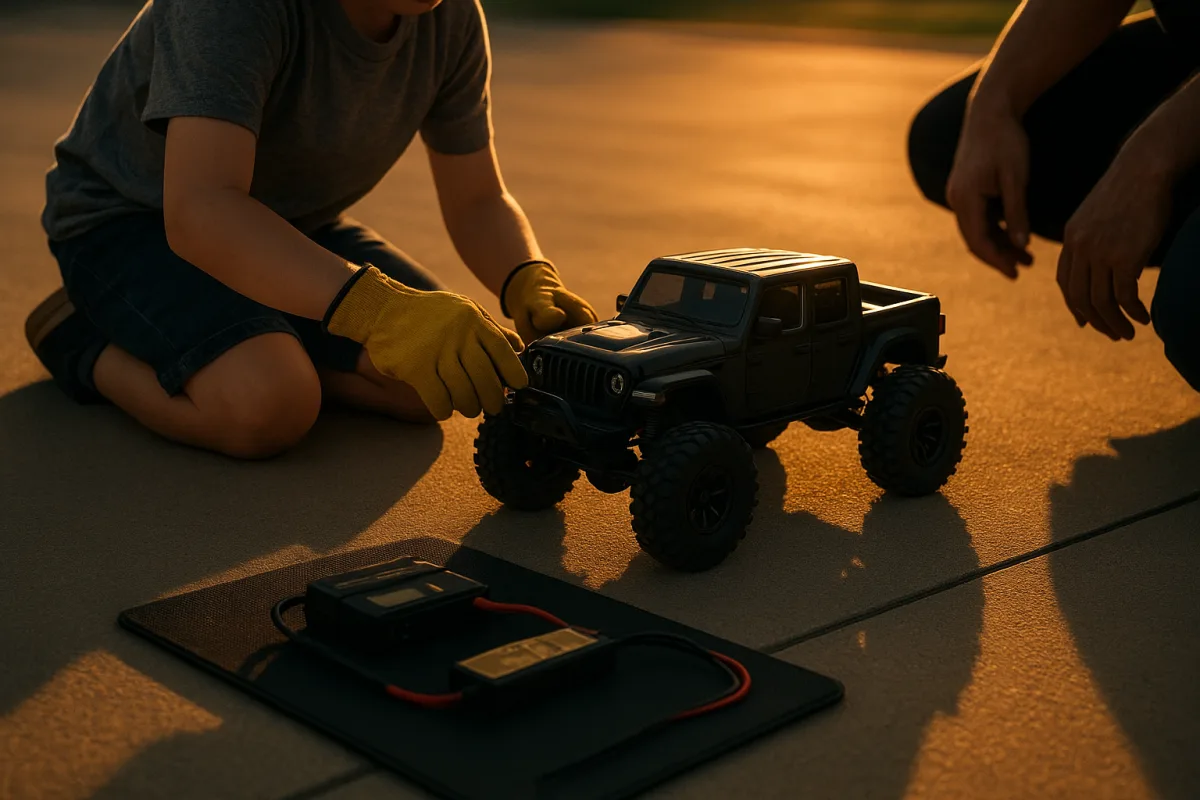
RC car safety for kids: manage speed, do not chase rules
The important number is not the legal limit
Parents often ask for the rule: what is the legal top speed for a child’s RC car? As of 2026, there is not one. Neither the United States nor the European Union has a dedicated child-specific RC-car law that sets a speed cap.
That does not mean RC cars are unregulated. In the United States, product safety sits broadly with the Consumer Product Safety Commission, while radio compliance falls under the Federal Communications Commission. Neither agency has a separate federal speed mandate for children operating RC cars.
In the EU, the Toy Safety Regulation, Regulation EU 2025/2509, took effect on 1 January 2026. It covers toys including RC cars through chemical-safety, transparency and digital-product-passport requirements, rather than a rule saying a ten-year-old may drive only at a stated mph. [10]
Radio compliance matters too, even though it is less obvious than top speed. A European Commission test published in June 2026 found that 60 percent of 88 tested radio-controlled toys failed interference standards. [11]
That failure rate is not a reason to panic about every transmitter. It is a reminder to buy from a traceable retailer, retain packaging and instructions, and avoid treating an anonymous online listing as equivalent to a properly supported toy.
For safe play, speed is still the number that matters most. It determines stopping distance, impact energy, how quickly a child outruns their own steering decisions, and how much space a mistake needs before it becomes a collision.
Speed is a system, not a number printed on a box
In RC racing, a car does not behave according to its advertised maximum speed. A 1:10 buggy on a grippy hardpack track, a loose gravel driveway and wet grass can have the same motor, but completely different stopping distance and predictability.
The same logic applies to children. A car that is manageable at 12 mph on a short-cut lawn may be a bad choice at that speed beside parked cars, near pedestrians, or on a pavement that leads toward a road.
Speed comes from the whole system: motor, battery voltage, gearing, tyre grip, surface and driver input. A child does not need to understand pinion sizes or diff fluid to drive safely, but the adult choosing and setting up the car should understand the basic relationships.
A higher-voltage battery can make a vehicle substantially faster and harder to control. That is why battery choice is not merely about runtime. It is one of the simplest ways to limit a car to an appropriate performance level.
The research-supported age guidance is useful because it starts with controllability, not horsepower. For children aged three to five, the sensible category is a 1:32 or 1:24 toy-grade car with a simple two-button controller and a top speed below 3 mph. [1][2]
For ages five to seven, a 1:24 model with proportional 2.4 GHz steering and throttle, running roughly 5 to 7.5 mph, introduces actual control without the speed becoming the whole event. [1][3]
Between six and eight, 1:16 or 1:14 stunt and off-road cars around 10 to 15 mph are commonly recommended. [1][2] That sounds like a broad overlap with the younger group, and it is, because maturity and available space matter more than a birthday.
For nine to twelve-year-olds, the usual next step is an outdoor, hobby-grade 1:10 4WD truck or similar ready-to-run vehicle, generally kept around 15 mph. [1][3] A 1:10 truck is not automatically safe simply because the scale is appropriate.
For teenagers aged 13 and up, advanced hobby-grade 1:10-scale or larger cars with brushless motors can exceed 20 mph. [1][2] Those cars are proper machines, not oversized toys, and their setup needs to match the driver and location.
Scale tells you size, not suitability
Scale labels are often misunderstood. A 1:24 car is smaller than a 1:10 car, while a 1:8 model is larger again. [13] But scale alone does not predict speed, weight, traction or how much damage a car can do.
A lightweight 1:24 toy-grade car bouncing off a shoe is different from a 1:10 brushless monster truck catching a shin. The bigger vehicle has more mass, larger tyres and usually more available power, even before considering its battery.
This is why buying the biggest car advertised as “for kids” is not a sound safety plan. Parents commonly skip the age-and-skill match, then find the child either frightened by the speed or mashing full throttle because controlled driving is too difficult. [12][14]
The fix is normally setup and selection, not an expensive upgrade. If a child cannot drive clean circles, stop on command and steer around an obstacle at half throttle, more motor is exactly the wrong direction.
A sensible first-session rule is simple: establish a finish line. The child drives toward a marked point, lifts off early and stops before it. Repeat from several distances until braking is automatic, not a shouted instruction after the car is already gone.
Then make the running area part of the setup. Keep the first sessions away from roads, driveways with moving vehicles, bodies of water, stairways, dogs and crowded play spaces. Open grass can work, although long grass adds load and heat.
Battery choice is also a speed limiter
NiMH packs remain a good fit for many toy-grade and younger-driver cars because they are comparatively forgiving. They offer less punch than LiPo batteries, but the trade is often worthwhile when the aim is dependable, lower-stress play. [4]
LiPo packs have higher performance potential, but that performance comes with handling requirements. A LiPo must be charged with the correct charger and settings, watched while charging, and kept on a fire-resistant surface or in a suitable LiPo bag. [5][6]
Never leave a charging battery unattended. Do not charge a pack that is swollen, physically damaged, hot from running, or showing damaged wires or connectors. Those checks are routine bench work, not optional paranoia. [5]
For small 1:16 to 1:18 vehicles, guidance commonly places a 2S LiPo in the 1500 to 2200mAh range. For a 1:10 vehicle, 2S packs around 3000 to 5000mAh are typical. [7]
The “2S” part describes two lithium-polymer cells in series. It is important because voltage influences motor speed. The mAh figure is mainly capacity, which affects runtime, though a bigger pack can also add weight and alter how the car handles.
A C-rating describes how much current a battery can theoretically supply relative to its capacity. It is not a permission slip to fit the highest-C pack available. For children, a suitable 2S pack and conservative power setup beat a hot battery chasing punch.
Guidance commonly recommends adult involvement with battery handling for children under 14. [5][6] That is the sensible division of labour: the child drives, learns steering and helps inspect the car, while the adult handles charging and storage.
After a run, let the battery cool before charging. Store LiPo packs partially charged in a cool, dry place, inspect them regularly and retire damaged packs properly. [5][15] A battery problem is one of the few RC incidents that can escalate without the car moving at all.
Terrain can turn a sensible car into a bad setup
Heat is a warning that the chosen speed, gearing and surface are not working together. Long grass creates drag, oversized tyres can increase load, and too-tall gearing can make the motor and electronic speed control work harder. [8]
A motor temperature above 160°F, or 70°C, indicates overheating. [8] For a child’s car, do not treat that as a reason to bolt on more cooling hardware and continue. Stop, let it cool and reduce the load.
That may mean a smaller pinion gear, a lower-voltage battery, shorter grass or simply a shorter run. Most handling and reliability problems are solved by matching the setup to the surface, not by buying the most expensive motor upgrade.
Wet conditions need the same practical judgement. Many hobby-grade cars are described as water-resistant, but water-resistant is not waterproof. Water can still reach bearings, connectors and electronics, while wet ground sharply changes grip and braking. [9]
After a wet run, disconnect the battery, dry the vehicle and inspect it before storing it. [9] For a young driver, wet or icy conditions also remove the predictable traction that makes early steering practice useful.
There are no identified child-specific seasonal regulations telling families when an RC car may be run. The useful rule is simpler: if the environment makes the car unpredictable, hot, hard to retrieve or likely to reach people, choose another place or another day.
Supervision beats safety accessories
No specific helmet, glove or eye-protection requirement for children driving RC cars was identified. There is also no useful evidence-based price range for RC safety gear, because formal gear requirements for ordinary RC operation do not exist.
That absence does not mean adults should stand back. It means the controls that matter are supervision, speed selection, battery handling, maintenance and location. Those are the things that decide whether a child’s first RC car becomes safe repeatable fun or a short-lived repair bill.
Before each run, check that the wheels turn freely, tyres are secure, the battery is not damaged, and the body is fitted. A loose wheel, jammed steering link or damaged pack can turn an otherwise mild car into an unpredictable one. [14]
The practical regulation for family RC running is therefore not a legal mph number. It is an adult choosing an age-appropriate scale, limiting voltage and speed, selecting clear ground, and staying present while the battery is charged and the car is driven.
Frequently Asked Questions
Are there legal speed limits for kids' RC cars?
As of 2026, there are no dedicated legal speed limits for children's RC cars in the United States or European Union. Safety is managed through broader toy safety regulations and radio compliance rules rather than specific speed caps for RC cars. Adult supervision and age-appropriate vehicle selection are the primary practical safety controls.
How to choose a safe RC car speed for children?
Safe RC car speed depends on the child's age, maturity, and the running environment. For example, children aged 3–5 should use toy-grade cars with speeds under 3 mph, while 9–12-year-olds can handle hobby-grade trucks up to about 15 mph. The entire system—including motor, battery, terrain, and driver skill—affects speed control and safety.
What battery safety precautions should kids follow with RC cars?
Battery safety is critical, especially with LiPo batteries. Children under 14 should have adult supervision when charging batteries, which must be done on fire-resistant surfaces using the correct charger. Regular inspection for damage and proper storage in a cool, dry place are also important to prevent hazards.
What age is appropriate for different RC car speeds?
Age-appropriate speeds generally increase with age: under 3 mph for ages 3–5, 5 to 7.5 mph for ages 5–7, 10 to 15 mph for ages 6–8, and up to 15 mph for ages 9–12. Teenagers 13 and older may use advanced cars exceeding 20 mph. These guidelines prioritize controllability and safety over maximum speed.
Is special safety gear needed for kids using RC cars?
No specific safety gear such as helmets or gloves is required for children operating RC cars. Instead, safety relies on selecting slower cars suitable for the child's age and providing a clear, safe running area with active adult supervision.
How we researched this
This article was assembled from 15 cited references.
Nothing here is based on hands-on testing. Where a figure or finding appears, it belongs to the source cited beside it, and the writing says so rather than implying otherwise. Every source is listed below so you can check it.
Sources
- RC Cars for Kids: The Complete Age-by-Age Guide (3 to 15+) | RC Toys For Boys Blog
- RC Car Gift Guide by Age: The Best Picks for 2026 – LockTech & Gear
- Best RC Cars for Kids (2026) — Top Picks Compared | RC Car Compare
- RC Car Batteries Explained — Li-ion, NiMH, AA, mAh and Run Time
- LiPo Battery Safety Guide for RC Hobbyists | RCCrafter – RCCrafter.com
- RC Product & Battery Safety Policy - RC with Curly
- RC Car Battery Sizes: What Size Do You Need? | Shock & Servo
- How Grass, Tyres and Gearing Affect RC Car Heat | RC Setup Lab
- How to Waterproof RC Cars: 5 Methods + Maintenance Guide | EuroRC.com
- Toy Safety Regulation - ECHA
- Radio-controlled toys tested for signal interference - Internal Market, Industry, Entrepreneurship and SMEs
- How to Choose Your Child's First RC Car (AU 2026 Guide) – ALL 4 KIDS
- RC Car Scales Explained — 1:8, 1:10, 1:12, 1:18, 1:24 | RCUK
- RC Car Safety for Kids & Beginners | WildTrack RC Guide – Atlas & Quill
- How Long to Charge RC Car Battery: Complete Timing Guide for NiMH, LiPo & Li-ion Batteries | EuroRC.com
Related Articles

RC Car Safety Regulations
Learn about RC car safety regulations, radio compliance, and best practices for batteries and equipment in the US, UK, and EU.
How to Set Up RC Car for Beginners: Complete Starter Guide
Learn how to set up your RC car for beginners with tips on battery, tires, suspension, and motor for a smooth first drive.
How to Adjust RC Car Brakes for Better Control
Learn how to adjust RC car brakes, including ESC calibration, brake strength, brake rate, and drag brake for optimal stopping power and control.
Prepare RC Car for Rainy Conditions
Learn how to prepare your RC car for rainy conditions with waterproofing tips, battery safety, tire choice, and post-run maintenance.