
RC Car Parts Compatibility Guide
Learn how to ensure RC car parts compatibility for chassis, electronics, batteries, wheels, and hardware with this detailed compatibility guide.
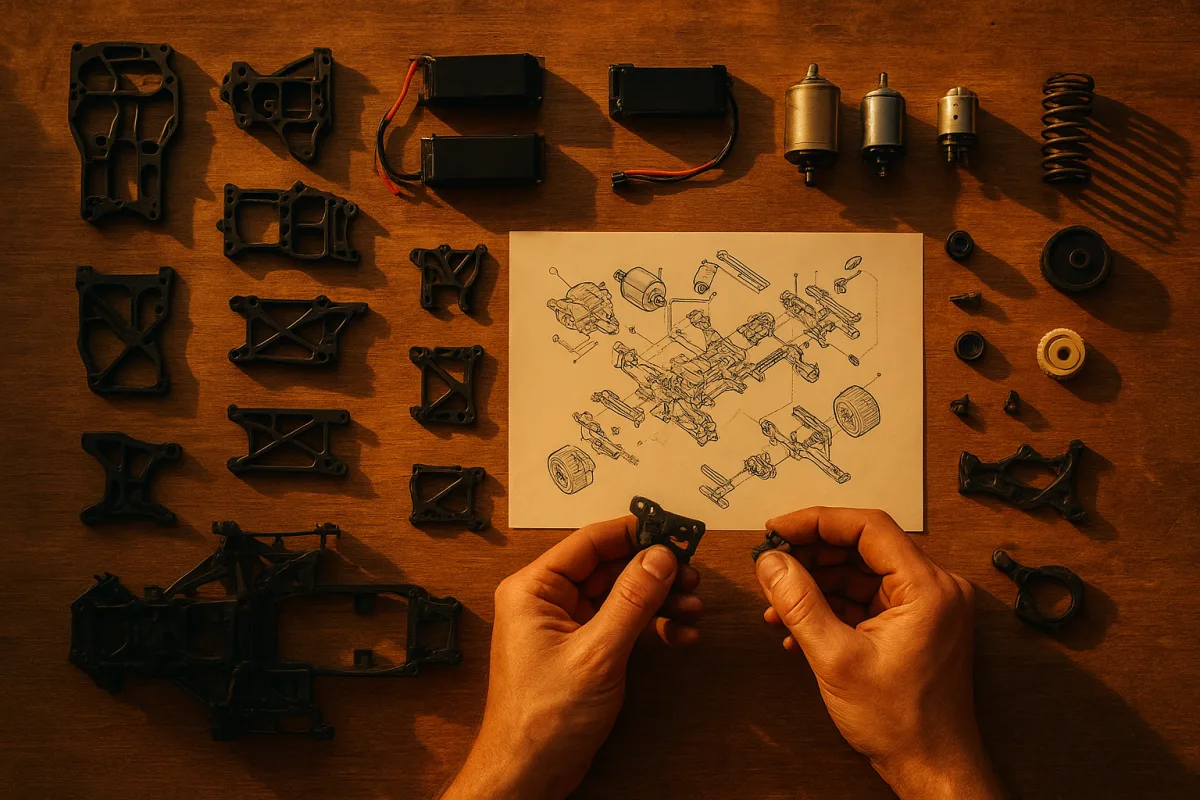
Compatibility starts with the part number, not the scale
The most useful number on an RC replacement part is usually not 1/10, 1/8, 2S or 17 mm. It is the manufacturer’s exact part number for your exact chassis version.
Scale tells you roughly what hardware and wheel standards you may encounter. It does not tell you whether an arm clears the driveshaft, whether a shock tower matches the hinge-pin brace, or whether a gearbox accepts your differential case.
That catches plenty of racers out because RC cars look more universal than they are. Two 1/10 buggies can use the same nominal screw size, wheel diameter and battery type, yet share almost no suspension or drivetrain parts. [11]
At the bench, I treat scale as a clue, not proof. The chassis family, kit generation, wheelbase, drivetrain layout and manufacturer revision determine whether a replacement physically bolts on and actually works through full suspension travel.
This is why the expensive aluminium option is often not the fix. If a car is pulling under power, traction rolling or eating bearings, the answer may be a bent mount, wrong shim stack, overtightened wheel nut or poor setup.
A replacement part has to satisfy three tests. It must attach to the chassis, clear every moving component, and preserve the geometry or electrical limits the car was designed around. Passing only the first test is not compatibility.
Think of fitment as a stack
The first layer is vehicle identity: manufacturer, model name, scale, class and exact version. “1/10 electric buggy” is not enough. “Current-production 1/10 two-wheel-drive buggy, specific transmission version” gets much closer to a usable search.
The second layer is the assembly. A front suspension arm is not merely an arm. It works with a particular hinge-pin diameter, pivot-ball or steering-block geometry, driveshaft length, shock position and wheel offset.
The third layer is the individual interface. That is where dimensions such as screw thread, bearing bore, wheel hex, gear pitch, motor shaft diameter or battery compartment length become relevant. These numbers confirm fitment, but they rarely establish it alone.
This order matters when a listing says “universal.” That word may mean the item fits multiple vehicles, not every vehicle in its scale. Generic accessories can be broadly useful, while structural parts remain tightly model-specific. [10]
A universal body clip is genuinely close to universal. A universal aluminium rear hub is usually a warning sign unless the listing specifies the exact chassis family, measurements and hardware required for installation.
Hardware standards help, but do not replace measurement
Many 1/10-scale cars use M3 hardware with a 0.5 mm thread pitch, a useful baseline when replacing ordinary screws. [1] That does not mean every M3 screw on the bench has the same required length, head style or engagement depth.
A countersunk M3 screw and a button-head M3 screw can share the same thread yet serve completely different jobs. Put the wrong head in a suspension mount and it may rub an arm, prevent a brace from seating, or crack plastic.
Length is just as important. A screw that is too short may strip the first hard landing. One that is too long may punch into a gearbox, lock a bearing, bind a differential case or cut into wiring.
Before ordering a screw kit, remove one clean example from the same location if possible. Measure thread diameter, length below the head and head type. Then check the exploded diagram rather than trusting a vague “fits 1/10” listing.
Bearings follow the same rule. A bearing must match inside diameter, outside diameter and width, but it also needs the right shields, flange arrangement and seating location. A dimensionally correct bearing can still be wrong for the assembly.
If a new bearing feels tight after installation, do not assume it needs breaking in. Check for a distorted carrier, overtightened wheel hardware, crushed shim, wrong spacer or a bearing seated at an angle before adding grease or buying upgrades.
Wheels show why standards are only the middle of the job
Wheel hex size is a useful starting point, not a final answer. Common 1/10 and 1/8 conventions exist, but wheel offset, axle length, hub thickness, wheel diameter and tire clearance decide whether the wheel works on your car.
A wheel can slide onto the hex perfectly and still be wrong. Excessive positive or negative offset changes scrub radius and track width, can overload wheel bearings, and may make a tire hit the steering link or shock spring.
That is especially important when crossing categories. A 1/10 stadium truck wheel, short-course wheel and buggy wheel can all appear close enough in online photos, but the tire diameter and offset can transform gearing and steering load.
Bigger tires effectively gear the car taller. The motor sees more load, temperatures rise, and a gearing combination that was safe with a smaller buggy tire may become hard on the motor and ESC.
For a replacement wheel or tire, confirm the hex, rim diameter, offset, tire outside diameter and intended class. Then turn the steering lock-to-lock and cycle the suspension without shocks before running it.
Electronics compatibility is not negotiable
The hard line in RC electronics is motor type. Brushed motors require brushed ESCs, and brushless motors require brushless ESCs. They are not interchangeable systems. [3]
That sounds basic, but replacement decisions get messy when a used car arrives with unknown electronics. Do not identify an ESC by its colour, heat sink size or connector. Read its label, manual and supported battery voltage.
A brushless setup also has additional matching work. The ESC must support the motor type and the battery voltage you plan to run, while the motor must be geared for the vehicle weight, tire diameter and class.
More motor is not always more speed. A high-kV motor in a heavy 1/8 platform, tall gearing and oversized tires can turn into a heat problem rather than a performance gain. Check temperatures and ratings before changing pinions.
The same applies to plugs and wiring, although connector compatibility data is not comprehensive in the available research. A battery may have the right voltage but still need a safe connector solution and enough room in the battery tray.
Do not force a battery into a chassis with foam, tape or a bent hold-down as the only plan. Verify pack length, width, height and wire exit before buying, then make sure the retention system still holds the pack securely.
Battery numbers need to be read together
LiPo packs commonly run from 2S, or 7.4V nominal, through 6S, or 22.2V nominal. Listed capacities span roughly 4000 to 12000mAh. [4] Those are ranges, not a recommendation to run the biggest pack available.
Voltage drives motor speed and electrical stress. Capacity determines stored energy, which usually means runtime, but a high-capacity pack can also be physically too large or unnecessarily heavy for a 1/10 racing class.
The C-rating describes discharge capability. In practical terms, it helps indicate whether a pack can supply the current demanded by the motor and ESC without excessive voltage sag. [4] It is not a standalone quality score.
A 5000mAh pack at 50C has a theoretical continuous discharge figure of 250 amps, calculated as 5Ah multiplied by 50. That arithmetic is useful, but it does not override the ESC’s voltage limit or the car’s physical battery fitment.
NiMH remains a different replacement decision. Common packs are six-cell 7.2V or seven-cell 8.4V units, typically rated from 3000 to 5000mAh. [4] Check that the vehicle’s ESC supports the chemistry and voltage before fitting one.
For any battery purchase, write down four things from the existing setup: battery chemistry, cell count, capacity range, and physical dimensions. Then check the ESC and motor manufacturer limits before comparing C-ratings or sale prices.
Replacement cost is less useful than correct fit
A cheap part that does not fit is not a bargain, especially once shipping and a second order enter the picture. Price ranges also vary by retailer, vehicle and whether the listing covers a complete assembly or one small component.
Current listings cited in the research put entry-level shocks at about $40, while a high-end shock or wing price point can appear around $22. [5][6] That comparison is not apples to apples, so read exactly what the package includes.
Tire listings show the same problem. Entry-level replacements are quoted around $41 to $44, while certain high-end options appear at $34 to $38. [7] Compound, wheel inclusion, pair versus set, and vehicle class all affect the number.
Gear prices in the cited listings run around $24 for entry-level parts and about $29 for higher-end examples. [8] Before choosing by material or price, confirm the gear pitch, tooth count, bore, slipper or centre-diff interface, and intended transmission.
I would spend the extra few minutes on fitment before spending the extra dollars on aluminium, carbon fibre or branded hardware. Most replacement mistakes happen because the buyer started with appearance, scale or price instead of the assembly specification.
Revisions and availability can change the answer
A part number can change while the model name stays the same. Manufacturers may revise moulds, hubs, transmissions, electronics mounts or suspension geometry during a product run, leaving an older and newer component that look nearly identical.
This is not just a theoretical problem. Circus RC News reported a Team Losi Racing shortage affecting 1/10 parts in early 2024, illustrating how availability can complicate repairs even when the correct part is known. [9]
When original equipment is unavailable, aftermarket parts can be useful, but structural replacements deserve extra caution. Their fit can vary widely, particularly for suspension, chassis and drivetrain components. [11]
Take photos before disassembly, including the part’s orientation, shims, spacers and fastener locations. Compare the damaged component to listing photos and the exploded diagram, then ask a local hobby shop to confirm the exact part number if doubt remains.
Finally, do not overstate seasonal certainty. Rubber generally changes feel with temperature and lubricants change viscosity, but the available research does not provide quantified, RC-specific 2026 data for tire compounds or lubricants. Follow manufacturer guidance and test methodically.
Frequently Asked Questions
How do I know if RC car parts are compatible?
Compatibility depends primarily on the exact vehicle model, production version, and part number rather than just the scale label. Scale can provide a rough guide but does not guarantee fitment because parts like suspension arms or gearboxes vary between models and revisions. Always check exploded diagrams and compare the new part to your existing one to confirm fitment.
Can I use parts from different RC car models?
Generally, parts are tightly model-specific, especially structural components. Even cars of the same scale and class can have incompatible suspension, drivetrain, or chassis parts due to differences in dimensions and hardware standards. Some generic accessories may fit multiple models, but structural parts require matching the exact chassis family and version.
What determines compatibility for RC car batteries and motors?
Battery compatibility depends on voltage, capacity, discharge rating, and physical fitment, all of which must align with the ESC and motor ratings. For motors, brushed motors require brushed ESCs, and brushless motors require brushless ESCs; these systems are not interchangeable. Physical battery tray space is also a critical factor to consider.
Are wheels and tires interchangeable between RC car types?
Wheels and tires are not universally interchangeable even within the same scale. Factors like wheel hex size, offset, axle length, hub thickness, tire diameter, and clearance affect fitment and performance. For example, wheels from a 1/10 stadium truck, short-course truck, and buggy may look similar but differ enough to impact gearing and steering loads.
How to check if an ESC matches my RC car motor?
You must match the ESC type to the motor technology: brushed motors need brushed ESCs, and brushless motors need brushless ESCs. There is no safe crossover between these systems. Additionally, verify that the ESC voltage and current ratings are compatible with your motor and battery specifications.
How we researched this
This article was assembled from 11 cited references.
Nothing here is based on hands-on testing. Where a figure or finding appears, it belongs to the source cited beside it, and the writing says so rather than implying otherwise. Every source is listed below so you can check it.
Sources
- Size Guide - RCFactoryParts
- Brushed vs Brushless Motors: What's the Difference? | RC Car Compare
- Brushed vs Brushless Motors: What's Actually Different
- Electric RC Cars Battery Guide: LiPo vs NiMH – Everything You Need to Know - Riverhobby Tech (Shenzhen) Co., Ltd.
- RC Shocks & Shock Parts | Horizon Hobby
- 12 Best RC Car Upgrade Parts (October 2026) Tested Picks
- Kyosho Rock Force Parts – 104 in stock | Fast RC Parts
- RC Car & Truck Parts – Suspension, Steering, Chassis & More | Hobby1
- Team Losi Racing on the availability of 1/10th parts - Circus RC News
- RC Parts Buying Guide: How To Choose The Right Components | ToolGuideDaily
- RC Model Shop | Are RC Car Parts Universal? What Every RC Owner Needs to Know Before Buying Spares
Related Articles
How to Replace RC Car Parts: A Step-by-Step Guide
Learn how to replace RC car parts safely and correctly with this step-by-step guide covering tools, part compatibility, and preparation tips.
Upgrade RC Car Speed Controller: How to Choose and Install
Learn how to upgrade your RC car speed controller with tips on matching ESC to motor, battery, and calibration for better performance.
How to Clean RC Car Parts: Safe and Effective Methods
Learn how to clean RC car parts safely with tips on brushes, cleaners, and electronics care to keep your car running smoothly.

RC Car Scale for Racing Tracks: Choosing the Right Size
Learn how to choose the right RC car scale for your racing track size, local classes, and power needs to optimize your racing experience.