
Best Locations for RC Car Events: Venue and Track Guide
Discover the best locations for RC car events, including venue size, track layout, pits, and weather considerations for successful races.
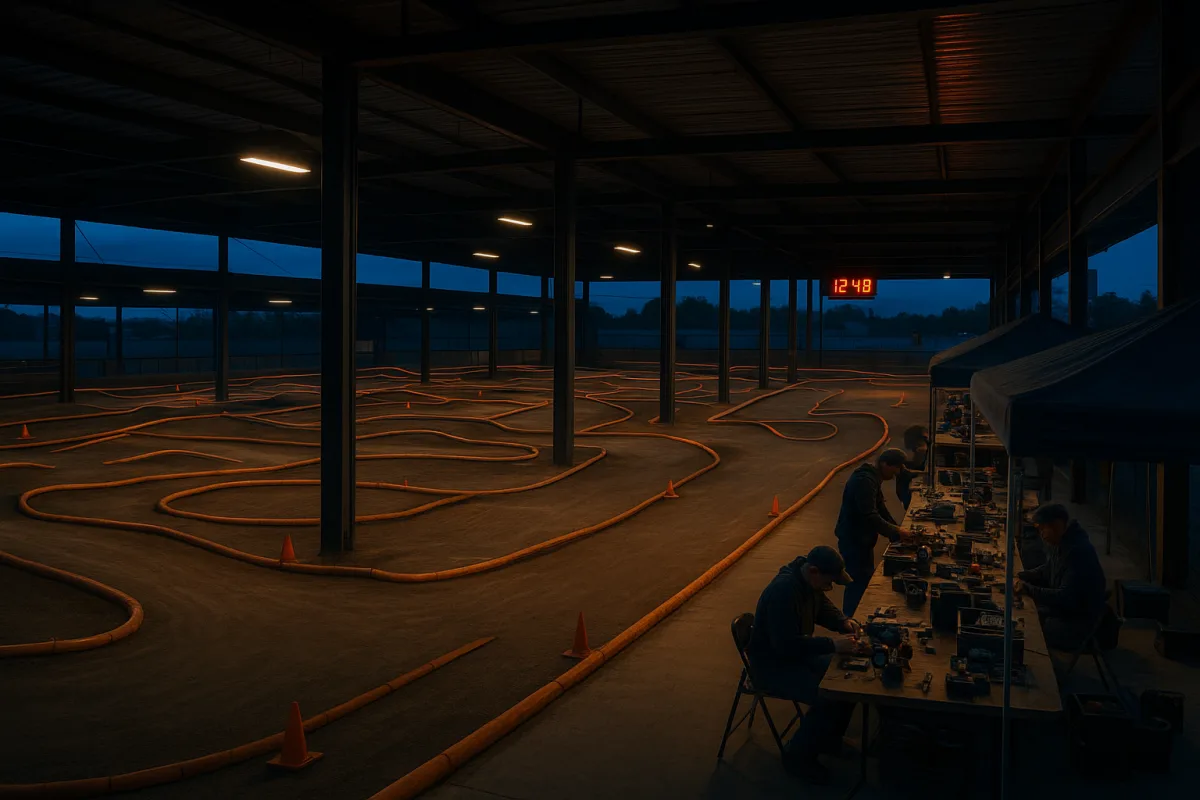
The important number is usable racing footprint
When racers say a venue is “big enough,” that usually means nothing until somebody marks out the course, driver stand, marshal positions, pit lane and safety buffer. The number that matters is usable racing footprint.
That is the space left after subtracting everything that cannot be raced on: walls, support columns, spectator areas, entrances, bathrooms, fire exits, tables, staging lanes and the bit of floor you need for people to walk safely.
I have seen plenty of club layouts where the room looked huge while empty, then became tight once the lap-counting table, pit benches and thirty people carrying LiPo bags appeared. More square footage is not automatically more track.
For an organizer, usable footprint determines class choice before it determines layout. Start by deciding whether the site is for 1/10 off-road, 1/8 off-road, on-road, drift, oval or a mixed public expo.
That order saves money. Trying to force a 1/8 buggy layout into a compact indoor hall is like fitting a 46-tooth spur to a gearing package that needs a 78. You can make it turn, but it will not work properly.
Why lane width decides whether racing is actually good
A track is not just its outer dimensions. It is a collection of lanes, jumps or corners, marshal access, runoff and sightlines. The lane width sets the whole scale of the event.
ROAR guidance calls for a minimum 8-foot lane width for 1/10-scale classes on off-road tracks. [2] That is a minimum, not a magic number that guarantees good passing or safe recovery after a first-lap pileup.
An 8-foot lane can work for a club-level 1/10 buggy or stadium truck layout, especially where the course is technical rather than fast. It gets much less forgiving when drivers bring wide 4WD buggies, short-course trucks or aggressive race pace.
For 1/8 buggy, 1/8 truggy and large nitro classes, use common sense rather than treating the 1/10 figure as permission. Those cars carry more speed, need more braking room and take up more lane when they get sideways.
A truggy with big tires and a heavy flywheel does not recover like a 1/10 2WD buggy on a tight clay layout. If the corners are narrow, marshals are constantly exposed and drivers stop making clean passes.
That is why dedicated outdoor facilities tend to be better for larger off-road classes. El Nido RC Park in Redondo Beach, California, is a volunteer-run facility with daily access for 1/10 and 1/8 off-road running. [1]
The useful point is not simply that El Nido exists. It is that a dedicated off-road site solves the conflict between dirt, noise, jump building and everyday public use that makes many otherwise attractive parks unsuitable.
The footprint changes by racing discipline
On-road needs length and a reliable surface more than jumps and elevation. EFRA specifications set a minimum 200-metre circuit length, a width of 4 to 6.5 metres and a 45-metre straight for the relevant on-road format. [2]
That 45-metre straight is not there for show. It lets a properly geared touring car or nitro on-road car stretch its legs, then gives the braking zone enough distance to separate a clean pass from a body-shell pile.
Surface preparation is part of the footprint calculation too. EFRA’s cited guidance calls for unsealed asphalt or a coarse-finish surface with smoothed joints. [2] A bumpy car park may have space, but expansion joints can unsettle a low 1/10 touring car.
Drift is the opposite case. A compact site can be a very good drift venue because the speeds are lower and the objective is controlled angle, line and proximity rather than a long full-throttle straight.
RC Cars Guide estimates that solo drift practice can use lanes around 80 cm wide in roughly 30 m². Group drift events need approximately 1.0 to 1.2-metre lanes and around 100 to 120 m². [2]
That makes polished concrete, carpet, wood and RCP-style modular surfaces viable in places that could never host a serious off-road meeting. Surface choice changes setup, though, so do not assume every hard floor drives the same.
A polished concrete floor may reward a different tire compound and gyro setting than carpet. An RCP surface can offer repeatability, while a dusty public hall floor can change from one run to the next as rubber goes down.
RC Racing Event in Lawndale, California, illustrates what a compact indoor model can look like: a 2,000-square-foot facility with two custom tracks, parking and a VIP room, with more than 60 events organized. That size points toward carefully matched classes rather than unrestricted large-scale racing.
Pits are part of the venue, not an optional extra
The course sells the event, but pits determine whether racers come back. For electric racing, every driver needs room for a charger, LiPo safety bag, tools, spare tires and usually a fan.
For nitro, add fuel, starter equipment, cleaning supplies and more elbow room. A 1/8 nitro racer trying to tune a clutch or replace a bent turnbuckle on a crowded folding table is not having a good race day.
The Groove Race Track in the Midwest shows the difference facilities make. Its 210-by-100-foot Euro-style layout includes banking and elevation, while the site provides 100 powered pit spaces and another 100 canopy spots.
That facility also has a raised pit lane and driver’s stand, food trucks, Starlink internet, tire truing, air and wash stations, plus premium fuel. Those are not luxuries for every club race, but they show what separates a destination event from an improvised one.
Power is the item organizers most often assume is included. It may not be. 517 RC Motorplex in Porter, Texas, provides space for pit trailers and RVs or campers, but has no power hookups, so racers need generators.
That changes the event plan. If the venue has no mains power, tell electric racers early, set generator rules, plan fuel storage and decide whether overnight camping is compatible with noise expectations and local requirements.
Richfield Raceway in Pennsylvania is another example of practical amenities: tables, chairs, restrooms, Wi-Fi and a concession stand. Those basics matter more than fancy scenery when families are spending a full day at the track.
Weather is effectively another piece of track equipment
For outdoor events, temperature affects the race just as much as layout. A useful target is 15 to 28°C, where tire behavior and battery performance are generally easier to manage. [3]
Below that range, tires may not come in consistently and LiPo packs can feel soft. Above it, motors, ESCs and batteries build heat quickly, especially when the driver has geared too tall for a high-grip surface.
Shade is not just for racers standing on the driver stand. It protects pit tables, batteries, chargers and tires. A LiPo sitting in direct sun before qualifying starts is beginning the run at a disadvantage.
Wind matters as well. Around 5 to 10 mph is manageable, but wind above 20 mph becomes troublesome for lightweight bodies, pop-up canopies, dust control and driver visibility. [3]
Rain and high humidity complicate dirt and clay especially. Moisture can make a track hook up beautifully for a short window, then turn it into ruts, mud or a slick surface once conditions move.
For temperate regions in the United States and Europe, late spring, May through June, and fall, September through October, are generally favorable outdoor windows. [3] That lines up with when tracks can avoid the worst summer heat.
Tropical climates and hot parts of the United States tend to favor spring and fall, while arid regions are generally more comfortable in those same shoulder seasons. Canada and northern Europe are much more summer-dependent. [3]
Match the venue to the kind of event
A major destination race has different needs from a Saturday points series. Orleans Arena in Las Vegas hosted the 2026 Team Associated Vintage Off-Road Championships for more than 400 drivers, its second consecutive year hosting the event.
That is an indoor event-scale decision: protected weather conditions, substantial access capacity and enough infrastructure for hundreds of racers. A venue that works for forty club members may collapse under that load.
The California RC Supershow, scheduled at Fairplex in Pomona, California, for October 24 and 25, 2026, is a different format again. It combines varied RC activities rather than operating as a single-class race meeting.
Fairplex has already demonstrated its ability to draw a large RC audience. RC Car Action reported that the 2023 Radio Control Expo at the Pomona venue attracted thousands of attendees. [4]
For a mixed event, the usable footprint has to be divided into racing, vendor space, demonstrations, charging areas, spectator flow and entry control. A strong race layout alone is not enough if it blocks public movement.
A local club race can use a simpler formula. El Nido RC Park’s volunteer-run structure and open-track availability make it a useful fit for regular 1/10 and 1/8 off-road participation rather than a once-a-year exhibition. [1]
Costs and permissions need direct answers
There is no reliable 2026 rental-cost table for RC-specific venues in the available reporting. General event spaces can range from roughly $25 to more than $300 per hour, or $1,500 to more than $10,000 per event in major cities.
Treat those figures as broad event-industry context, not an RC venue quote. The actual number depends on the day, staffing, cleaning, insurance, power, security, toilets, track construction and whether the facility wants a share of entries.
Insurance is another budget line that cannot be hand-waved. General event-planning guidance places typical coverage around $500 to $2,000, although that is not an RC-specific rate and should not be used as a final budget figure.
The same caution applies to permits and regulation. ROAR technical rules govern racing classes and equipment, but they do not replace local rules on zoning, noise, public safety, parking or temporary structures.
Ask the venue manager and local authority directly before publishing a date. The available research does not establish a comprehensive national picture of RC-event permits, and rules can vary sharply from one town or property to another.
A sensible first call covers four things: whether motors and generators are permitted, whether jumps or barriers can be installed, whether charging is allowed indoors, and who carries liability if a spectator enters the racing area.
That may sound less exciting than choosing a layout, but it is the same logic as setting a car up from ride height before buying aluminum parts. Get the foundation right, then spend money on the details.
Frequently Asked Questions
What are the best locations for RC car events?
Top venues for 2026 include 517 RC Motorplex in Porter, TX; Orleans Arena in Las Vegas, NV; El Nido RC Park in Redondo Beach, CA; California RC Supershow in Pomona, CA; and the RC Racing Event in Lawndale, CA. These sites offer a range of facilities from outdoor dirt tracks to indoor custom layouts, accommodating various RC classes and event sizes.
How to choose a venue for an RC car race?
Start by selecting the racing class and then determine the required surface, lane width, and pit capacity. Assess the usable racing footprint after accounting for non-racing areas like pits, spectator zones, and safety buffers. This approach ensures the venue suits the specific needs of the class rather than relying on total square footage or appearance.
What factors determine a good RC car event location?
Key factors include the usable racing footprint, lane width appropriate to the vehicle class, surface type, weather conditions, and availability of essential amenities such as power, pits, parking, and noise compliance. The venue should also support safe marshal access and provide enough space for drivers and equipment.
How does track size and layout affect RC car event venues?
Track size and layout must match the vehicle scale and racing style. For example, 1/10 off-road tracks require at least 8-foot lanes, while on-road circuits need a minimum 200-meter length with a 45-meter straight for proper passing. Drift tracks can be compact but require specific lane widths depending on solo or group practice. Incorrect sizing can hinder safe racing and driver performance.
What amenities should an RC car event location have?
Essential amenities include adequate pit space with power access for chargers and equipment, parking for participants and spectators, noise management, and safety features. Indoor venues may also benefit from VIP rooms and internet access, while outdoor sites should consider shade and wind conditions to optimize tire grip and battery performance.
How we researched this
This article was assembled from 5 cited references.
Nothing here is based on hands-on testing. Where a figure or finding appears, it belongs to the source cited beside it, and the writing says so rather than implying otherwise. Every source is listed below so you can check it.
Sources
- El Nido RC Club – News and Events for the club. Check here first for updates to the schedule and opportunities to help out. El Nido RC Club. Everyone welcome.
- How to Find an RC Drift Track Near You (2026 Guide) | RC Cars Guide
- Optimal Times to Visit U.S. Regions for Outdoor Events | Clime Blog
- Radio Control Expo 2023 Takes Over Fairplex In Pomona With Thousands In Attendance – RC Car Action
- Special Local Regulations; Marine Events Within the USCG East District-Ocean City, NJ, 57512-57513 [2026-18463] :: Coast Guard :: Department Of Homeland Security :: Regulation Tracker :: Justia
Related Articles

How to Choose RC Car Tires for Racing
Learn how to choose RC car tires for racing by matching compound, tread, and size to your track surface and conditions for optimal grip and performance.
RC Car Scale for Racing Tracks: Choosing the Right Size
Learn how to choose the right RC car scale for your racing track size, local classes, and power needs to optimize your racing experience.
Best RC Car for Racing: Arrma Limitless V2 vs Traxxas XO-1
Compare the best RC car for racing with detailed setup, tuning, batteries, motors, and kit choices for high-speed 1/7 scale brushless RC cars.

Exploring the Interceptor V2: Aeromodeling Innovation with 3D Printing
Join the team and 3D printing expert Nick as they test the Interceptor version two RC plane. With innovative design features and plans for speed testing and FPV upgrades, this collaboration takes aeromodeling to new heights.