
Best Locations for RC Car Off Road
Discover the best locations for RC car off road and how surface type affects your car’s performance and setup.
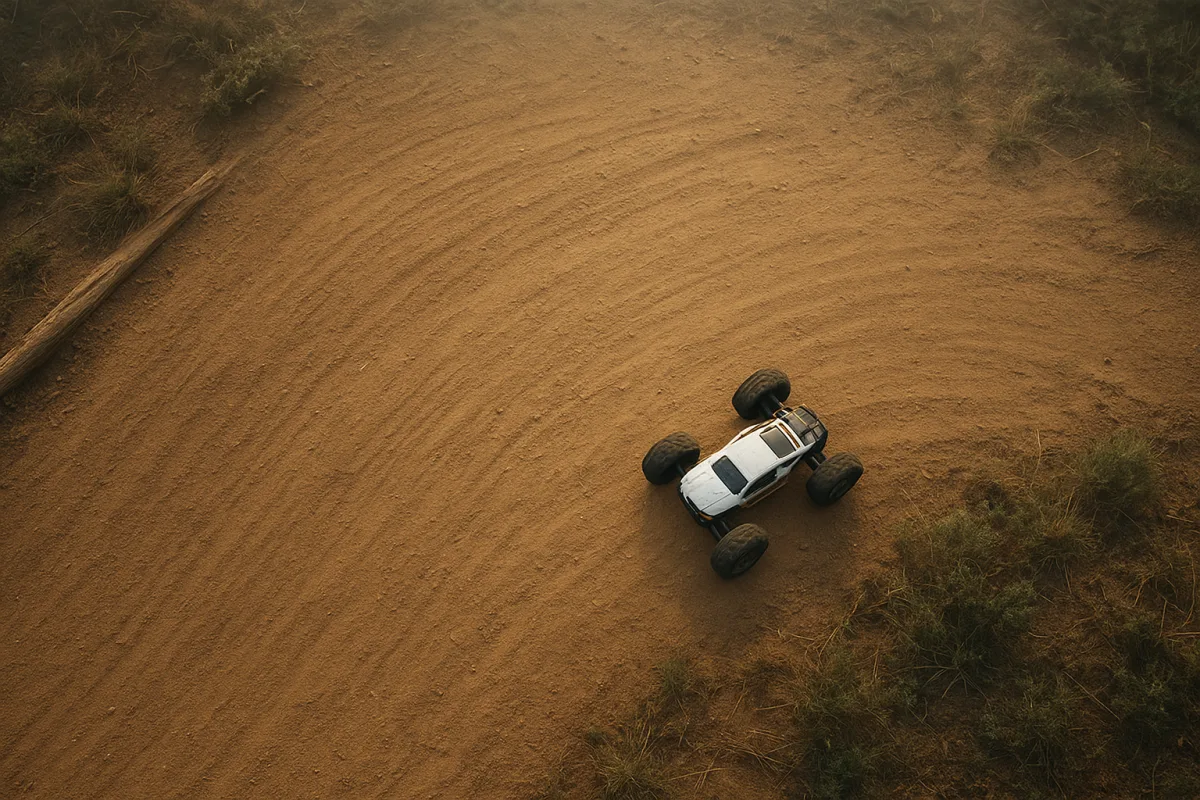
The one thing that makes a location suitable: surface load
When racers ask for the best locations for RC cars off road, the useful answer is not a list of towns. It is surface load: what the ground asks the tires, suspension, drivetrain and cooling system to do.
A 1/10 electric buggy on groomed clay is not dealing with the same problem as a 1/8 truggy in loose gravel. Both are called off-road cars, but the first needs repeatable grip while the second needs clearance, wheel speed and enough compliance to stay composed.
That is why the expensive upgrade usually is not the first fix. A good location lets you identify whether the car has a setup problem, while a bad location can make a sound setup look terrible.
I would start every site check with four questions: What is the surface? How much room is there? Is driving permitted? And can the car survive a full pack there without turning into a cleaning and bearing-replacement exercise?
Why dirt composition matters more than a dramatic jump
The most useful dedicated off-road surface is sandy-clay loam, with around 30 to 40 percent clay according to RC Tracks and Setups. That mix is not magic dirt, but it explains why some tracks feel hooked up and others never stop changing. [1]
Sand provides drainage and keeps the ground from becoming a hard slab. Clay gives particles something to bind to, so tires can bite into a consistent layer rather than skating across dry, loose dust. [1]
Too little clay means a dusty surface that blows apart under acceleration. Your rear tires dig holes, the racing line develops marbles, and the car starts feeling like it has a diff or motor problem when it is really losing mechanical grip.
Too much clay brings the opposite problem. Once wet, it can pack into tread blocks, add rotating mass to the wheels, and turn a tidy 2WD buggy into something that pushes on entry and snaps loose when the mud finally sheds.
Moisture is the part racers notice immediately, even when nobody has a scientific meter beside the driver stand. A managed dirt track needs enough water to remain tacky, but not so much that tire grooves fill and the racing line becomes rutted mud. [1]
That changing grip is why copying a setup sheet blindly is risky. The same 1/10 buggy can want a more open rear tire on dusty dirt, then a lower-profile, more tightly packed tread once the clay comes up and grip increases.
Suspension follows the surface too. On rough, loose ground, the job is keeping the tire in contact with the terrain, not making the chassis feel artificially stiff. Going heavier on shock oil because the car rolls can easily reduce grip over chatter.
For a 1/10 buggy, a track size quoted by RC Tracks and Setups is roughly 80 centimetres to 1.2 metres wide and 15 to 25 metres long. That is compact enough that turn placement and surface consistency matter more than raw top speed. [1]
Beginner layouts should use gentler features and flowing turns, while advanced layouts add sharper corners and more technical jumps. There is no verified universal jump-height standard in the research, so do not assume every track’s obstacles suit every scale. [1]
A 1/8 truggy needs particular care here. It may physically fit on a small 1/10 layout, but the extra width, speed and mass can make narrow lanes unsafe and leave no useful margin when a truck lands slightly off-line.
Asphalt and carpet are not automatically wrong
The label “off-road track” can mislead a new driver. Valkaria RC Raceway in Florida is listed among off-road venues, yet its stated surface is asphalt, not dirt or clay. [1]
That does not make Valkaria a poor location. It makes it a specialised one. An off-road chassis can run there, but tall dirt tires, soft long-travel suspension and a high ride height are not automatically the fast or durable combination.
On asphalt, traction arrives faster and impacts are more abrupt. A 1/10 stadium truck or buggy may need lower ride height, less chassis roll and tires suited to a hard, abrasive surface, rather than the pin tire you would bolt on for watered clay.
The same exception applies to AMC Hildesheim e.V. in Germany, another outdoor venue identified with an asphalt surface. It is a legitimate place to drive, but it should not be presented as proof that all “off-road” tracks offer loose terrain. [1]
Forest of Dean RC Car Club in England is identified as an indoor carpet venue. Carpet has very high consistency compared with outdoor dirt, and it rewards smooth steering inputs, controlled weight transfer and a setup that prevents traction roll. [1]
If your goal is specifically dirt practice for a 1/10 buggy, these asphalt and carpet venues are poor substitutes for clay. If your goal is safe, organised driving and setup repetition, they may still be more useful than an unapproved patch of open ground.
RACG in Montbonnot-Saint-Martin, France appears in track listings, but the available research does not specify its surface or even clearly define its track type. I would not make a trip based on that listing alone, confirm directly first. [1][2]
Known places to start looking
For verified United States options, RC Tracks and Setups identifies SDRC Raceway in San Diego as an indoor dirt venue. That is the kind of location worth seeking if you want repeatable dirt conditions without rainfall rewriting the setup between rounds. [1]
Race City Speed Factory in Mooresville is described as multi-discipline, which matters because multi-discipline does not tell you which surface or layout will be available on a given day. Ask what class and surface are running before loading the car. [1]
Clermont RC Complex in Florida is another practical example because it offers a $25 day-practice pass and monthly memberships of $50 to $70. Those prices buy track access, not your batteries, tires, repairs or travel. [4]
For discovering more sites, RC Road is a sensible starting tool because it is built around community track finding. Treat any community listing as a lead, though, not final confirmation of surface, opening hours, fees or vehicle restrictions. [2]
Hills Offroad RC is an example of the kind of off-road destination often found where more space is available. The important point is not that rural is always better, but that room allows dedicated layouts and terrain that dense urban sites may lack. [6]
Urban areas can still have good facilities, as Clermont demonstrates. There is no solid evidence for a universal regional rule on track availability, so use local club directories and direct contact rather than assuming your nearest city has nothing. [2][4]
Access cost is part of choosing the location
The cheapest-looking place can become the expensive one if you cannot practice often enough to learn it. A track’s access structure determines whether you can do a quick shakedown, race weekly, or only show up for major events.
Eastern Model Car Club in Australia lists adult membership at $70 per year, with member race fees of $15 per class. That structure suits a regular racer because the annual cost is modest and you pay according to how many classes you enter. [3]
The UK’s KMRC lists senior membership at £15 per year and event fees of £15, with the first event free when joining. That is an approachable model for someone who wants to try organised racing before buying extra class-specific gear. [1]
Other clubs operate differently. Coastal RC Speedway lists memberships from $75 to $150 per month, including race entries and discounts, which can make sense for frequent use but is poor value if you only run once monthly. [1]
WMARCC lists $50 annual membership and $5-per-class race fees for non-members. Indy RC World in Texas lists $15 practice and race fees from $10 to $25 depending on class, so a two-class race day costs more than the posted minimum. [1]
Before joining, ask whether the stated fee covers practice, race entry, transponder use, pit power, insurance, or only membership. The research gives fee examples, but it does not establish a universal package across clubs. [1][3][4]
Weather changes whether the location still works
A good dirt track is not a fixed object. Cold weather reduces battery output, thickens lubricants and makes plastic parts more brittle, according to Hearns Hobbies. That turns a normal landing into a greater risk for arms, shock towers and wing mounts. [5]
For electric cars, keep battery temperature in mind before blaming the motor. A cold LiPo can sag under load, which means less punch out of corners and a car that feels geared too tall even when the pinion is unchanged. [5]
Heat reverses some of that behavior. Batteries can overheat, lubricants thin and wear accelerates, so a hot, dry location can be hard on diffs, bearings and tires as well as grip levels. [5]
Tire compound is part of location setup, not a cosmetic choice. Cooler conditions may need a compound that can generate grip, while heat and abrasive surfaces can destroy a soft tire quickly, leaving you with fading balance over a single run. [5][7]
I would change one setup variable at a time when conditions move. Start with tire choice and ride height, then look at shock oil and springs if the chassis still cannot follow the surface. Jumping straight to a new motor only hides the diagnosis.
The locations to avoid
Avoid grass with a low-clearance race car unless the grass is genuinely short and firm. Long grass loads the drivetrain, catches suspension arms and turns the motor and ESC into lawn equipment, especially on smaller 1/10-scale cars. [7]
Avoid crowded, confined places where a missed braking point sends a 1/8-scale vehicle toward pedestrians. Safety is not just about speed, it is about whether the site gives drivers, marshals and spectators enough separation. [10]
Do not run through sensitive habitat, cut new routes, or assume public land permits RC vehicles. LegalClarity notes that illegal off-roading in the United States can lead to fines up to $500, alongside the obvious damage issue. [8]
Finally, choose locations you can clean up after. Dirt, moisture and debris left in the chassis promote rust and reduce performance, so a good site includes somewhere to inspect the car before the next run, not just somewhere to pull the trigger. [10]
Frequently Asked Questions
What makes a location suitable for off-road RC cars?
A suitable off-road RC location matches its surface to the car’s clearance, tires, drivetrain, and scale rather than just being labeled “off-road.” Key considerations include the surface type, available space, permission to drive there, and whether the car can run a full battery pack without excessive wear or damage. Surface load—the demands the ground places on tires and suspension—is the main factor in suitability.
How does dirt composition affect RC car off-road performance?
Dirt composition is critical; sandy-clay loam with about 30 to 40 percent clay is ideal because it provides grip without becoming dusty or muddy. Sand offers drainage to prevent hard slabs, while clay binds particles for consistent traction. Too little clay causes dust and loss of grip, while too much clay leads to mud buildup that hampers tire performance.
Are asphalt and carpet tracks good for off-road RC cars?
Asphalt and carpet tracks can be valid for off-road chassis but require different setups compared to loose dirt. Asphalt demands lower ride height, less chassis roll, and tires suited for hard surfaces, while carpet rewards smooth steering and controlled weight transfer. These surfaces are specialized and do not replicate loose terrain conditions.
What are some verified off-road RC car tracks in the US?
Verified US off-road tracks include SDRC Raceway in San Diego (indoor dirt), Race City Speed Factory in Mooresville (multi-discipline), and Valkaria RC Raceway in Florida (asphalt). Each offers different surfaces and access models, so it’s important to check membership and fee structures before planning visits.
What should I consider before choosing an off-road RC car location?
Before choosing a location, consider the surface type, track size, driving permissions, and environmental regulations. Illegal off-roading can result in fines up to $500 in the US. Also, assess whether your car’s setup matches the terrain to avoid damage and poor performance, and verify access costs such as memberships or daily fees.
How we researched this
This article was assembled from 10 cited references.
Nothing here is based on hands-on testing. Where a figure or finding appears, it belongs to the source cited beside it, and the writing says so rather than implying otherwise. Every source is listed below so you can check it.
Sources
- RC Tracks and Setups
- RC Road – The #1 RC Car Racing Community & Track Finder | RC Road
- 2026 Club Membership and Fees – Eastern Model Car Club (EMCC)
- Off-Road RC Track in Clermont, FL | Clermont RC Complex
- How Weather Affects RC Car Performance | Hearns Hobbies
- Home | Hills Offroad RC
- Best Terrain for RC Cars: Matching Surface to Your Setup
- Is Off-Roading Illegal? A Breakdown of the Rules - LegalClarity
- Remote Control Cars | Hobby Portal
- Top 5 Beginner Mistakes to Avoid with Your First RC Car – Naughty Boy RC
Related Articles
Best Locations for RC Car Events: Venue and Track Guide
Discover the best locations for RC car events, including venue size, track layout, pits, and weather considerations for successful races.
RC Car Scale for Racing Tracks: Choosing the Right Size
Learn how to choose the right RC car scale for your racing track size, local classes, and power needs to optimize your racing experience.
Beginner RC Car Comparison Under 200: Crawler vs Off-Road
Compare beginner RC cars under 200 to find the best crawler or 4WD off-road model with setup and tuning tips for new drivers.
Best RC Car for Off Road: ARRMA Granite vs Traxxas Slash
Compare the best RC car for off road use: ARRMA Granite vs Traxxas Slash. Get expert advice on terrain fit, battery, and maintenance.