
RC Car Scale for Racing Tracks: Choosing the Right Size
Learn how to choose the right RC car scale for your racing track size, local classes, and power needs to optimize your racing experience.
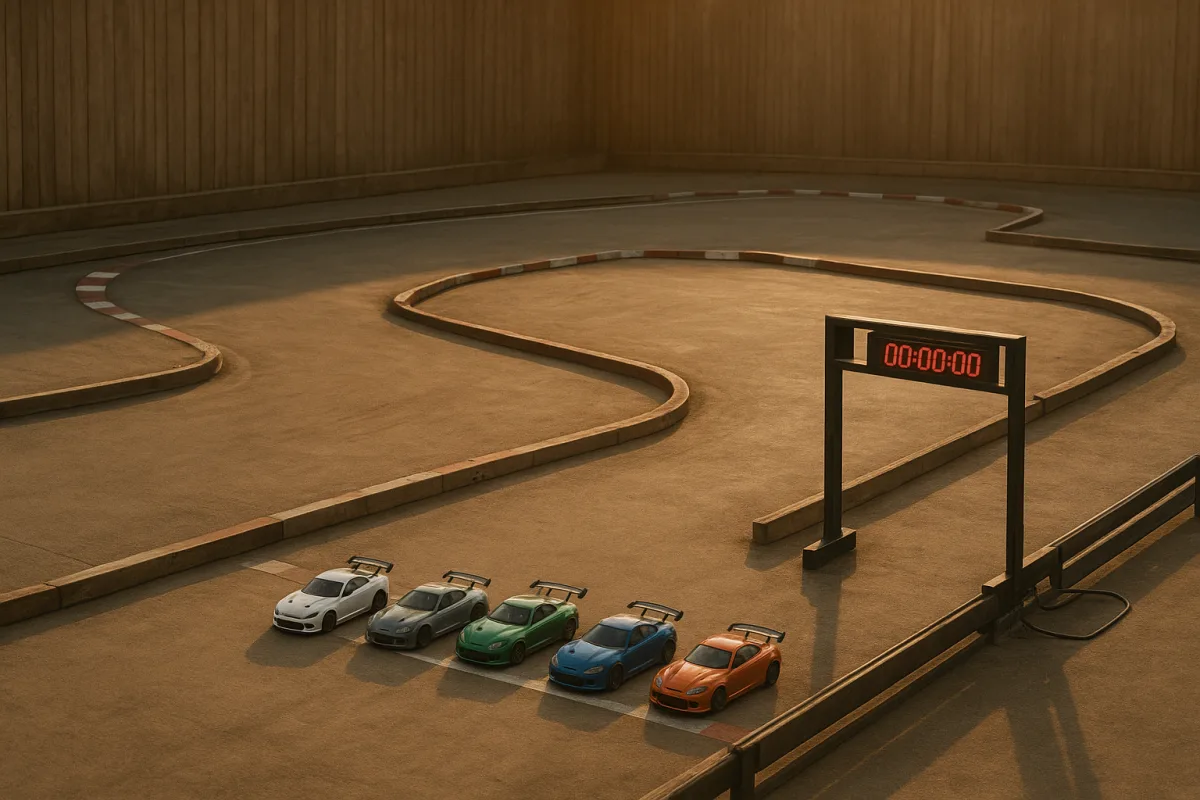
Scale is really a track-fit number
The ideal RC car scale for racing is usually 1/10, unless you already know you are racing a supported 1/8 off-road class. That is the short answer. The longer answer is that scale determines much more than the car’s physical size.
It determines whether the track has enough room for the car, whether the club runs a class for it, what batteries it uses, how expensive the initial purchase is, and how easily you can find replacement parts. A fast car without a class is just an expensive practice car.
The usual scale notation describes the model relative to the full-size vehicle it represents. It is useful shorthand, but it is not a complete performance specification. Two 1/10 cars can have different wheelbases, tyres, bodies and class rules, despite sharing the same scale label.
That is why picking by a photo can go wrong. A 1/10 touring car, a 1/10 buggy and a 1/10 short-course truck all occupy the same broad scale category, but they are not interchangeable race entries. The class, surface and local rules decide that.
Modelrec’s September 2026 competitive-racing guide identifies 1/10 and 1/8 as the scales that dominate serious racing. [1] The important distinction is not that one is universally better. It is that each one fits a different amount of track, power and budget.
Why 1/10 is the default racing scale
A typical 1/10 RC car measures roughly 17 to 22 inches long and weighs about 2.5 to 4 kg. [2][3] That is large enough to be stable and visible on a proper circuit, yet small enough for many accessible on-road and off-road tracks.
This is the scale I would point a new racer toward before talking about motors, aluminium hop-ups or exotic tyre compounds. A well-supported 1/10 class gives you somewhere to race, people who stock spares, and a field of cars against which setup changes mean something.
The formal-racing side matters. Sources covering ROAR-style regulations and club rule structures show heavy attention to 1/10 classes, including specific motor-turn and battery restrictions. [3] Rules are not glamorous bench-racing material, but they tell you where competitors, technical inspection and established formats already exist.
That support reduces the risk of buying the wrong thing. CompetitionX and TopRC both identify choosing a scale that is too large, overlooking available space and ignoring parts support as common beginner errors. Both point newcomers toward 1/10 as the balanced starting scale. [8][9]
There is also a sensible purchase range. RC Car Compare puts 1/10 RTR cars at about $150 to $500, while 1/10 kits fall around $130 to $500. [2] Those are indicative vehicle-price bands, not a complete first-season budget.
An RTR means ready-to-run, while a kit is a build project with the contents varying by manufacturer and listing. The available research does not establish exactly which electronics, batteries, chargers, tyres or tools each price includes, so do not read either range as a guaranteed race-ready total.
That caveat matters because racers often blame the car when the real issue is buying into a class without considering its running requirements. Before spending on upgrades, establish the scale, class rules and parts pipeline. A stock car in the correct class is a better starting point than a premium car nobody races locally.
The mechanical divide: 2S 1/10 versus 4S 1/8
The cleanest way to understand the 1/10 versus 1/8 decision is through the power system each scale commonly carries. The research brief identifies 2S LiPo packs as typical for 1/10 cars and 4S LiPo packs as typical for 1/8 racing. [5][12]
In LiPo terminology, the S refers to cells connected in series. A 2S pack has two cells in series, while a 4S pack has four. More series cells mean the electronics are designed around a higher-voltage power source, which is one reason the larger platform needs more room and more robust hardware.
That does not mean every 1/8 car is automatically quicker around a lap. It means the scale is generally designed for a different level of mass, terrain and power. Gear ratio, tyre grip, track condition and driver control still determine whether that potential becomes usable pace.
Published speed ranges show the gap in outright potential. Radio-Controlled UK places 1/10 cars broadly around 25 to 60 mph, depending on brushed or brushless power, while it notes brushless 1/8 cars can reach up to 100 mph. [10]
Those numbers are not target race speeds. A 100 mph claim says very little about what works on a bumpy dirt layout, a compact club track or in a regulated heat. It is a capability figure, not a recommendation to gear the car for maximum speed.
Runtime is similarly easy to misunderstand. MAD Toys and Hobbies gives 1/10 LiPo runtime as roughly 20 to 35 minutes, while Truth Motorsports gives a 4S 1/8 estimate of about 20 to 25 minutes. [5][12] The ranges overlap, so scale alone does not guarantee longer runs.
Driving style, terrain and temperature affect battery life, and the research does not provide a reliable percentage for those effects. [6][7] What matters in practice is that a 1/8 car’s 4S system belongs to a larger, more demanding package, not that it always stays on track longer.
What 1/8 scale buys you
A 1/8 RC car is generally about 19 to 24 inches long and can weigh roughly 2.3 to 6 kg. [2][4] The size overlap with 1/10 on paper is real, but the upper end of 1/8 weight and its usual off-road specification change the driving environment considerably.
RC Car Compare and VRX Racing place 1/8 scale squarely in larger-track, off-road use. [2][4] This is the scale to consider for a club that already runs 1/8 buggy, truggy or comparable off-road racing, particularly where the circuit has the width and runoff for it.
The main attraction is durability and performance in rougher, higher-energy off-road use. [2] A bigger car can make more sense where the surface is loose, the jumps are substantial and the layout is too open for a smaller platform to feel settled.
The trade-off is cost. RC Car Compare lists 1/8 RTR cars at approximately $200 to $700, while SDFI places 1/8 kits around $500 to $1,200. [2][11] Again, those figures describe model categories, not every necessary item for a race programme.
The price gap should change your decision process. Do not start with, “Can I afford this 1/8 kit?” Start with, “Does my track run a 1/8 class, do I have the space to practice it, and can I source what I will need?” If the answer is no, the extra scale is not an upgrade.
Space is part of the setup
Scale choice starts before the first battery is charged. Larger cars need larger venues, and the research consistently identifies space and environmental conditions as meaningful factors in scale suitability. [2][8] That is not just about whether the car physically fits in the garden.
A 1/8 car needs enough room to accelerate, brake and turn without spending the whole lap on the edge of control. On a cramped course, more speed and mass can become a disadvantage because the driver is constantly managing braking distance rather than carrying corner speed.
A 1/10 platform is the more flexible answer because it can suit accessible on-road and off-road racing venues. [2][3] It is not inherently the faster or tougher choice, but it is more likely to fit the available track rather than requiring the track to fit the car.
Climate also enters the picture, although the evidence is qualitative rather than measured by region. Larger scales are reported to need more space and to be more affected by environmental conditions, while smaller cars suit indoor or limited-space use more readily. [2]
That does not justify making up a universal wet-weather, heat or cold-weather rule. The research does not provide quantified regional comparisons. It does support a basic practical point: match the car to where it will actually race, not where its promotional photos suggest it could run.
Why smaller scales are usually not the race answer
Smaller scales, including 1/12, 1/18 and 1/24, are growing for indoor and backyard use. [2][10] They make sense when physical space is the limiting factor, especially for casual driving where a large outdoor circuit is unavailable.
But they are not the same thing as a broadly supported competitive-racing route. The research finds these smaller scales uncommon in competitive racing and notes limited parts availability for 1/12-scale cars. [2][10] That is a support problem, not a criticism of the cars themselves.
There is also no clear evidence in the research of major-league rules specifically favouring or restricting 1/12 scale. That absence matters. It means a buyer should not assume the formal class structure available for 1/10 will be waiting for smaller scales.
If your local club has an established 1/12 class, local reality beats a general recommendation. Otherwise, a small-scale purchase should be treated as an indoor or backyard choice first, with competition as a separate question requiring confirmation from the track.
The scale decision before the shopping list
The right order is simple. First identify the local track and its active classes. Second, decide whether your available space supports 1/10 or 1/8 running. Third, price the appropriate RTR or kit category with a realistic allowance for the items not confirmed in the listing.
For most new racers, that process ends at 1/10. Its 17-to-22-inch size, broad racing presence, 2S battery format and lower indicative purchase range make it the sensible all-round entry point. [1][2][12]
For the racer with a large off-road venue and a real 1/8 class to enter, 1/8 is not excessive. It is the correct tool for the job, with 4S power, larger dimensions and a higher price band accepted as part of that package. [2][5][11]
The expensive answer is not automatically the competitive answer. Pick the scale that fits your class first, then work on driving and setup within that platform. That is how you avoid turning a scale choice into a pile of unused parts.
Frequently Asked Questions
How does RC car scale affect track compatibility?
RC car scale determines the physical size of the car and thus the amount of space it requires on a track. Larger scales like 1/8 need bigger tracks, often outdoor off-road venues, while 1/10 scale fits more accessible on- and off-road tracks. Choosing a scale incompatible with your track size can limit racing opportunities and performance.
Which RC car scale fits best on local racing tracks?
The 1/10 scale is generally the best fit for most local racing tracks because it balances size, track accessibility, and formal class support. It suits tracks that are neither too small nor too large, providing a stable and visible racing experience. If your local club runs 1/8 scale classes and has a large outdoor venue, then 1/8 may be preferable.
What scale RC car should I choose based on my track size?
If your track is relatively small or medium-sized, 1/10 scale is recommended due to its manageable size and broad class support. For large outdoor off-road tracks, especially those with rough terrain, 1/8 scale is more suitable because it is designed for higher speed and durability on bigger courses. Smaller scales like 1/12 or 1/18 are better for tight indoor or backyard spaces but lack major competitive support.
How do local club classes influence RC car scale choice?
Local club classes strongly influence scale choice because they determine what cars you can race competitively. It is best to select a scale that your local club officially supports to ensure access to races, parts, and a community of competitors. Buying a car without a supported class can lead to an expensive practice vehicle with limited racing opportunities.
What are the power differences between 1/10 and 1/8 scale RC cars?
Typically, 1/10 scale RC cars use 2S LiPo battery packs, providing moderate power suitable for their size and track compatibility. In contrast, 1/8 scale cars commonly run on 4S LiPo packs, delivering significantly more power and higher speeds, often up to 100 mph. This power difference makes 1/8 scale cars better suited for large, rough terrain tracks but also increases cost and space requirements.
How we researched this
This article was assembled from 12 cited references.
Nothing here is based on hands-on testing. Where a figure or finding appears, it belongs to the source cited beside it, and the writing says so rather than implying otherwise. Every source is listed below so you can check it.
Sources
- 12 Best 1/10 Scale RC Car Kits for Competitive Racing (September 2026) Buyer Reviews
- RC Car Scales Explained (1/10 vs 1/8 vs 1/16) | RC Car Compare
- Best RC Crawlers by Scale: 1/24, 1/18, 1/10 & 1/8 Compared (2026) | RC Cars Guide
- RC Car Sizes Explained: The Ultimate Guide to RC Scale Sizes (1/8, 1/10, 1/16, 1/18, 1/24) - Riverhobby Tech (Shenzhen) Co., Ltd.
- What Battery Do I Need for 1/8 Scale RC Racing?
- RC Car Battery Guide 2025: Best Batteries & Expert Tips - Xrccars
- How Long Does RC Car Battery Last? LiPo Guide 2026 | FUNYAT
- RC Car Scale Explained: A Beginner’s Guide to Choosing the Right Size
- What is the best scale for an RC car for beginners?
- RC Car Scales Explained — 1:8, 1:10, 1:12, 1:18, 1:24 | RCUK
- How Much Does an RC Model Car Really Cost?
- RC - How Long Do RC Batteries Last? (2026) - MAD Toys and Hobbies
Related Articles
What Size Motor for RC Car: Choosing the Right Can and KV
Learn what size motor fits your RC car scale and how to match KV rating for optimal performance and reliability.

Best Locations for RC Car Off Road
Discover the best locations for RC car off road and how surface type affects your car’s performance and setup.
Best RC Car Type for Beginners: Choosing the Right Model
Discover the best RC car type for beginners, including scale, chassis, motor, and battery choices to fit your terrain and skill level.
RC Car Parts Compatibility Guide
Learn how to ensure RC car parts compatibility for chassis, electronics, batteries, wheels, and hardware with this detailed compatibility guide.