
Prevent RC Car Battery Swelling
Learn how to prevent RC car battery swelling with safe charging, proper storage, and maintenance tips to extend your LiPo battery life.
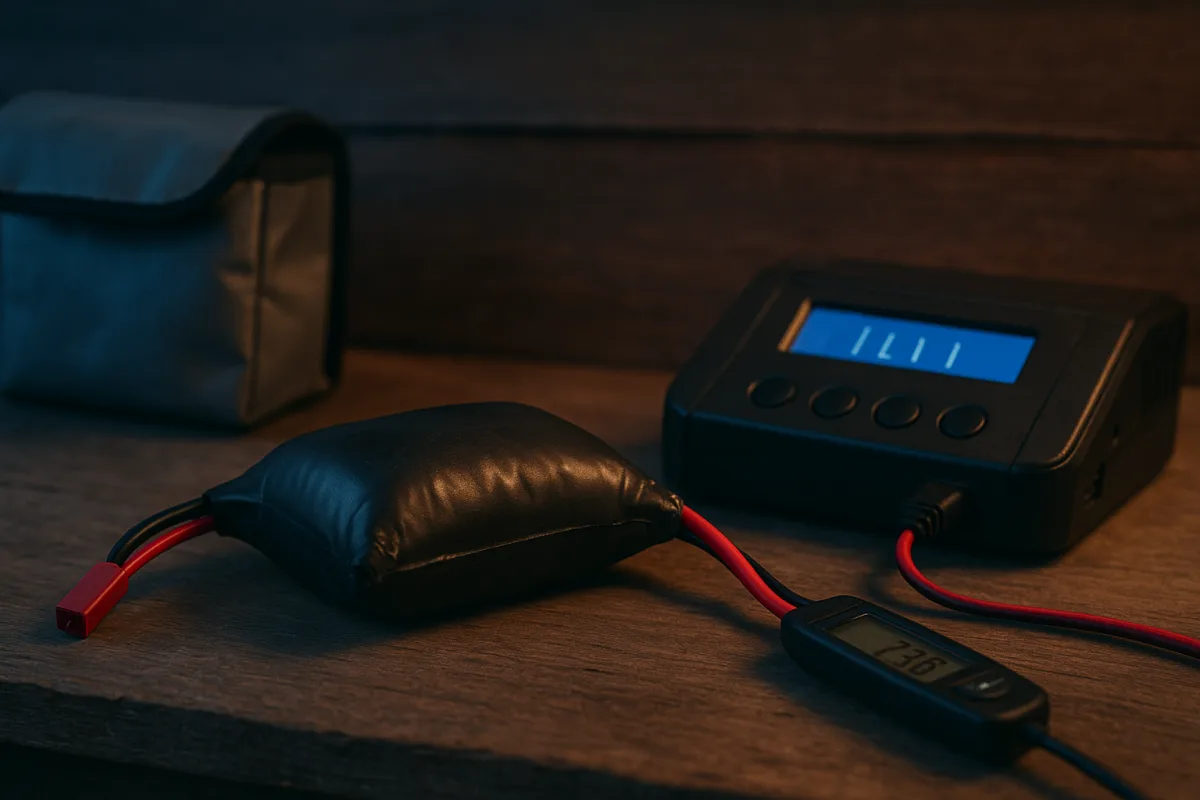
How to Prevent RC Car LiPo Battery Swelling
The problem starts when the pack comes out of the car hot
You finish a five-minute run, pull the body, and the LiPo is warmer than you expected. That is the point where plenty of packs get damaged, not because the driver bought a bad battery, but because they immediately plug it into a charger.
Do not charge a warm pack. Battery Skills identifies excessive heat, particularly temperatures above 60°C, as a swelling risk during operation and charging. Its stated charging range is 0°C to 45°C, while RC hobbyist guidance commonly puts normal operating temperature at 10°C to 40°C. [2]
There is no single authoritative RC-car study that declares one exact temperature safe for every 2S shorty, 3S basher pack, or 4S 1/8-scale brick. Treat the published ranges as practical limits, not permission to run a battery until it is cooking.
For a 1/10 buggy or stadium truck, pull the pack after a hard run and let it return to ambient temperature before charging. For a heavier 1/8 truggy or monster truck, be more cautious, because a high-load 4S pack can retain a lot more heat.
The battery temperature is also a clue about the car. If the pack repeatedly comes out unusually hot, check gearing, drivetrain drag, motor temperature, binding brakes, and whether the battery’s discharge rating actually suits the load. The research brief does not establish a direct tuning-to-swelling rule, but excessive electrical load creates heat, and heat is one established cause of puffing. [2]
Do not try to solve that with a shiny new battery first. A 1/10 2WD buggy geared too tall, with a slipping diff or crunchy bearings, will punish a premium pack just as effectively as an inexpensive one. Fix the car’s load before blaming the cells.
Before plugging in, inspect the pack and its leads
Inspection is not glamorous wrenching, but it is the quickest way to avoid charging a damaged LiPo. CAYOTE recommends looking over batteries before and after every use, and after impacts. DEERC also identifies physical damage and the internal short circuits it can cause as a swelling risk. [10][20]
Check both broad faces of the pack. A healthy hard-case LiPo should sit flat, while a soft pack should not feel ballooned or unusually soft. Look for split shrink wrap, cracked hard cases, dented corners, torn balance wires, loose main leads, and connectors that have been hot enough to discolor.
A hard crash matters even if the car drives away. In a 1/10 touring car, the battery may be protected by chassis walls, but curb strikes can still shock the pack. In an 1/8 buggy, a battery ejected from a loose tray is a reason to inspect it before the next charge.
Do not flatten, compress, puncture, or keep running a swollen pack to “get your money’s worth.” RC Airplane Guide’s advice is direct: replace a pack when swelling is detected. Physical damage and swelling are internal-battery problems, not setup changes you can tune out with a different punch setting. [1]
This is one area where a racer’s parts-bin mentality can work against you. Bent turnbuckles can be straightened in a pinch, and a leaking shock can be rebuilt. A puffed LiPo does not belong in the same salvage category.
Set the charger correctly, every cycle
The charger setup is where preventable swelling usually begins. Overcharging past 4.2V per cell is an established cause of LiPo swelling, so set the chemistry and cell count correctly before you press start. [1][4]
That means 2S for a 7.4V nominal pack, 3S for an 11.1V nominal pack, and 4S for a 14.8V nominal pack. Do not select a mode by connector type or by what fits in the battery tray. Read the pack label and verify the cell count.
Use a balance charger every time. RC Factory recommends balance charging to prevent cells becoming imbalanced, and Common Sense RC likewise advises balancing on every charge cycle. [4][21]
A balance lead is not an optional extra for careful owners. It lets the charger monitor individual cells rather than treating the pack as one lump of voltage. One cell can reach an unsafe voltage while the total pack voltage still looks plausible.
For charge rate, 1C is the sensible longevity setting. AllRCGuide gives the useful example: a 2200mAh pack charges at 2.2A at 1C. A 5000mAh pack therefore charges at 5.0A, while a 5800mAh pack charges at 5.8A. [3]
Some packs advertise 2C or 3C charging, and higher rates are possible, but Erle Robotics notes that higher charge rates reduce lifespan and increase heat. There is no good evidence in this brief quantifying exactly how much faster a 2C charge makes a pack swell. [19]
So the practical call is simple. If you need a quick turnaround at the track, a higher charge rate may be available within the battery maker’s stated limit. If your goal is preventing puffing over a season, charge at 1C and give the pack time to cool first.
Do not run the pack until the car slows to a crawl
The next common failure happens during the run. Deep discharge below about 3.0V per cell is listed by RC Airplane Guide and RC Cars Guide as a cause of damage and swelling. [1][9]
Set your ESC low-voltage cutoff for the battery type and stop when it activates. Do not keep squeezing out laps after the cutoff has made the car sluggish. That last minute is rarely useful track time, and it is hard on the pack.
This is especially important with 1/10 stock-class cars and crawlers, where a modest motor can keep moving a depleted pack long after it has stopped feeling fast. It also matters in 1/8 electric classes, where high current can make voltage sag look like the pack has more run time than it really does.
After the run, check the pack rather than immediately topping it off. If it is hot, let it cool. If it is swollen, damaged, or has a damaged wire from a crash, do not put it back on charge. [10][20]
A low C-rating can be a poor match for a high-draw platform, but C-rating alone is not a swelling-prevention solution. The established causes remain overcharge, deep discharge, heat, physical damage, and normal aging through charge cycles. [1][18]
Storage is where good race packs quietly go bad
The race day ends, you get home tired, and the packs are still fully charged. That is the exact moment to use the charger’s storage mode. RCModel recommends storing LiPos at 3.7V to 3.85V per cell, roughly half charge. [5]
For reference, that means approximately 7.4V to 7.7V for a 2S pack, 11.1V to 11.55V for 3S, and 14.8V to 15.4V for 4S. Use the charger’s per-cell storage program rather than estimating from a run timer.
Do not store fully charged packs in the car, pit bag, or garage. RCModel and RaceNRCs both warn against full-charge storage and high-temperature storage, while FMS Hobby specifies a cool, dry storage environment of 10°C to 25°C. [5][7][13]
That rules out the dashboard of a tow vehicle, a sun-baked shed, or a sealed race trailer in summer. A climate-stable indoor location is the practical answer, particularly for racers with several 2S shorties or large 4S and 6S packs.
There is no evidence in the research brief for a precise maximum storage period before a LiPo must be cycled. VRX Racing’s guidance is to keep packs near 50 percent and check them every few months. [6]
When you do that check, inspect for swelling and damage before deciding whether the pack is still serviceable. TECH1RC specifically recommends inspecting batteries before storage and discarding swollen or damaged packs. [8]
Choosing a pack: useful features, not immunity
A quality pack and smart charging features can add safeguards, but they do not override the basics. A premium LiPo can still swell if it is overcharged, cooked in a hot car, deeply discharged, or damaged in a crash. [1][2][20]
Horizon Hobby lists the Spektrum Smart G2 11.1V 2200mAh 3S 30C LiPo at about $30. Its compact 2200mAh capacity suits smaller 3S applications where physical size and modest runtime matter more than feeding a full-size 1/8 truggy. [15]
Mike’s Hobby lists a Traxxas Power Cell 7.4V 5800mAh 2S 25C LiPo at about $70. That larger 2S capacity suits vehicles built around a full-size 2S pack and drivers prioritising run time, but the listed price is for the battery, not a charger or other equipment. [16]
Tower Hobbies lists a Gens ace 7.4V 3500mAh 2S 30C LiPo at about $69. A 3500mAh 2S pack is more naturally suited to applications with less battery-tray space or shorter run-time needs than a 5800mAh pack, provided its dimensions and connector suit the vehicle. [17]
I have not personally run these packs, and the supplied research does not provide a controlled brand-by-brand swelling comparison. Their price, voltage, capacity, and C-rating do not prove one will outlast another under abuse.
The real purchasing rule is less exciting: buy a pack with the correct cell count, physical size, connector, and discharge capability for your specific class, then charge, run, inspect, and store it correctly. Proper handling remains the main swelling-prevention tool.
Frequently Asked Questions
How can I prevent my RC car battery from swelling?
Prevent swelling by charging LiPo batteries on a balance charger at no more than 4.2V per cell and using a 1C charge rate as a default. Always let the battery cool to ambient temperature before charging and keep charging temperatures between 0°C and 45°C. Avoid deep discharging below about 3.0V per cell and store batteries at roughly 50% charge in a cool, dry place between 10°C and 25°C. Regularly inspect batteries for physical damage or swelling and retire any suspect packs immediately.
What causes LiPo batteries in RC cars to swell?
Swelling is primarily caused by overcharging above 4.2V per cell, excessive heat during use or charging (especially above 60°C), deep discharge below approximately 3.0V per cell, physical damage causing internal shorts, and battery aging or cycle degradation. Heat generated by improper gearing, drivetrain drag, or unsuitable battery discharge ratings can also contribute to swelling by increasing battery temperature.
What is the best way to charge RC car LiPo batteries to avoid swelling?
Use a balance charger set to the correct cell count and chemistry, never exceeding 4.2V per cell. Charge at a standard 1C rate (for example, 2.2A for a 2200mAh pack) to reduce stress on the battery. Always charge batteries only when they have cooled to ambient temperature and keep the charging environment between 0°C and 45°C to minimize swelling risk.
How should I store RC car batteries to prevent swelling?
Store LiPo batteries at about 3.7V to 3.85V per cell, which is roughly half charge, in a cool, dry place with temperatures between 10°C and 25°C. Avoid storing them fully charged or in hot environments. Check stored batteries every few months to ensure they remain in good condition and retire any that show signs of swelling or damage.
When should I replace a swollen RC car battery?
Replace a LiPo battery immediately if it shows any swelling, physical damage, or signs of internal short circuits. Swollen packs are unsafe and cannot be repaired by changing cases, connectors, or other external components. Continuing to use or attempt to flatten a swollen battery risks further damage and safety hazards.
How we researched this
This article was assembled from 21 cited references.
Nothing here is based on hands-on testing. Where a figure or finding appears, it belongs to the source cited beside it, and the writing says so rather than implying otherwise. Every source is listed below so you can check it.
Sources
- LiPo Battery Swelling: Warning Signs & What to Do | RC Airplane Guide
- Battery Case Swelling - Battery Skills
- How to Charge an RC LiPo Battery | AllRCGuide
- Safe use of Lipo batteries | RC Factory
- RC Battery Storage Guide – How to Store LiPo Batteries Safely
- How to Store RC Car to Avoid Battery Damage: Smart Storage Tips for Longer Battery Life - Riverhobby Tech (Shenzhen) Co., Ltd.
- How to Store RC Car to Avoid Battery Damage – FMS Hobby
- RC Battery Safety & Charging Guide | TECH1RC
- RC Car Maintenance Guide: Routines That Actually Keep Your RC Running (2026) | RC Cars Guide
- CAYOTE RC Car LiPo & LiHV Racing Battery Maintenance Guide
- How to Tell If My RC Battery is Bad: The Indicators
- Why RC Batteries Swell (And When to Worry) - TRVBABY
- LiPo Battery Storage: Safe Storage Voltage, Location, and Tips – RaceNRCs
- How to Charge RC LiPo Batteries (Beginner's Guide) | So Dialed
- RC Cars & Trucks Batteries | Horizon Hobby
- RC Car Batteries – Mike's Hobby
- 4S LiPo RC Car and Truck Batteries | 4S LiPo RC Boat Batteries | Tower Hobbies
- A Complete Guide On Lithium Battery Swelling | EcoFlow US
- LiPo Batteries | Erle Robotics: Erle-copter
- RC Battery Safety & Charging Guide | DEERC
- Guide to Correct LiPo Battery Management
Related Articles
RC Car Winter Storage Maintenance Checklist and Tips
Learn a detailed RC car winter storage maintenance checklist to clean, dry, oil, and prepare your car and batteries for off-season protection.

Prevent RC Car from Flipping: Setup and Tuning Tips
Learn how to prevent RC car from flipping with setup tips on ride height, suspension, weight distribution, and driving techniques for better stability.

How to Store RC Car for Winter: Essential Preparation Tips
Learn how to store your RC car for winter safely with tips on cleaning, battery care, and maintenance to protect your car during off-season.

Prepare RC Car for Rainy Conditions
Learn how to prepare your RC car for rainy conditions with waterproofing tips, battery safety, tire choice, and post-run maintenance.