
What Size Motor for RC Car: Choosing the Right Can and KV
Learn what size motor fits your RC car scale and how to match KV rating for optimal performance and reliability.
“Motor size” means two different things
When somebody asks what size motor an RC car needs, they usually mean two separate measurements: the physical motor can size and the KV rating. Those numbers work together, but they solve different problems.
The can size tells you how much motor physically fits and, broadly, how much load it can tolerate. KV tells you how fast the motor tries to turn for each volt supplied. [2][3]
Get the can size wrong and you can create a fitment problem, overload the motor, or add pointless weight. Get the KV wrong and you can make a car slow, uncontrollable, hot, or hard on batteries.
That is why “just install the highest-KV motor” is usually bashing-forum advice rather than setup advice. More KV can produce more unloaded RPM, but it does not create free torque. [3][7]
A motor is part of a system: motor, ESC, battery, gearing, tyres, drivetrain and track surface. I would no more pick a motor from KV alone than choose shock oil without knowing whether the car is a 1/10 carpet buggy or a 1/8 truggy.
Start with the physical motor class
Scale is the useful first filter because bigger RC cars are heavier, run larger tyres and impose more load through the drivetrain. The research guidance consistently groups motor size by the class of vehicle. [18][19]
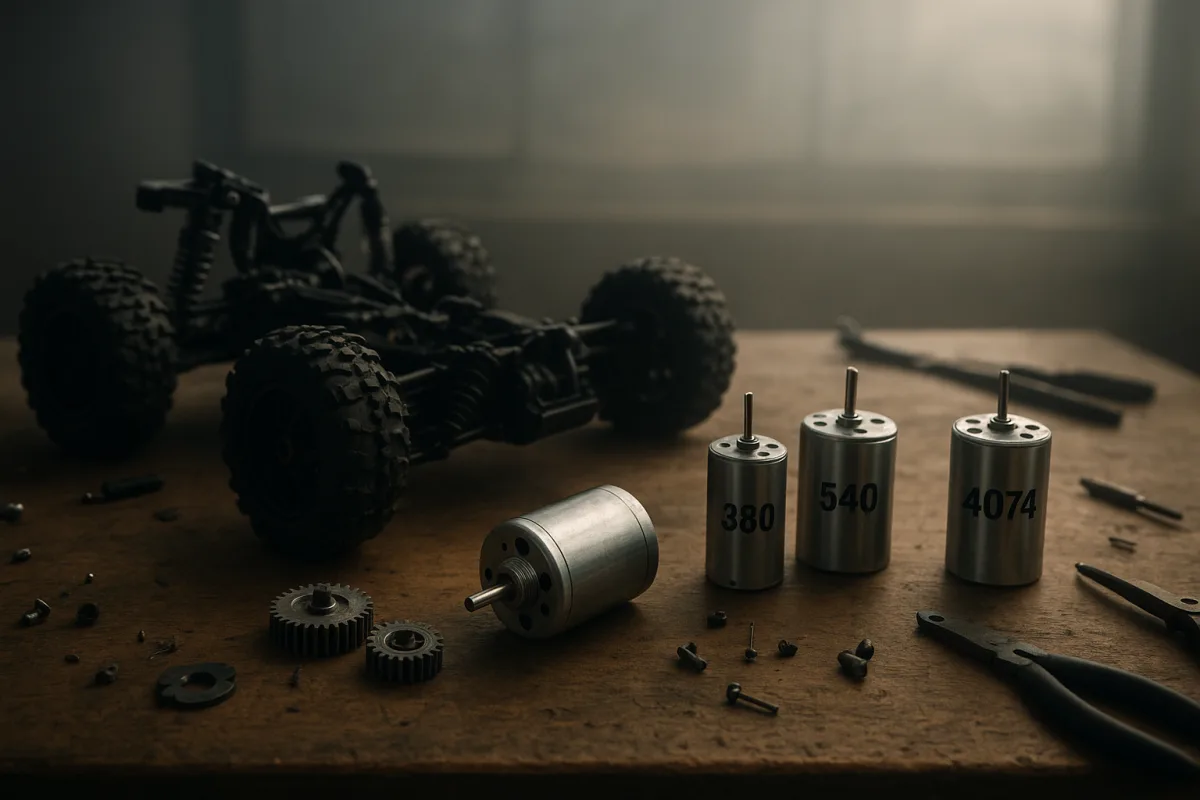
For 1/18 and 1/16 vehicles, a 380-size motor is the usual starting point. A small rally car, mini buggy or micro monster truck does not need a huge can, and forcing one in can create more problems than power. [18]
For most 1/10-scale cars, the normal reference point is a 540-size motor. That covers a large range of cars, from touring cars and drift chassis to 2WD buggies, stadium trucks and many 4WD bashers. [18][19]
For 1/8-scale buggy and truggy platforms, 4074 and 4092 brushless motors are the commonly cited classes. Those are much more appropriate for a heavy 1/8 vehicle on 4S power than a 540 can intended for a 1/10 car. [18][19]
At 1/5 and 1/6 scale, sources point toward 4274-size motors and larger. These vehicles carry much more mass, use large tyres, and need motors built to cope with a much higher sustained load. [18]
That scale guide is not a law, but it is a better starting point than chasing a headline speed number. A 1/10 buggy and a 1/8 truggy may both be “off-road,” yet their motor requirements are nowhere near interchangeable.
The 540 versus 550 complication
The awkward category is the 1/10 basher. Some guidance treats a 540 can as the standard 1/10 motor, while other recommendations favour a longer 550-style motor for heavier 1/10 trucks and bashers. [18][19][21]
The important point is not that one label is automatically better. A longer-can motor can offer more torque capacity and thermal mass, which helps a heavy short-course truck or monster truck pull tall tyres through grass.
But “550” is not a universal promise of fitment. Manufacturer conventions vary, and a longer can may interfere with a chassis brace, battery tray, centre driveshaft, gear cover or motor mount adjustment. [18][21]
Before ordering, check the actual mounting pattern, can length, shaft diameter, connector arrangement and pinion compatibility for your chassis. A motor that theoretically suits the class is still wrong if it cannot sit squarely in the mount.
I have seen plenty of handling complaints blamed on a supposedly weak motor when the real issue is that the car is geared too tall for grass. A bigger can may be sensible, but it is not the first answer to every hot 1/10 truck.
KV is RPM per volt, not a power rating
KV is the number that most often gets misunderstood. RC Setup Lab explains it as motor RPM per volt under no load: a 4000KV motor supplied with 10 volts theoretically spins at 40,000 RPM unloaded. [3]
The actual loaded RPM will be lower because the car has to accelerate its tyres, drivetrain and mass. Dirt, deep grass, a tight drivetrain and aggressive gearing all make the motor work harder than the simple KV calculation suggests. [7]
Battery voltage changes the result immediately. A 3S LiPo has more voltage than a 2S LiPo, so the same motor spins faster on 3S, provided the ESC and motor are rated for it. [14][15]
That is why fitting a 3S pack to a 1/10 car is not merely “more runtime.” It raises motor RPM and available power, often enough to demand a smaller pinion gear and closer temperature monitoring. [14][16]
A LiPo’s C-rating matters too, but it does not replace voltage or motor sizing. C-rating describes the pack’s claimed discharge capability, while voltage and capacity determine the electrical supply available to the system. [14][16]
Do not buy a high-C battery expecting it to cure an overheated motor. If the current demand is excessive because gearing is too tall, the better battery may simply allow the system to keep making heat harder.
Match KV to the kind of driving
For an on-road speed-oriented 1/10 car, 4000 to 6000KV is the typical range cited by the research. This suits light, low-drag vehicles on relatively smooth surfaces where wheel speed matters. [3][7]
That could make sense in a touring car, speed-run chassis or some drift applications, assuming the class rules, ESC, battery and gearing support it. It is not automatically right for a heavy 4WD monster truck.
For off-road bashing, 3000 to 4000KV is the more useful range. It trades some theoretical RPM for more manageable torque and temperature behaviour under the repeated acceleration loads of loose dirt, jumps and rough ground. [3][7]
A 1/10 4WD short-course truck on 3S is a good example of why this matters. A moderate-KV 540 or compatible longer can, geared correctly, is usually more usable than a screaming high-KV setup geared for parking-lot passes.
For crawling, the cited range drops to roughly 1500 to 2200KV. Crawlers need slow, controllable wheel speed and torque delivery, not a motor that reaches maximum RPM before the tyres can find grip. [3][7]
The same crawler guidance sometimes uses turns, such as 13.5T to 17.5T, instead of KV. Turns and KV are inversely related in principle, but they are not cleanly interchangeable across every motor brand and design. [1][7]
More turns generally means lower KV and a calmer motor. However, do not assume every 13.5T motor behaves exactly like another manufacturer’s 13.5T, or that it maps to one exact KV number without checking the motor maker’s specifications.
Gear ratio decides whether the motor survives
Once the motor is selected, the pinion gear is the tuning tool. A larger pinion gives the motor more load and more potential top speed. A smaller pinion reduces load, improves punch and usually lowers operating temperature. [7]
Think of it like final-drive gearing in a full-size car. Tall gearing can make the car fast if the motor has enough torque and cooling, but it can also bog the system and turn electrical power into heat.
Changing from 2S to 3S, fitting larger tyres, moving from hardpack to grass, or installing a higher-KV motor are all reasons to revisit gearing. Those changes raise load even if the motor itself has not changed. [7][14]
Hot weather makes the margin smaller. Cobra Racing’s cooling guidance identifies fans and cooling as important because heat hurts efficiency and can shorten electronic component life, particularly when the car already works hard. [17]
A heatsink and fan are worthwhile support parts, but they are not permission to overgear. If the motor is too hot after a normal run, reduce pinion size first, then assess airflow, drivetrain drag and battery choice. [7][17]
Rough terrain does not automatically require a physically larger motor. The research does not support a universal terrain-based size upgrade rule. It supports adjusting gearing and cooling to manage the additional load. [7][17]
ESC compatibility is part of motor sizing
An ESC has to be rated for the motor type, battery voltage and expected current draw. A brushless motor needs a brushless ESC, and the ESC must support the sensor arrangement if you are using a sensored motor. [1][6]
The practical mistake is fitting a motor based on KV, then assuming the existing ESC is fine. A higher-voltage battery or more aggressive motor setup can exceed what the ESC was designed to handle. [14][15]
Check the ESC’s cell-count rating before moving from 2S to 3S or from 3S to 4S. Also check the motor manufacturer’s recommended voltage range, because a motor that survives 3S may not be intended for 4S. [14][15]
Connectors, wire gauge and battery condition matter as well. A tired LiPo or high-resistance connector can create voltage sag, while an overloaded system can pull enough current to heat wires, plugs, ESC and battery together. [14][16]
Spend money where the mismatch is
The research brief flags price overlap in brushless motor listings, especially where apparent motor prices may actually reflect an included ESC or a combined motor-and-ESC system. That makes bare price comparisons unreliable without checking the listing carefully. [8][9][10]
So I would not tell a newcomer that low-KV means cheap, high-KV means expensive, or that a certain can size has one fixed price. Brushless motor cost depends heavily on whether the listing is motor-only, sensored, bundled, or includes an ESC.
The better buying sequence is simple: identify the scale, confirm physical fitment, choose KV for the driving class, verify LiPo cell count and ESC limits, then start conservatively with gearing. [7][18][19]
If the car is still slow after that, inspect the drivetrain before buying another motor. Binding bearings, tight gear mesh, slipping clutch hardware, over-thick diff fluid or ballooning tyres can waste more performance than an expensive motor can restore.
Frequently Asked Questions
What size motor should I use for my 1/10 scale RC car?
For most 1/10-scale RC cars, a 540-size motor is the standard choice. This size fits a wide range of 1/10 vehicles, including touring cars, drift chassis, 2WD buggies, stadium trucks, and many 4WD bashers. Some heavier 1/10 bashers may use a longer 550-style motor, but 540 is generally the best starting point.
How does motor can size affect RC car performance?
Motor can size relates to the physical dimensions and load capacity of the motor. Larger cans can handle more sustained load and generate more torque, which suits heavier vehicles with bigger tires. Using an incorrect can size can cause fitment issues, overload the motor, or add unnecessary weight, impacting performance and reliability.
What is the difference between 540 and 550 motor sizes?
The 540 and 550 motor sizes are similar, but 550 motors typically have a longer can. This longer can provides greater torque capacity and better thermal mass, which benefits heavier 1/10 trucks and bashers pulling large tires. However, 550 motors may not fit all chassis due to varying manufacturer dimensions and potential interference with other components.
How do I match motor KV rating to my RC car type?
After selecting the motor can size, choose a KV rating based on the vehicle’s purpose. For speed-focused on-road cars, 4000 to 6000 KV is typical. Off-road bashers usually suit 3000 to 4000 KV, while crawlers require lower KV, around 1500 to 2200. Remember, KV indicates motor speed per volt but does not guarantee actual speed, which depends on gearing, battery voltage, and vehicle load.
Can I use a bigger motor can size on a smaller RC car?
Generally, it is not recommended to use a bigger motor can size than what matches your vehicle scale and weight. Larger motors add weight and may not fit properly, causing mechanical interference. It is better to choose the motor size appropriate for your car’s scale to avoid fitment and performance problems.
How we researched this
This article was assembled from 21 cited references.
Nothing here is based on hands-on testing. Where a figure or finding appears, it belongs to the source cited beside it, and the writing says so rather than implying otherwise. Every source is listed below so you can check it.
Sources
- RC Motor Guide: Brushless vs Brushed — Everything You Need to Know | MinutesofThunder
- RC Motors Explained
- What Does KV Mean on an RC Car? | RC Setup Lab
- RC Drift Motor & ESC Guide: Best Combos at Every Budget (2026) | RC Cars Guide
- RC Car Scales Explained (1/10 vs 1/8 vs 1/16) | RC Car Compare
- Brushless RC Cars - RCexplained
- Choosing a Motor and ESC: KV, Turns, Size — and Heat
- RC-N-Go RC Car ESCs & Motors - Shop
- RC Motors—Brushed & Brushless– | PowerHobby
- Shop Brushed & Brushless Electric RC Motors | Hobby Wholesale
- Electric Motors — RC Parts | liquidrc.com
- RC Car Motors – RC Papa
- Mini & Micro Motors
- Can a Bigger Battery Give an RC Car More Power - Battery Skills
- What Volts Mean in RC Car Batteries: A Complete Guide
- Blog - Why Bigger Batteries Don’t Always Help RC Cars
- RC Motor Cooling Explained: Why Fans Matter More Than Power - Cobra Racing
- Size Guide - RCFactoryParts
- How to Choose the Right Motor for Your RC Car Digital RC – DigitalRc.ca
- RC Car Scales Explained — 1:8, 1:10, 1:12, 1:18, 1:24 | RCUK
- RC Model Shop | Brushless Motor Upgrade Guide for RC Cars
Related Articles

RC Car Scale for Racing Tracks: Choosing the Right Size
Learn how to choose the right RC car scale for your racing track size, local classes, and power needs to optimize your racing experience.
Common RC Car Motor Mistakes: KV, Battery & Setup Tips
Learn common RC car motor mistakes including KV misunderstandings, battery matching, and setup tips to avoid overheating and poor performance.
How to Upgrade RC Car Motor
Learn how to upgrade your RC car motor with the right KV, ESC matching, and installation tips for better power and performance.
RC Car Kit Selection Guide for Beginners
Explore our RC car kit selection guide to learn how to choose the right scale and components for your first rc car.