
Best RC Car for Beginners Under 300
Compare the best RC cars for beginners under 300, including ARRMA Gorgon 3S BLX and Traxxas Slash 2WD XL-5, with battery and terrain advice.
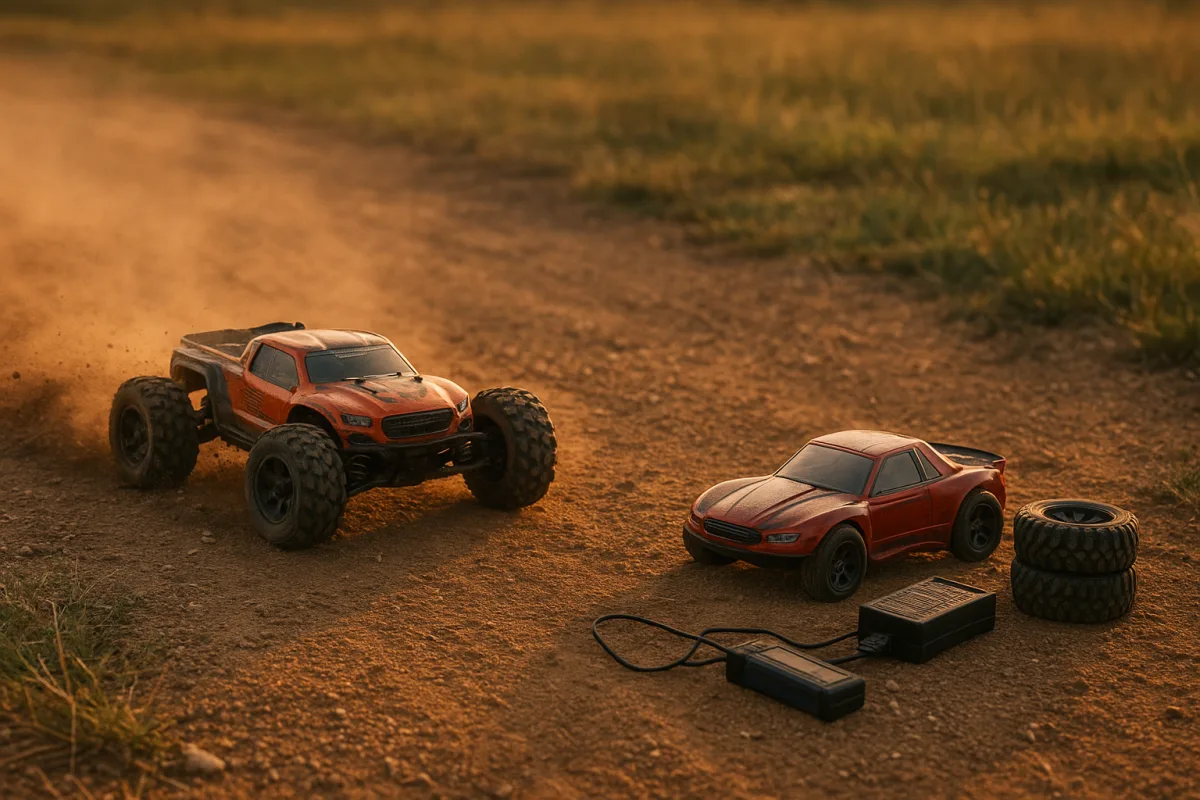
The decision: ARRMA Gorgon 3S BLX versus Traxxas Slash 2WD XL-5
For a first hobby-grade RC car, I would put the ARRMA Gorgon 3S BLX ahead of the Traxxas Slash 2WD XL-5 for the buyer who wants to bash in varied terrain. The Gorgon’s reported four-wheel-drive layout, brushless power and broad-terrain intent make it the more flexible starting point. [1][6]
That is not a universal win. The Traxxas Slash 2WD XL-5 is the more sensible answer for somebody who wants a conventional 1/10 short-course truck, included NiMH power and a less intimidating first battery routine. Its limitation is grip, not quality.
I have not personally run either truck, and this is not a fabricated hands-on review. The decision rests on the supplied specifications, published beginner guidance and the practical stuff racers learn quickly: vehicle type, battery system and parts support matter more than catalogue hype.
Both vehicles sit in a different lane from a rock crawler. Neither is the right pick if your local running spot is mostly roots, rocks and walking-speed trail lines. A monster truck and a short-course truck are built to cover ground, not to delicately place tires.
| Criterion | ARRMA Gorgon 3S BLX | Traxxas Slash 2WD XL-5 with battery |
|---|---|---|
| Place in this field | Entry-level choice | Mid-range choice |
| Vehicle type | 4WD basher/monster-truck style | 1/10 2WD short-course truck |
| Reported performance | Up to 50 mph | Titan 12T 550 brushed motor, speed is not the main selling point |
| Terrain fit | Mixed dirt, open areas and rougher bashing ground | Hardpack, loose dirt, pavement and groomed tracks |
| Drivetrain advantage | Four driven wheels help acceleration and recovery on loose surfaces | Simpler 2WD driving feel, but less forward bite in loose ground |
| Battery approach | Verify the actual package contents and compatible battery before buying | Includes a 3000 mAh 8.4V NiMH iD battery |
| Beginner challenge | Performance can outrun a new driver’s available space and reactions | Rear-wheel-drive traction management and slower charging |
| Support picture | ARRMA warranty details vary by product, with reported repair turnaround of roughly 8 to 10 days | Traxxas publishes a 30-day electronics warranty and offers flat-rate repairs afterward |
| Best for | A newcomer who wants one faster, more adaptable basher | A newcomer who wants an easier battery entry and the 1/10 short-course format |
| Main drawback | Battery, charger and 3S power details need checking before purchase | 2WD gives away traction where grass, deep dust and loose soil are involved |
The ARRMA Gorgon 3S BLX is reported at up to 50 mph, which is more than enough speed to turn a small backyard into a bad test track. Faster is not automatically better for a beginner, especially when the truck reaches the fence before steering corrections catch up. [1][6]
The Traxxas Slash 2WD XL-5 has a Titan 12T 550 brushed motor and a 3000 mAh, 8.4V NiMH iD battery in the stated package. That battery inclusion is meaningful because it removes one compatibility question from the first purchase. [1][6]
A LiPo setup is lighter and punches harder, but it asks more from the owner. Published battery guidance puts typical LiPo run time around 15 to 30 minutes, while NiMH commonly manages roughly 20 to 40 minutes, though driving style, terrain and temperature can reverse expectations. [4][9][20]
NiMH takes longer to charge, often two to four hours, but is comparatively forgiving because it does not need storage-voltage management. LiPo charging is commonly quoted at one to two hours, but requires proper charging practice, storage near 3.8V per cell and careful inspection after impacts. [4][10][11]
That gives the Slash a real beginner advantage. It is not glamorous, but a truck you can charge without learning LiPo storage discipline on day one is a truck more likely to get used correctly. The Gorgon becomes the better pick once that battery responsibility feels normal.
Four-wheel drive also does not erase setup work. If either truck traction-rolls, pushes wide or swaps ends, do not jump straight to aluminum arms, giant tires or a hotter motor. Check wheel nuts, ride height, shocks, steering trim and damaged suspension links first.
Grass is particularly good at making a healthy truck run hot. It adds load, and tall grass can turn a reasonable gear ratio into an overheated motor and ESC session. RC Setup Lab specifically flags grass, tires and gearing as heat factors worth watching. [17]
After a hard run, stop if motor, ESC or battery temperatures approach 140°F, or 60°C. Heat, not a lack of expensive alloy parts, is what quietly shortens electronic life. Loose dirt and sand also work into gears, while water and humidity promote rust. [14][15][16]
The Gorgon’s broader off-road intent makes it the better candidate for uneven ground, but not for tall wet grass all afternoon. The Slash’s lower short-course stance should feel more natural on packed dirt and pavement, where its two-wheel-drive layout does not have to fight deep loose terrain.
On support, Traxxas has the clearer published picture. RC Cars Guide reports daily support hours, a 30-day electronics warranty and flat-rate repair options afterward, while ARRMA’s exact warranty treatment varies by product and reported repair turnaround can be slower. [7]
That does not prove every Traxxas interaction will be better, or that every ARRMA repair will take the same time. It does mean a buyer who values predictable support information has a practical reason to consider the Slash despite the Gorgon’s broader performance envelope.
Where the rest of the field sits
The Redcat Volcano EPX Pro is the budget-conscious alternative for a buyer specifically wanting a brushless 4WD monster truck. It is reported as the cheapest brushless 4WD monster truck that works properly and reaches 35 mph, so it sits below the mid-range group but behind the Gorgon on outright reported speed. [1][4]
The MJX Hyper Go 10208 is a mid-range 1/10 monster truck for the enthusiast who prioritises high-speed off-road running. Its claimed 80 km/h figure makes it a space-hungry choice, not my first recommendation for a confined beginner running area. [1][6]
The Redcat Everest Gen7 Sport is also mid-range, but it is not competing with bashers at all. Its ladder-frame chassis, solid axles and four-link suspension suit a beginner who wants deliberate 1/10 rock crawling rather than jumps, speed runs or dirt-track laps. [3][6]
The Traxxas TRX-4M Bronco is another mid-range crawler, this time in 1/18 scale. It suits small obstacles, indoor courses and people who value a recognizable scale body with a clear parts ecosystem, but available information leaves several detailed specifications unclear. [2][3][18]
The Losi Mini-T 2.0 2S 2WD Brushless occupies the mid-range small-truck slot. It suits someone who wants a compact brushless stadium truck with a Spektrum Smart G2 2S LiPo and USB-C charger included, rather than assembling a battery system separately. [1][6]
The ARRMA Typhon Grom DSC 223S bundle is the mid-range choice for a driver who wants a 1/14 brushless buggy format and included battery equipment. It is reported around 35 mph on 2S and above 50 mph on 3S, which makes room and restraint mandatory. [1][6]
The WIAORCHI 1/14 Brushless RC Truggy is among the premium options in this field. It suits an enthusiast wanting a high-speed 4WD truggy, spare parts and two included 3S LiPos, with a claimed combined 44 minutes of runtime, although conditions will affect that figure. [19]
The ARRMA 1/16 Mini Kraton is another premium choice, aimed at the buyer prioritising durability and Dynamic Stability Control in a compact 4WD package. It makes more sense for someone already certain they want the smaller scale and its faster reactions. [1][6]
The UDIRC 1/10 Off-Road Racing RC Truck is the premium-field option for a beginner who wants brushless 4WD bashing on open terrain and dirt tracks. It is positioned for high-speed running, which makes it a poorer match for small gardens than its 1/10 body suggests. [1][6]
Those alternatives are not lesser because they lose this particular head-to-head. They are different tools. A 1/18 crawler, a 1/14 buggy and a 1/10 monster truck need different terrain, different driving expectations and different amounts of available space.
Budget for running, not just buying
The common beginner mistake is treating the vehicle as the entire cost. Tires, suspension arms, gears and body shells all wear or break, and published cost guides recommend allowing an annual consumables budget rather than assuming a hobby-grade truck will be maintenance-free. [12][13]
Avoid the upgrade spiral early on. Brushless systems, ESCs, aluminum components, LiPo packs and metal-gear servos can each add substantial cost, but they do not cure a bent turnbuckle, poor tires, incorrect steering trim or a battery that is not compatible. [12][13]
Battery size needs restraint as well. More capacity adds weight, and that can reduce agility and increase heat, especially over rough terrain. Buy a pack that fits the tray, connector and voltage requirement, not the biggest pack printed on the shop shelf. [8]
After each run, brush off dirt without oiling everything, inspect the driveline and suspension, and dry metal hardware after wet running. LiPos should not be stored fully charged, and neither battery type should be put away damaged, swollen or unusually hot. [14][16]
Who each option suits
The ARRMA Gorgon 3S BLX suits the beginner with a large open running area, mixed dirt and rougher ground, and an interest in learning LiPo care. It is the better all-round basher choice here, provided the buyer confirms exactly what battery and charger are included.
The Traxxas Slash 2WD XL-5 with battery suits the beginner who wants a full-size 1/10 truck, a simpler NiMH starting point and clearer published support arrangements. It falls down in deep loose terrain and tall grass, where two-wheel drive gives away the traction advantage.
If the intended surface is rocky trails, choose neither and look toward the Redcat Everest Gen7 Sport or Traxxas TRX-4M Bronco according to preferred scale. If the intended surface is a compact dirt track, the Slash’s short-course layout may be the more satisfying decision.
Frequently Asked Questions
Which is the best RC car for beginners under $300?
The ARRMA Gorgon 3S BLX is a strong choice for beginners who want a versatile basher capable of handling mixed dirt, short grass, and open ground. Alternatively, the Traxxas Slash 2WD XL-5 with battery suits those preferring a conventional 1/10 short-course truck and an easier battery charging routine. Both have different strengths, so the best depends on terrain and user priorities.
What are the pros and cons of ARRMA Gorgon 3S BLX vs Traxxas Slash 2WD XL-5?
The ARRMA Gorgon 3S BLX offers four-wheel drive, brushless power, and adaptability to rougher terrain but requires careful checking of battery and charger compatibility. The Traxxas Slash 2WD XL-5 includes a NiMH battery for simpler charging and has strong parts support but lacks traction on loose surfaces due to its two-wheel-drive layout. The Gorgon is faster and more versatile, while the Slash is easier for beginners to manage initially.
Should beginners choose 2WD or 4WD RC cars under $300?
Four-wheel drive, like in the ARRMA Gorgon 3S BLX, provides better acceleration and recovery on loose or rough terrain, making it more adaptable for mixed surfaces. Two-wheel drive, as in the Traxxas Slash 2WD XL-5, offers a simpler driving experience and easier battery management but sacrifices traction on grass, deep dust, or loose soil. Beginners should consider their typical terrain and comfort with battery care when choosing.
What battery types are best for beginner RC cars under $300?
NiMH batteries, like the 3000 mAh 8.4V included with the Traxxas Slash, are more forgiving, require no special storage, and have longer run times (20–40 minutes) but take longer to charge (2–4 hours). LiPo batteries are lighter and provide more power with shorter charging times (1–2 hours) but need careful handling, proper storage, and have shorter run times (15–30 minutes). Beginners benefit from NiMH batteries for ease of use, while LiPo suits those ready for more battery responsibility.
How does terrain affect the choice of beginner RC cars under $300?
Terrain greatly influences RC car performance and suitability. Four-wheel-drive cars like the ARRMA Gorgon 3S BLX handle mixed dirt, open areas, and rougher bashing ground better, while two-wheel-drive models like the Traxxas Slash 2WD XL-5 perform best on hardpack, loose dirt, pavement, and groomed tracks. Neither type is ideal for rocky, root-filled trails or crawling; matching vehicle type to local terrain improves enjoyment and durability.
How we researched this
This article was assembled from 20 cited references.
Nothing here is based on hands-on testing. Where a figure or finding appears, it belongs to the source cited beside it, and the writing says so rather than implying otherwise. Every source is listed below so you can check it.
Sources
- Best RC Cars for Beginners (2026) — Top Picks Compared | RC Car Compare
- Traxxas TRX4M Review First Look - Crawler RC Cars bei Modellbau Lindinger
- Best Beginner RC Rock Crawlers Under $300 (2026) – Friendly Hobbies
- Best Beginner RC Car 2026: 4WD, Brushless & Budget Picks Tested – FUNYAT
- MJX HYPER GO H16H V3 Upgraded 1/16 RC Car GPS Module | Dronesset
- Best RC Cars for Beginners in 2026 — RC Torquehouse
- Traxxas vs Arrma: Which RC Brand Fits Your Driving? | RC Cars Guide
- Blog - Why Bigger Batteries Don’t Always Help Monster Trucks and Bashers
- RC Car Batteries Explained — Li-ion, NiMH, AA, mAh and Run Time
- Batteries and chargers, explained – RC Hobby Shop
- LiPo vs. NiMH RC Batteries: What's the Difference? | RC Saver
- Is RC Car Hobby Expensive? A Realistic Cost Breakdown (From Someone Who’s Actually Spent the Money) - TRVBABY
- 12 Best Hobby Grade RC Cars for Beginners (October 2026) Reviews
- Why Does My RC Car Battery Die Fast? Causes, Fixes, and Battery-Saving Tips -
- Brushless RC Cars - RCexplained
- How Long Do Electric RC Cars Last? Lifespan & Tips | VRX Racing
- How Grass, Tyres and Gearing Affect RC Car Heat | RC Setup Lab
- Traxxas TRX-4M Bronco
- WIAORCHI 1/14 Brushless RC Truggy
- LiPo vs NiMH RC Car Battery: Which Is Best? | Cleveland Models
Related Articles
Beginner RC Car Comparison Under 200: Crawler vs Off-Road
Compare beginner RC cars under 200 to find the best crawler or 4WD off-road model with setup and tuning tips for new drivers.
Best RC Car for Beginners Under 100: Top Entry-Level Picks
Discover the best RC car for beginners under 100 with detailed comparisons, battery tips, and beginner-friendly features to help you choose right.
Best RC Car for Beginners Under 150: HAIBOXING vs Everest-10
Compare the best RC car for beginners under 150, featuring HAIBOXING 18859 and Redcat Everest-10 for versatile and crawler driving styles.
How to Set Up RC Car for Beginners: Complete Starter Guide
Learn how to set up your RC car for beginners with tips on battery, tires, suspension, and motor for a smooth first drive.