
Best RC Car for Beginners Under 100: Top Entry-Level Picks
Discover the best RC car for beginners under 100 with detailed comparisons, battery tips, and beginner-friendly features to help you choose right.
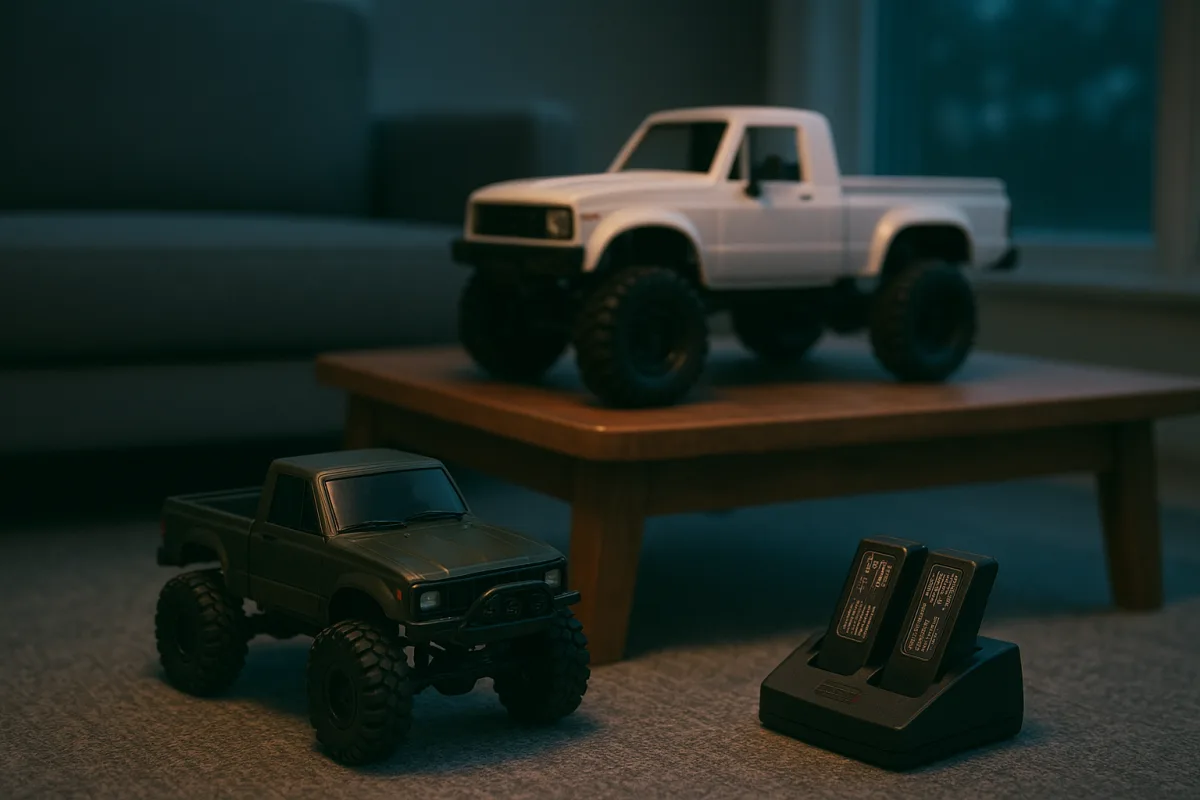
The decision: Altair for the typical beginner, DEERC for the speed-minded beginner
I would put a first-time buyer in the Altair 1:16 Scale All Terrain 4WD RC Truck camp. It is the more sensible recommendation for shared family use, younger drivers, smaller running spaces and anyone learning how much trigger control matters.
The DEERC 9206E DIY Extra Shell 1:10 Scale Large RC Car is the alternative for someone who wants a bigger 1:10-scale truck, more claimed pace and the option of changing its look with the supplied extra shell. That is a valid brief, but it is not the same as “best first RC car.”
Neither recommendation comes from personal track time or hands-on testing. This is a decision based on the supplied specifications and wider budget-RC reporting, which consistently shows that low-cost electric RTR cars trade premium materials, range and long-term parts support for an accessible starting point. [10][11]
The important distinction is class and intended use. A 1:16 all-terrain truck is not a mini 1:10 basher, and a 1:10 budget monster truck is not automatically a better buy because it looks more substantial. The place you drive matters more than the number printed on the box.
Head-to-head comparison
| Criteria | Altair 1:16 Scale All Terrain 4WD RC Truck | DEERC 9206E DIY Extra Shell 1:10 Scale Large RC Car |
|---|---|---|
| Position in the field | Entry-level option | Entry-level option |
| Scale and format | 1:16-scale 4WD all-terrain truck | 1:10-scale large off-road RC car |
| Driveability for a first timer | Stronger choice, because it has two speed settings | Less clearly beginner-focused, because its appeal is claimed high speed |
| Drivetrain | 4WD | Reported as 4WD |
| Claimed performance | Extended play through two included batteries, with no quoted top speed in the brief | More than 48 km/h claimed, plus two batteries and more than 40 minutes of claimed playtime |
| Battery approach | Two batteries are useful for swapping rather than ending the session after one pack | Two batteries also extend a session, but do not guarantee the advertised combined runtime |
| Size and running area | Better suited to driveways, short grass and modest outdoor spaces | Better suited to a larger open area where speed can be used safely |
| Customisation | Simple, practical beginner format | Includes an extra shell, so it suits a buyer who values appearance changes |
| Main weakness | Smaller scale means it will not have the presence or claimed outright pace of the DEERC | Real-world reports flag overheating after roughly 20 minutes, so sustained hard running may fall short of the headline [4] |
| Best fit | New drivers, families and all-ages casual use | A careful beginner who prioritises speed, size and a customisable look |
The Altair wins the beginner decision because its two-speed arrangement gives the driver a sensible learning progression. Start in the lower setting, learn smooth turns and braking distance, then unlock more pace once the truck is no longer constantly clipping kerbs.
That sounds basic, but it is the setup adjustment most new drivers actually need. On a small 1:16 truck, limiting throttle is more valuable than chasing a hotter motor, taller gearing or a claimed top-speed number that needs a long, smooth surface to mean anything.
The DEERC’s larger 1:10 format has a real attraction. A larger truck generally looks more planted outdoors, is easier to see at distance and can be more comfortable over uneven ground than a smaller 1:16 platform, provided the surface is not excessively rough.
However, speed changes the crash energy quickly. A reported 48-plus km/h is far beyond what a first-time driver needs in a garden or cul-de-sac. If the transmitter lacks a useful throttle-limit function, the beginner has to supply that restraint with their trigger finger.
Battery claims need a little skepticism
Both head-to-head choices include two batteries, and that is a proper advantage at this end of the market. Rather than waiting for one pack to charge, a driver can inspect the car, let the motor cool, swap packs and get another run.
Budget electric RC cars commonly use 7.4V lithium packs, whether lithium-ion or LiPo, often in roughly the 1200mAh to 2000mAh range. Published guidance places typical run times between 10 and 30 minutes and charge times between 30 and 90 minutes. [7][13]
That makes the DEERC’s claim of more than 40 minutes with two batteries plausible as a combined best-case figure, but it should not be read as 40 minutes of flat-out grass running. Reports across this category suggest advertised 20 to 30 minute sessions often become 15 to 20 minutes in actual use. [2]
For the DEERC specifically, reported overheating after about 20 minutes is worth taking seriously. [4] Heat is not just an inconvenience. It can shorten brushed-motor life, soften performance and turn a fun second battery into a cool-down break.
A beginner should not run either truck until it slows to a crawl. Stop when the car loses punch, let the motor and battery cool before charging, and check that the wheels still spin freely. A binding wheel, grass around an axle or a too-tight drivetrain makes a cheap motor work harder.
Terrain, durability and the expensive-upgrade trap
The Altair is the safer choice for mixed family terrain because it is explicitly positioned as an all-terrain 4WD truck with straightforward controls. Four-wheel drive helps the vehicle pull through loose dirt, short grass and uneven pavement, but it does not make it waterproof or indestructible.
The DEERC is also presented as a 4WD off-road truck, so neither vehicle is a pavement-only toy. Still, running surface matters. Long wet grass, deep gravel and standing water add load and heat, especially on entry-level electric systems with plastic drivetrain parts.
Do not assume waterproof electronics just because a car is advertised for outdoor use. Waterproofing is model-specific in this class, and warranty coverage commonly excludes misuse, water damage and normal wear even when defects themselves are covered. Keep the receipt and read the actual policy before driving through puddles. [16]
This is where the Traxxas Slash 2WD RTR sits differently in the supplied field. It is a mid-range, more expensive option, aimed at the buyer who values waterproof electronics, a Titan 12-turn motor and a broad aftermarket. Its reported 30 mph capability is meaningful, but its 2WD layout will behave differently from a 4WD truck on loose ground. [19]
The common beginner response after a crash is to buy aluminium suspension arms, a faster motor or oversized tyres. Usually, that is money pointed at the wrong problem. Check wheel nuts, steering trim, shock leaks and throttle habits first, because setup and driving line solve more than shiny parts.
Where the rest of the field sits
The supplied field includes more than the two finalists, and each has a distinct role. These are not equal substitutes, particularly because scale, motor type and intended terrain vary so much.
| Model | Relative cost position | What it suits |
|---|---|---|
| DEERC 9206E DIY Extra Shell 1:10 Scale Large RC Car | Entry-level, cheaper than the mid-range group | Beginners wanting claimed high speed and an extra body shell |
| Traxxas Slash 2WD RTR | Mid-range, a step up from entry-level choices | Buyers prioritising durability, waterproof electronics and aftermarket support |
| ARRMA Voltage Granite | Mid-range, a step up from entry level | Beginners wanting a 1:10 4WD truck for rougher terrain and a claimed 25 mph ceiling |
| Redcat Racing Tornado EPX | Mid-range, a step up from entry level | Drivers wanting a 1:10 4WD vehicle for technical, slower driving and oil-filled shocks |
| Hosim 9155 Brushless | Mid-range, a step up from entry level | Speed-focused buyers who specifically want a 1:12 brushless platform with a claimed 36 mph |
| Altair 1:16 Scale All Terrain 4WD RC Truck | Entry-level | All-ages drivers wanting simple controls, 4WD and two speed settings |
| WL Toys 12428 | Entry-level | Older children wanting a 1:12 crawler-style vehicle with genuine suspension travel |
| MJX Hyper Go 14210 | Mid-range, among the more performance-oriented choices | Enthusiasts seeking a 1:14 brushless vehicle with an approximately 45 mph claim |
| BEZGAR HM161 | Entry-level | Beginners wanting a compact 1:16 high-speed car with a claimed 36 km/h |
| HAIBOXING 1/18 Scale All Terrain RC Car | Entry-level | Buyers wanting a small 1:18 4WD all-terrain car with a durable-build focus |
| Perseids 1/16 RC Crawler | Entry-level | Beginners who want a 1:16 crawler format rather than speed-run performance |
The ARRMA Voltage Granite is the relevant alternative for a buyer who has already decided that 1:10 4WD and rough-terrain ability matter more than the lowest entry cost. The brief lists its composite chassis and 25 mph top speed, a more manageable target than the speed claims attached to some rivals.
The Redcat Racing Tornado EPX belongs with drivers who prefer technical driving over full-throttle blasting. Its oil-filled shocks and reported 2000mAh battery, with about 20 minutes of runtime, point toward a more conventional hobby-style feature set, though a 1:10 car still needs space. [2]
For crawling, the WL Toys 12428 and Perseids 1/16 RC Crawler should not be judged against the DEERC or MJX Hyper Go 14210 by top speed. The WL Toys is a 1:12 plastic-bodied crawler with reported 15 to 20 minute battery life, while the Perseids is the smaller 1:16 crawler option. [2][5]
The Hosim 9155 Brushless and MJX Hyper Go 14210 are for buyers who have already decided speed is the point. Brushless power below this budget is possible, contrary to the idea that every cheap RC car is brushed, but it raises the importance of space, cooling and careful throttle use. [8][9]
The BEZGAR HM161, HAIBOXING 1/18 Scale All Terrain RC Car and Altair occupy the compact beginner end. The BEZGAR suits the buyer attracted to a 36 km/h claim, while the HAIBOXING suits someone wanting the smallest listed 4WD all-terrain format. [1]
Who each option suits
Choose the Altair 1:16 Scale All Terrain 4WD RC Truck if
Choose the Altair for a first RC car that will be driven in ordinary spaces by a new driver, a child with supervision or a family sharing the transmitter. Its two speed settings matter more than a headline speed figure during the first dozen battery packs.
It is also the better match if you want two batteries without making every run a maximum-speed run. Use the lower mode on pavement first, then move to short grass once steering and braking become predictable.
Choose the DEERC 9206E DIY Extra Shell 1:10 Scale Large RC Car if
Choose the DEERC if the buyer specifically wants a larger 1:10 vehicle, likes the extra shell and has enough clear space to use a faster truck responsibly. It is the more exciting-looking option on paper, not automatically the more beginner-friendly one.
Treat its speed and combined battery-runtime claims as targets rather than guarantees. Keep runs short on hot days, avoid long grass, and let the electronics cool between packs, particularly given reports of overheating during extended use. [4]
Frequently Asked Questions
What is the best RC car for beginners under $100?
The Altair 1:16 Scale All Terrain 4WD RC Truck is recommended as the best beginner RC car under $100. It offers two speed settings and two batteries, making it easier to learn throttle control and suitable for shared family use and smaller spaces. The DEERC 9206E 1:10 Scale is an alternative for those wanting a larger, faster truck but is less beginner-friendly.
Which RC car is easier to drive for a beginner under $100?
The Altair 1:16 Scale truck is easier for beginners because it has two speed settings, allowing new drivers to start slow and gradually increase speed as they gain control. Its smaller size and manageable power make it better suited for learning in modest outdoor spaces compared to the faster, larger DEERC 1:10 scale car.
How do battery life and speed compare in beginner RC cars under $100?
Both the Altair and DEERC models come with two batteries to extend playtime. Typical run times for these budget RC cars range from 10 to 30 minutes per charge, though real-world use often yields 15 to 20 minutes. The DEERC claims over 40 minutes combined runtime and speeds above 48 km/h but may overheat after about 20 minutes, while the Altair prioritizes manageable speed over outright pace.
Is a 1:16 scale or 1:10 scale RC car better for beginners under $100?
A 1:16 scale RC car like the Altair is generally better for beginners due to its smaller size, two-speed settings, and suitability for smaller spaces. The 1:10 scale DEERC offers a larger size and higher speed but requires more careful handling and is better for larger open areas, making it less ideal for typical beginners.
What should beginners consider when choosing an RC car under $100?
Beginners should consider the car’s speed settings, size, and suitability for their available driving space. Managing throttle control and battery care is crucial, as most breakages come from full-throttle impacts. Dual batteries are helpful for longer sessions, but overheating and realistic run times should be expected rather than relying solely on advertised specs.
How we researched this
This article was assembled from 23 cited references.
Nothing here is based on hands-on testing. Where a figure or finding appears, it belongs to the source cited beside it, and the writing says so rather than implying otherwise. Every source is listed below so you can check it.
Sources
- HAIBOXING 1:18 Scale RC Car 18859, 36 KPH High Speed 4WD BLUE - (Never Used) | eBay
- 10 Best RC Cars Under $100 (August 2026) Rated for Fun & Quality
- 1:10 Scale High Speed RC Cars, 50+ KM/H Hobby Grade 4WD Off Road Monst
- 10 Best RTR RC Cars for Beginners Under $200 (August 2026) Honest Reviews
- 8 Best RC Crawlers for Beginners (August 2026) Complete Guide
- Best RC Car Under $100 2026 — Top Budget Picks for Beginners & Kids | FUNYAT
- 7 Best RC Cars Under $100 in 2025 - shelf
- WLtoys 144010 1:14 RC Car 75KM/H High Speed Brushless Drift Racing Car – rc-wing
- Best RC Cars Under $100: Top Picks for Every Category (2026) | RC Cars Guide
- 7 Best Radio Controlled Cars Under $100 | Best RC Cars Under $100
- Best RC Cars Under $100: The Ultimate Review - RC Ratings
- 9 Best RC Cars Under $100 (2025 Guide)
- Best low-cost RC cars in 2026 | Affordable RC car guide
- RCG Racing Micro DC 1/43 Drift Car - Rally
- Rc Cars - Macy's
- Warranty Policy - RC Cars
- Beginner Guide To RC Cars: What To Buy First
- Best RC Cars for Beginners: What to Buy First
- Traxxas Slash 2WD RTR
- HGRC HG4-209 Toyota 4Runner 1/18 Scale Licensed Full Proportional Allo – Makerfire
- Best RC Cars under 100 | AT Models
- Best RC Car for Beginners UK 2026 — Tested Picks | RCUK
- RC Model Shop | Best RC Car for Beginners: What to Buy
Related Articles
Best RC Car for Beginners Under 150: HAIBOXING vs Everest-10
Compare the best RC car for beginners under 150, featuring HAIBOXING 18859 and Redcat Everest-10 for versatile and crawler driving styles.
Beginner RC Car Comparison Under 200: Crawler vs Off-Road
Compare beginner RC cars under 200 to find the best crawler or 4WD off-road model with setup and tuning tips for new drivers.
Best RC Car Type for Beginners: Choosing the Right Model
Discover the best RC car type for beginners, including scale, chassis, motor, and battery choices to fit your terrain and skill level.
RC Car Kit Selection Guide for Beginners
Explore our RC car kit selection guide to learn how to choose the right scale and components for your first rc car.