
RC Car Battery Types Explained: LiPo vs NiMH and More
Learn about RC car battery types, including LiPo and NiMH, voltage, capacity, and C-ratings to choose the right battery for your RC car.
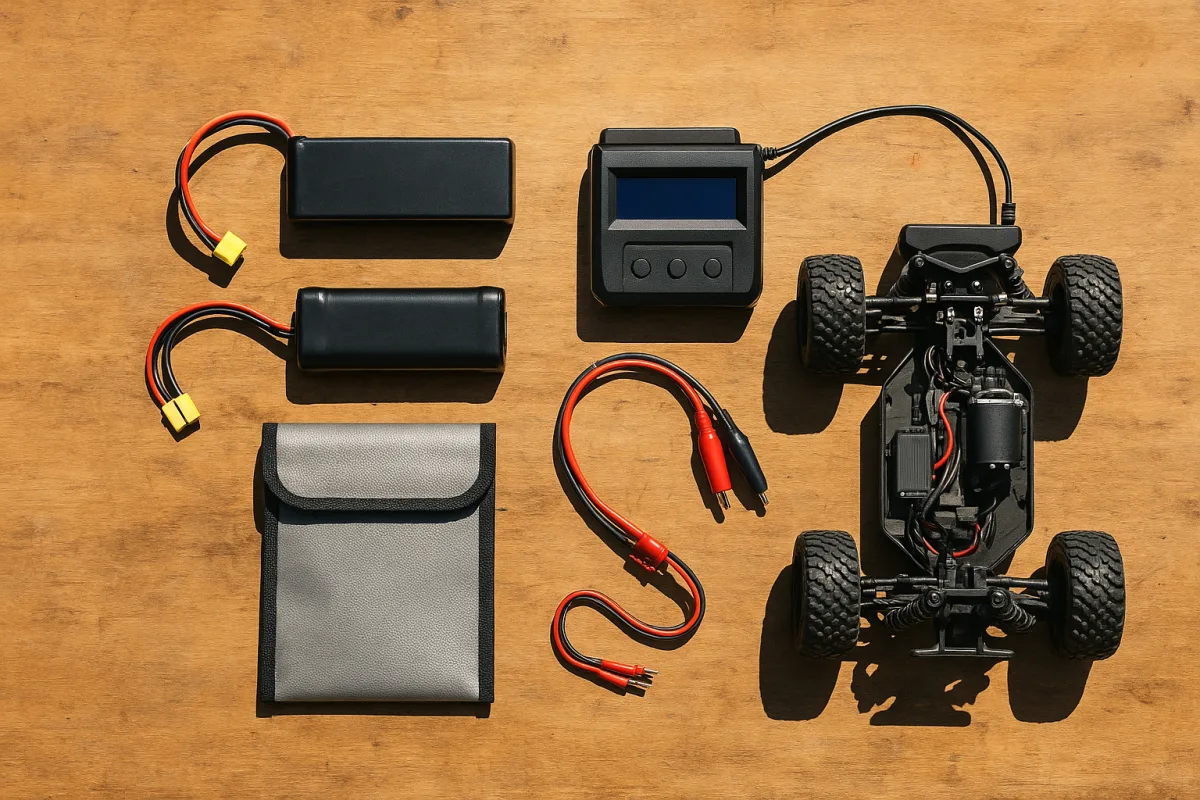
The battery number that matters on track: voltage under load
Most battery explanations start with chemistry, then list LiPo, NiMH and perhaps LiFePO₄ as if all three are normal choices for an RC car. That makes the decision look broader than it is.
For RC cars in 2026, the real choice is usually LiPo versus NiMH. LiFePO₄ is established in applications including electric vehicles and battery-electric karts, but there is no evidence that it is a mainstream RC car battery format. [1]
The useful concept is not simply “which battery lasts longest?” It is how well a pack maintains voltage when the motor asks for current. That is what you feel as launch punch, mid-corner throttle response and top speed.
A brushed 1/10 stadium truck on a casual driveway run can tolerate a battery that softens over time. A brushless 1/10 buggy with a grippy track and a hard gear ratio notices voltage sag immediately.
That distinction is why two packs with apparently similar voltage labels can make the same car feel completely different. One keeps supplying current cleanly, while the other loses voltage as the motor load rises.
Nominal voltage: why 2S does not equal “just 7.4 volts”
Lithium-polymer cells have a nominal voltage of 3.7V each. Put two cells in series and you get a 2S pack rated at 7.4V nominal, while 3S is 11.1V and 4S is 14.8V. [2][6]
Series wiring raises voltage, not capacity. A 2S 5,000mAh pack is still 5,000mAh, but it has two cells working together to provide the higher 7.4V nominal output.
NiMH cells are nominally 1.2V each. A typical six-cell stick pack is therefore 7.2V, while a seven-cell pack is 8.4V. [2][3]
That is why a 2S LiPo often replaces a six-cell NiMH in a 1/10 electric car. The nominal voltage numbers are close enough that manufacturers commonly design entry-level electronics around both options.
But “close” does not mean identical on the track. A LiPo holds its working voltage more consistently through the run, while NiMH voltage declines progressively as the pack discharges. [3][22]
The result is straightforward. A NiMH-powered car can feel lively when freshly charged, then progressively less eager as the run goes on. A healthy LiPo usually preserves more of its acceleration and speed until it is near its safe discharge limit. [3]
That steadier output is the main reason performance-oriented RC racers moved toward LiPo. It is not magic chemistry or an automatic lap-time upgrade, but it gives the motor and ESC a more stable electrical supply.
Capacity is fuel tank size, not motor strength
Capacity is measured in milliamp-hours, written mAh. It tells you how much charge the pack stores, not how much current it can necessarily provide at a given instant. [5][7]
A 5,000mAh pack has a rated capacity of 5Ah. In simplified terms, it could provide 5A for one hour, 10A for half an hour, or 20A for roughly 15 minutes.
RC motors do not draw one fixed current, of course. Current rises when you accelerate, land from a jump, run tall gearing, drive in thick grass or bind the drivetrain with an over-tight mesh.
That means runtime varies with the car and setup. A free-rolling 1/10 touring car on a smooth surface asks less of a pack than a 1/10 4WD buggy repeatedly launching from low speed.
For 1/10 scale cars, LiPo capacities commonly sit between 3,000mAh and 5,000mAh. Smaller 1/16 and 1/18 cars more often use packs around 1,500mAh to 2,200mAh. [3][5]
NiMH packs used in 1/10 applications commonly fall around 1,200mAh to 3,000mAh, with 1,200mAh also common in smaller 1/12 off-road trucks. [3][22]
More capacity generally means more runtime, but also more mass and sometimes a larger physical pack. Before buying the biggest number on the label, confirm the battery tray dimensions, connector type and vehicle voltage rating.
A heavier pack can alter handling as well. On a 1/10 buggy, adding weight high or rearward can make the car less settled over jumps and less willing to rotate. Battery choice is part of setup, not merely runtime planning.
C-rating: the current-demand number behind the label
The second number on a LiPo label is usually the C-rating. This is the manufacturer’s stated discharge multiplier, used to estimate how much continuous current the pack can provide. [5][6]
The calculation is simple:
capacity in amp-hours × C-rating = stated continuous current capability
Take a 2S 5,000mAh 50C pack. Convert 5,000mAh to 5Ah, then multiply 5 by 50. The result is 250A of stated continuous discharge capability. [3][6]
That does not mean every 1/10 car actually pulls 250A continuously. It means the pack is specified to supply high current without the same degree of voltage collapse expected from a lower-output battery.
This is where capacity and C-rating stop being interchangeable. A 5,000mAh 25C LiPo is rated at 125A, while a 5,000mAh 50C pack is rated at 250A. [6]
The two packs carry the same nominal amount of energy. The higher-C pack is intended to supply that energy faster, which matters most during heavy throttle applications rather than gentle cruising.
NiMH packs are not usually marketed with similarly clear or comparable C-ratings. Available guidance consistently places their discharge capability below LiPo for high-performance RC demands. [3][22]
That is why a LiPo-equipped car often feels more immediate even when its nominal voltage is similar to a NiMH setup. The LiPo is lighter and better able to support the motor’s current demand. [3]
Still, do not treat the highest C number as an automatic cure for a slow car. Bad gearing, a dragging bearing, overheated motor, slipping clutch or too-thick differential fluid can all make a car feel lazy.
Most handling and speed complaints are setup or maintenance problems before they are battery problems. A fresh expensive pack cannot fix a motor that is geared beyond what its cooling and load can support.
Weight is part of the performance difference
A typical 2S 5,000mAh LiPo weighs about 250g. A roughly equivalent NiMH battery can weigh 400g or more. [3]
That 150g-plus gap matters more than beginners often expect. In a 1/10 car, it changes acceleration, braking load, suspension response and how quickly the chassis transfers weight from side to side.
The lighter LiPo gives a car less mass to accelerate and stop. It can also reduce the burden on springs, shock oil and damping when the car lands or changes direction.
This does not mean every light battery produces better handling in every class. The battery’s location matters, and a car built around a stick-pack NiMH may not balance identically with a shorty LiPo conversion.
But it explains why LiPo became the standard performance route. Its advantage is a system advantage: stable voltage, stronger current delivery and lower mass work together. [3][22]
Charging is where the two chemistries separate sharply
LiPo packs need a compatible balance charger. A balance charger monitors individual cell voltages, which matters because a 2S, 3S or 4S pack contains multiple series-connected cells that must remain properly matched. [2][10]
The standard conservative charge rate is 1C. For a 2,200mAh LiPo, that means 2.2A, with a charge time of roughly one hour from empty in ideal conditions. [9][10]
A 5,000mAh pack charged at 1C would be set to 5.0A. The arithmetic is easy, but the charger must also be set for the correct chemistry and series-cell count.
NiMH charging is simpler. These packs use chargers with automatic shutoff, and a 3,000mAh NiMH charged at 1A can take around three hours. [2][3]
That slower, more forgiving routine is a real advantage for a newcomer with a ready-to-run car. NiMH is not obsolete, it is simply a poorer fit for drivers who need sustained high-current performance.
For LiPo, charge on a non-flammable surface or in an appropriate LiPo safety bag, use a LiPo-compatible charger and never leave charging unattended. Those are baseline habits, not optional racer superstition. [10][15][17]
Storage determines whether the pack stays healthy
A LiPo should not be put away fully charged after a run. Recommended storage is about 3.8V per cell, roughly 50 percent charge, in a cool, dry place around 20 to 25°C and preferably in a fire-resistant container. [15][16]
That means a 2S LiPo is stored at approximately 7.6V total. Many balance chargers include a storage-charge mode, which is one of the most useful functions on the charger.
NiMH is more tolerant. It can be stored charged, although it self-discharges and needs periodic recharging before use. [2][22]
Neither chemistry likes environmental abuse. Below 0°C, NiMH capacity can fall by up to 30 percent, while lithium-ion batteries, including LiPo, also lose voltage and capacity in the cold. [18][19]
Heat is worse over the long term. Temperatures above about 35°C for NiMH and 45°C for lithium-ion batteries accelerate degradation significantly. [19][20]
High humidity also matters because it can promote terminal corrosion and internal damage, raising resistance. A battery left in a damp garage can become a poor performer even if its casing looks fine. [20][21]
Cost and realistic service life
In the 2026 US market, NiMH packs are listed around $20 to $50, while LiPo packs range more widely from roughly $30 to $180 depending on voltage, capacity and intended performance level. [5][8]
Those prices are for the pack, not the entire changeover. Moving from NiMH to LiPo may also require a balance charger, an adapter or different connector, plus safe storage equipment. [2][10]
LiPo packs commonly last around 150 to 300 cycles, with careful use sometimes extending that toward 500 cycles. Published guidance places practical lifespan around one to four years. [11][12][14]
NiMH batteries are also generally cited at about 150 to 300 cycles and one to four years of service. The cheaper upfront pack is not necessarily cheaper per usable run if it is worked hard or neglected. [12][22]
LiFePO₄ is often described as thermally stable and long-lived in other battery sectors, but RC-specific charging, lifespan and performance data is not sufficiently documented to recommend it as a normal RC-car alternative. [1]
For most RC car owners, the answer remains uncomplicated. NiMH suits uncomplicated running, modest cost and simpler charging. LiPo suits cars where speed, punch, weight and consistent output matter enough to justify stricter charging and storage discipline.
Frequently Asked Questions
What are the main types of RC car batteries?
The primary battery types for RC cars in 2026 are Lithium Polymer (LiPo) and Nickel-Metal Hydride (NiMH). LiFePO₄ batteries exist but are not common or mainstream for RC cars. LiPo and NiMH dominate due to their availability and compatibility with most RC car electronics.
How do LiPo and NiMH batteries differ for RC cars?
LiPo batteries have a higher nominal voltage per cell (3.7V) compared to NiMH cells (1.2V), allowing for packs like 2S (7.4V) that closely match or exceed NiMH pack voltages. LiPo packs are lighter and maintain voltage more consistently under load, providing steadier acceleration and speed. NiMH packs are heavier, simpler to use, but their voltage drops progressively during discharge, causing reduced performance over a run.
What does the C-rating on an RC car battery mean?
The C-rating indicates the battery’s continuous discharge capability relative to its capacity. For example, a 2S 5,000mAh LiPo with a 50C rating can theoretically provide 250A continuously (5Ah × 50). NiMH batteries have much lower C-ratings and generally cannot support such high current draws, limiting their performance in high-demand situations.
How does battery voltage affect RC car performance?
Battery voltage under load is crucial for performance. Although nominal voltages may be similar (e.g., 7.4V for 2S LiPo and 7.2V for six-cell NiMH), LiPo batteries maintain voltage better during use, resulting in more consistent acceleration and top speed. NiMH voltage declines steadily as the pack discharges, leading to a noticeable drop in punch and speed over a run.
Which battery type provides better acceleration for RC cars?
LiPo batteries provide better acceleration because they can sustain higher current output and maintain voltage more consistently throughout the run. Their lighter weight and higher discharge rates allow the motor and ESC to receive a steadier, stronger electrical supply compared to NiMH packs, which lose voltage and power as they discharge.
How we researched this
This article was assembled from 22 cited references.
Nothing here is based on hands-on testing. Where a figure or finding appears, it belongs to the source cited beside it, and the writing says so rather than implying otherwise. Every source is listed below so you can check it.
Sources
- Electric Racing Kart with BLDC Drive, LiFePO4 Battery System, Traction Control and Regenerative Braking
- Batteries and chargers, explained – RC Hobby Shop
- RC Car Battery Types Explained | Shock & Servo
- 10 Best RC Car Batteries (October 2026) Complete Guide - fccj
- RC Car Batteries 101: Types, Sizes, Prices, and Chargers – RaceNRCs
- RC Drift Car Battery Basics - Understanding 1S, 2S, 3S and C-Ratings | RC Drift Parts Upgrade Guides
- RC Car Batteries Explained — Li-ion, NiMH, AA, mAh and Run Time
- Toy Car Battery Price Guide: How Much a Replacement Battery Costs – Drive Smart Tools
- LiPo Charge Time Calculator — RC Battery Charging Guide | AllRCGuide
- RC Battery Safety & Charging Guide | TECH1RC
- How Long Do RC LiPo Batteries Last? Cycles, Runtime And Lifespan
- How Long Do RC Car Batteries Last: Complete Guide to Runtime, Lifespan & Optimization Tips | EuroRC.com
- How Long Does RC Car Battery Last? LiPo Guide 2026 | FUNYAT
- How long do LiPo batteries last in RC cars? - Drone Battery
- LiPo Battery Safety: Storage, Charging & Disposal Guide | FPV Recycling
- RC Battery Storage Guide – How to Store LiPo Batteries Safely
- LiPo Battery Safety Guide for RC Hobbyists | RCCrafter – RCCrafter.com
- Water Temperature Effects On Batteries - RCBoatGarage
- Designing Battery Packs for Thermal Extremes | Electronic Design
- Why Is My Battery Capacity Going Down - Battery Skills
- How to store batteries – general advice – BatteryGuy.com Knowledge Base
- NiMH vs LiPo Batteries for RC: Which Should You Use?
Related Articles
Best Batteries for RC Cars: A Detailed Comparison
Discover the best batteries for RC cars with our detailed comparison of top options, including voltage, capacity, and performance insights.
2S vs 3S RC Car Batteries: Which Offers Longer Runtime?
Compare 2S and 3S RC car batteries to learn which provides longer runtime and better performance for your vehicle's needs.
Best RC Car Type for Beginners: Choosing the Right Model
Discover the best RC car type for beginners, including scale, chassis, motor, and battery choices to fit your terrain and skill level.
Best RC Car for Off Road: ARRMA Granite vs Traxxas Slash
Compare the best RC car for off road use: ARRMA Granite vs Traxxas Slash. Get expert advice on terrain fit, battery, and maintenance.