
How to Check RC Car Battery Health: Tests and Tips
Learn how to check RC car battery health with voltage, cell balance, and internal resistance tests to keep your batteries safe and performing well.

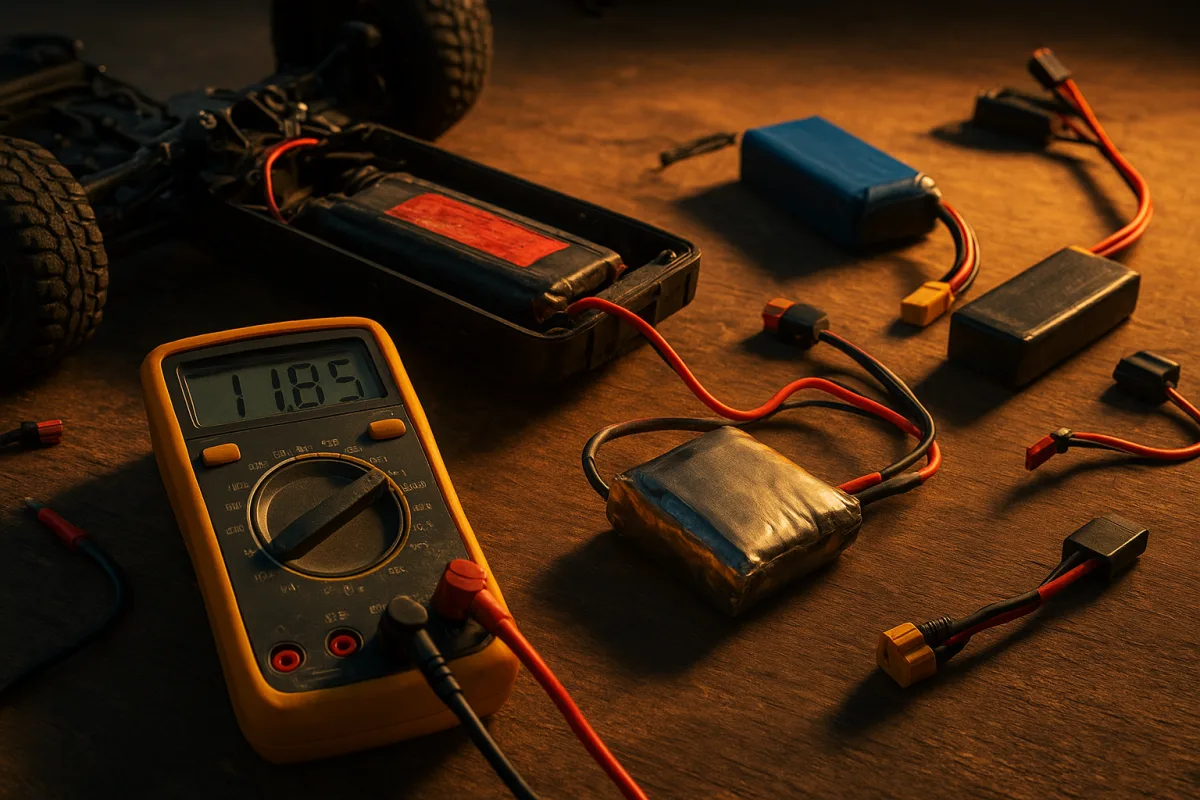
Photo: alekseiap199232 via Pixabay
Inspect the pack before charging
A soft LiPo case, puffed shrink wrap, or a pack that no longer lies flat on the pit table is your stop sign. Swelling indicates internal damage and a safety hazard, so do not charge, run, or try to recover that pack. [3][6]
Look over the main leads, balance plug, solder joints, and connector housing at the same time. Exposed wire, a loose bullet connector, crushed insulation, corrosion, or a plug that gets hot can create resistance and intermittent power loss. [7][9]
A hard landing can damage a battery even when the car still drives afterward. Check a pack after a major impact, especially in a 1/8 buggy or truggy where the battery can move hard against the chassis and strap. [3][7]
Identify the battery chemistry first
Read the label before setting charger mode or judging voltage. A LiPo cell is nominally 3.7V, reaches 4.20V fully charged, and needs different handling from a NiMH cell, which is nominally 1.2V and typically reads 1.4 to 1.45V when fully charged. [3][6][11]
Count cells rather than trusting the pack’s sticker alone. A 2S LiPo should show roughly 8.4V fully charged, while a 6-cell NiMH stick pack should read roughly 8.4 to 8.7V after charging, based on its 1.4 to 1.45V cells. [3][6]
We would not use a charger’s automatic chemistry detection as the final answer. Set the battery type and cell count manually from the pack label, then confirm the displayed pack voltage and individual LiPo cell readings before starting. [9][11]
Check resting voltage before the run
Plug a LiPo into a cell checker, balance charger, or digital multimeter and read each cell, not only total pack voltage. A healthy stored LiPo should be near 3.8V per cell, and cells that differ noticeably from one another need attention before race day. [3][5]
A fully charged LiPo should read 4.20V per cell. Do not keep using a cell below 3.0V, because that level is considered unsafe, and set your car’s low-voltage cutoff or warning around 3.5V per cell to avoid reaching it. [3][6]
For a NiMH pack, voltage is a useful quick check but not a complete health report. A pack may show normal voltage immediately after charging yet fade early under throttle, so follow the voltage reading with a capacity or loaded-runtime check. [4][6]
Compare LiPo cells, not only the pack total
A 4S pack can show a normal total voltage while one weak cell hides among three healthy ones. The balance lead lets your charger show each cell, revealing imbalance that a main-lead voltage check cannot catch. [3][11]
Check cell balance before each use and after any period of storage. Monthly balance and load checks are a reasonable maintenance rhythm, while a crash, swelling, unusually hot pack, or sudden loss of punch calls for an immediate inspection. [3][7]
Do not try to fix a consistently weak LiPo cell by repeatedly charging it harder or cycling it through repeated runs. Overcharging, over-discharging, and continuing to use damaged packs are all common causes of further battery failure. [3][9]
Measure internal resistance on LiPos
Internal resistance, usually displayed as mΩ, is the number that explains why a pack can charge normally but feel flat on the straight. Resistance rises as a LiPo ages, producing more voltage sag and less ability to deliver current under load. [1][2][10]
Use a balance charger with an IR function and record each cell’s value when the pack is at a similar temperature and state of charge. A single cell that is far higher than its neighbors is often the problem, even if the average pack reading looks acceptable. [2][5]
TechGF describes 1 to 5 mΩ per cell as excellent, while ViBMS puts healthy LiPo cells at 2 to 8 mΩ. Both place packs above roughly 15 to 20 mΩ in the degraded range, where reliability and punch suffer. [1][5]
We would use 8 mΩ per cell as the line for a strong performance pack, then watch the trend rather than obsessing over one reading. A 2S shorty with both cells climbing together is aging, but one cell climbing alone deserves retirement sooner. [1][5][10]
Check voltage sag under throttle
A battery’s real job is holding voltage while your motor draws current. Voltage sag is the drop from resting voltage to loaded voltage, and excessive sag points toward high internal resistance, inadequate discharge capability, or a pack nearing the end of its useful life. [2][10]
Watch what happens during a hard acceleration or use a tester that applies a load. If the car slows sharply, the low-voltage cutoff triggers early, or the pack voltage falls unusually fast under throttle, inspect IR, connectors, gearing, and pack condition before buying a motor upgrade. [2][7][10]
We found no published universal sag number for every RC class. A 1/10 stock touring car, 1/10 2WD buggy, and 1/8 electric truggy draw different current, so compare a suspect pack against your own known-good pack in the same car and conditions. [2][4]
Run a controlled capacity test
Charge the pack correctly, then use your charger’s discharge or capacity function to measure how much energy it can return. Capacity retention is a core battery-health indicator, and a pack that returns much less capacity than it once did will shorten your run time. [3][4]
Repeat the test under comparable conditions so the numbers mean something. Cold weather, a hot pack, and different discharge loads can change the result, while a gradual downward trend across repeated checks tells you more than one isolated cycle. [4][8]
For NiMH packs, capacity testing carries extra weight because clear RC-specific IR benchmarks are not established. Track how much the charger puts back in, how long the pack runs in your vehicle, and whether it gets unusually hot during charging or use. [4][6]
Watch heat after a normal run
Feel the battery only after disconnecting it and giving it a moment to settle. Excessive heat can accompany high resistance, heavy current draw, poor connections, over-gearing, or a pack working beyond what it can comfortably supply. [2][7][10]
Heat is a setup clue, not automatic proof that the battery alone failed. If both a fresh pack and an older pack come off hot in the same 1/10 buggy, check pinion size, drivetrain drag, motor condition, and connector resistance before replacing batteries. [2][7]
High ambient temperature also accelerates battery degradation and raises LiPo swelling risk. Keep packs out of a hot car, direct sun, and enclosed charging areas where heat can build around the cells. [3][8]
Account for weather and storage conditions
Below 50°F, or 10°C, cold can reduce available battery capacity by up to 30 percent. A pack that feels weak on a winter practice day may recover much of its normal performance at moderate temperature, so avoid condemning it from one cold run. [8]
High humidity can promote corrosion and parasitic drain, particularly around connectors and exposed wiring. The available guidance does not quantify exactly how humidity changes RC battery readings, but dry storage and clean connectors reduce an avoidable source of trouble. [7][8]
Store LiPos around 3.80 to 3.85V per cell, with another recommendation placing storage at about 3.8V and roughly 50 percent charge. Both agree that leaving a LiPo fully charged or fully discharged for storage is the wrong move. [3][11]
Choose the tools that fit your bench
A digital multimeter costs about $10 to $100 and gives you a basic voltage check. Battery testers run about $15 to $100 or more, while balance chargers with internal-resistance measurement generally cost $30 to $150. [1][3]
For LiPo racing packs, we would buy the balance charger with IR measurement first. It combines charging, cell-balance checks, and resistance readings, giving you a loggable picture of the pack instead of a guess based on how the car felt. [1][5]
A separate multimeter still earns its place in the pit bag for checking connector voltage and diagnosing a charger, switch, or wiring fault. It cannot replace a LiPo balance check because it does not read individual cells through the balance lead. [7][9][11]
Keep a battery log and retire packs early
Label each pack and record its date, cell count, capacity, IR readings, charge behavior, and any hard impacts. A basic note on your phone can show a rising-resistance cell or shrinking capacity long before it ruins a qualifier. [1][4][10]
Before every use, inspect the pack and verify voltage. Each month, check LiPo cell balance, IR, and loaded behavior, then repeat those checks after crashes, unusual heat, swelling, charging trouble, or an unexplained early low-voltage cutoff. [3][7]
Retire a LiPo with swelling, physical damage, repeated imbalance, unsafe low voltage, or resistance in the degraded range. For NiMH, retire packs that no longer hold useful capacity, self-discharge rapidly, run excessively hot, or collapse under the load your car normally handles. [3][4][6]
Frequently Asked Questions
How do I check the health of my RC car battery?
Start by inspecting the battery pack for physical damage such as swelling, punctures, or damaged leads. Then measure the resting voltage of each cell using a cell checker, balance charger, or digital multimeter. For LiPo batteries, check internal resistance and capacity to identify packs losing performance. For NiMH packs, monitor charge capacity, runtime, voltage under load, and heat buildup.
What tools do I need to test RC battery condition?
A digital multimeter is essential for measuring voltage and can cost between $10 and $100. Battery testers and balance chargers that include internal resistance measurement are also useful, typically costing from $15 to over $150. These tools allow you to check cell voltages, balance, and internal resistance to assess battery health.
How can I tell if an RC battery cell is weak?
For LiPo batteries, a weak cell often shows a voltage noticeably different from the others when checked individually through the balance lead. A cell with significantly higher internal resistance than the rest is also a sign of weakness. Avoid repeatedly charging or discharging a weak cell, as this can worsen the damage.
What is a good internal resistance value for RC LiPo batteries?
Internal resistance values below 15 to 20 milliohms (mΩ) per cell are generally considered acceptable for performance use. Values above this range indicate the battery is worn out or degrading. Healthy LiPo cells typically have internal resistance in the range of 1 to 8 mΩ per cell, according to various measurements.
How often should I check my RC car battery health?
Perform a physical inspection and check resting cell voltages before each use. Monthly checks of cell balance and load performance are recommended for routine maintenance. Additionally, inspect the battery immediately after any crash, swelling, excessive heat, or sudden loss of power.
How we researched this
This article was assembled from 11 cited references.
Nothing here is based on hands-on testing. Where a figure or finding appears, it belongs to the source cited beside it, and the writing says so rather than implying otherwise. Every source is listed below so you can check it.
Sources
- How to Tell if an RC Battery is Bad: The Pro Performance Guide Review & Specs
- Measuring Your Own Power System: IR, Sag and Amp Draw
- How to Tell If RC Car Battery Is Bad: Signs, Tests, and Next Steps -
- Battery University | BU-901: Fundamentals in Battery Testing
- How to check internal resistance of a LiPo battery? - ViBMS Battery
- How to Tell If an RC Battery Is Bad | LiPo and NiMH Signs, RaceNRCs
- RC Car Battery Troubleshooting
- How Weather Affects RC Car Performance | Hearns Hobbies
- Why Is My RC Car Battery Not Charging? Common Causes and Fixes, Drive Smart Tools
- LiPo Internal Resistance (IR) & Battery Health Diagnostics
- Everything You Need to Know About RC Batteries, RC Car Action
Related Articles
RC Car Battery Troubleshooting
Learn RC car battery troubleshooting steps to identify, test, and fix common battery problems for better performance and longer runtime.
How to Upgrade RC Car Battery for Better Runtime and Performance
Learn how to upgrade your RC car battery safely, improve runtime, and ensure compatibility with your ESC and motor for optimal performance.

RC Car Battery Safety Rules
Learn essential RC car battery safety rules including charging, handling, and voltage limits to race safely and comply with regulations.
RC Car Battery Types Explained: LiPo vs NiMH and More
Learn about RC car battery types, including LiPo and NiMH, voltage, capacity, and C-ratings to choose the right battery for your RC car.