
How to Upgrade RC Car Battery for Better Runtime and Performance
Learn how to upgrade your RC car battery safely, improve runtime, and ensure compatibility with your ESC and motor for optimal performance.
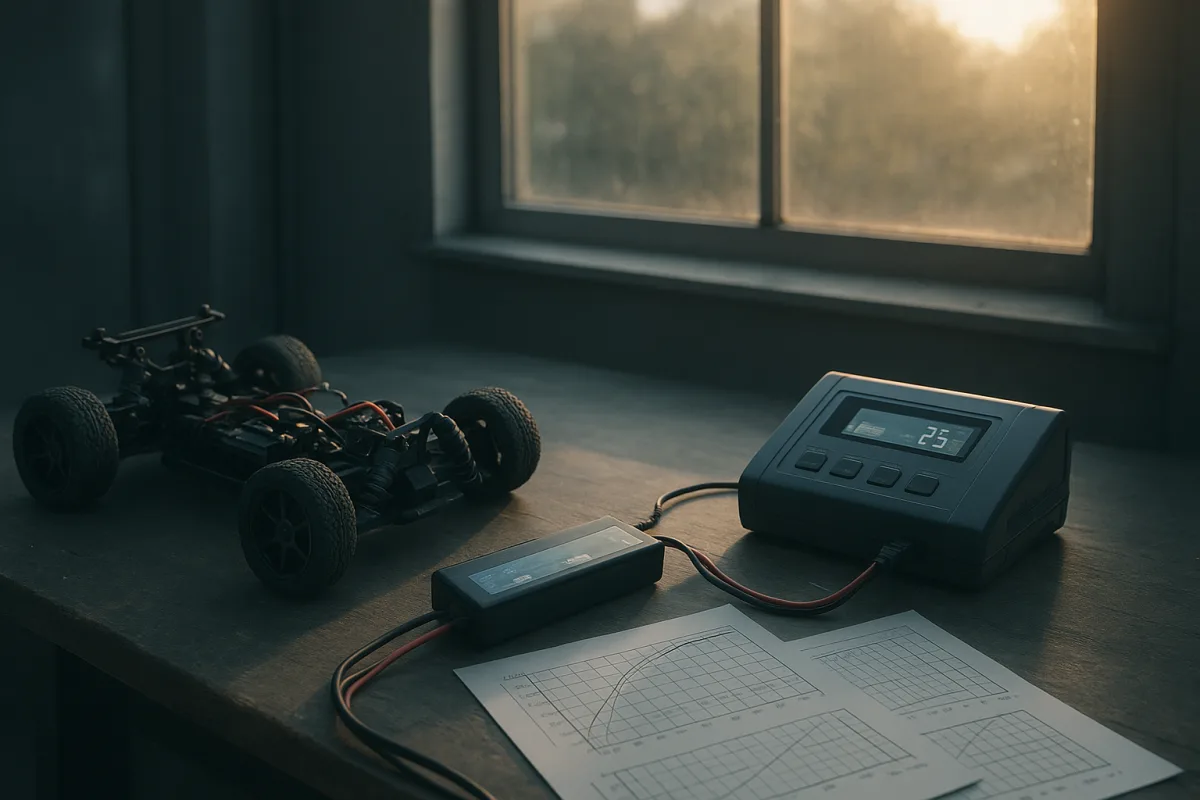
Check the battery tray
The battery tray tells you how much runtime you can realistically add. Before ordering a higher-capacity pack, check the current pack’s physical fit, hold-down method, and the vehicle manufacturer’s battery specifications.
A larger mAh number usually means a larger and heavier pack. Higher capacity increases runtime, but the added weight can reduce handling quality, alter balance, and put more stress on the drivetrain. [7][8]
Do not force a pack into the tray or rely on a loose hold-down. Improper fitment is a common battery-upgrade mistake, and a battery moving in the chassis can create problems before its extra capacity delivers any benefit. [16]
We would keep the battery low, secure, and close to the chassis layout intended by the manufacturer. A little less capacity that fits correctly is the better upgrade than a large pack that compromises the car’s balance.
Confirm ESC and motor voltage ratings
Read the ESC and motor ratings before looking at capacity. Voltage must match what both components are rated to handle, because an incompatible battery can damage the electronics. [1][3]
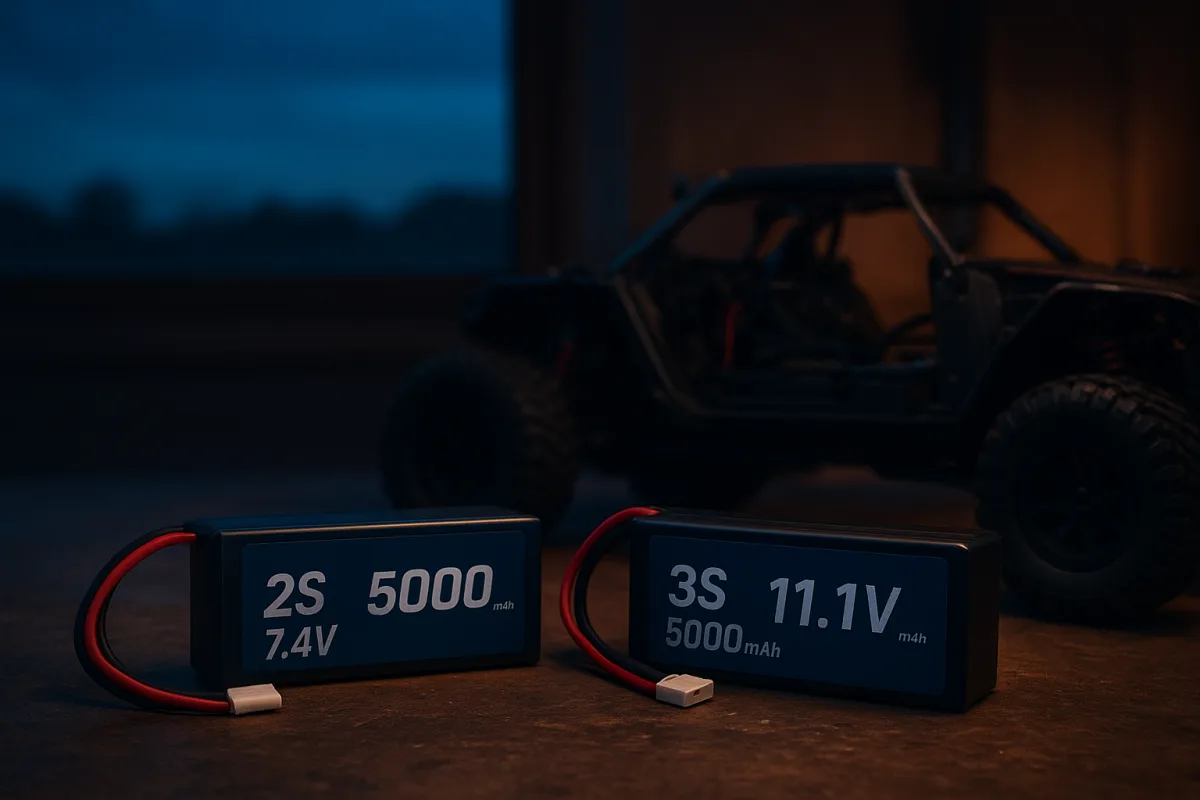
Most 1/10 electric RC cars use a 2S LiPo, which has a nominal voltage of 7.4V. Typical capacities for that class run from 3,000mAh to 5,000mAh. [3]
A 3S LiPo raises voltage and speed, but it generally reduces runtime compared with a 2S pack. VRX Racing puts typical 3S runtime at 12 to 20 minutes, compared with 15 to 25 minutes for 3,300mAh to 5,000mAh 2S packs. [1]
Do not assume a 1/10 car accepts 3S because its battery tray has room for it. 3S packs are not commonly compatible with every 1/10 model, so the ESC and motor ratings decide this one. [1]
For a runtime upgrade, we would keep a 2S-equipped 1/10 car on 2S unless its electronics are explicitly rated for 3S and you also want the extra speed. More voltage is the wrong direction when longer runs are the priority.
Choose capacity before chasing voltage
Capacity, expressed in milliamp-hours, is the first battery specification to increase for longer runs. A 5,000mAh 2S LiPo is a familiar upper-end capacity within the typical 3,000mAh to 5,000mAh range reported for 1/10 electric cars. [3]
Runtime figures are guides, not promises. VRX Racing reports 15 to 25 minutes from 3,300mAh to 5,000mAh 2S LiPos, while Model Press estimates 20 to 35 minutes for a 5,000mAh 2S LiPo. [1][5]
Those different estimates reflect what happens at the track. Driving style, terrain, battery quality, and vehicle setup all change how quickly the pack is discharged, so two cars carrying the same 5,000mAh pack may not finish together.
Start with the capacity increase that still fits the chassis properly. If you currently use a 3,000mAh 2S pack, moving toward 5,000mAh is the normal direction, provided weight and tray fit remain acceptable. [3][7]
There is no universal maximum pack size that preserves handling across all 1/10 cars. A short-course truck, touring car, stadium truck, and 2WD buggy distribute battery weight differently, so follow the vehicle manufacturer’s specification instead of copying another class’s pack choice.
Keep the car balanced
A high-capacity pack gives you more energy, but it also changes what the chassis carries through turns, jumps, and rough ground. HobbyKing warns that bigger batteries do not always help because weight can work against overall vehicle performance. [8]
You will feel that tradeoff most clearly when the car already feels heavy in transitions or struggles to hold its line. Adding battery mass can make the handling less responsive even as the stopwatch shows a longer run. [7][8]
Drivetrain stress belongs in the same calculation. More battery weight increases the load the car has to move, so do not treat capacity as a free upgrade. [7]
We would make one step in capacity, run the car, and assess the handling before going bigger. That approach keeps a runtime upgrade from turning into a setup problem that costs you more time than it saves.
Pick a C-rating for the car’s job
C-rating describes a battery’s discharge capability. For racing and high-performance use, Shock & Servo recommends a 50C rating or higher. [3]
A runtime-focused pack still needs enough discharge capability for the motor and ESC. Choosing capacity while ignoring discharge rating can leave you with a pack that does not suit the demands of the vehicle. [3]
Do not buy the biggest mAh figure and treat C-rating as an afterthought. Match both specifications to the electronics, then prioritize the capacity that fits the chassis and the runtime you need.
For a hard-driven 1/10 car, we would use the 50C-or-higher guidance as the baseline from the available information. For lower-demand use, the battery still needs to meet the requirements of the ESC and motor. [3]
Charge the new LiPo correctly
A new LiPo needs a LiPo-capable balance charger. Balance charging is essential because it manages the cells in the pack as a set, rather than treating a 2S battery as one undivided unit. [9][10]
Use a 1C charge rate unless the battery manufacturer specifies otherwise. On a 5,000mAh pack, 1C equals 5A, so set the charger for 5A. [9][10]
Stay with the battery while it charges. Monitoring during charging is part of proper LiPo practice, helping prevent hazards from a damaged pack, incorrect charger setting, or charging problem. [9][10]
Do not over-discharge the battery in pursuit of a few additional laps. Over-discharging is among the mistakes linked with shortened battery life and unreliable performance. [13][17]
A larger battery only adds runtime if it remains healthy. Incorrect charging and storage can erase the gains from the upgrade faster than a small change in capacity will add them. [13][17]
Store the pack at storage voltage
After a driving day, do not leave a LiPo fully charged for an extended period. Store it at about 3.8V per cell, which means roughly 7.6V for a 2S pack. [11]
Inspect the pack regularly for swelling or physical damage. A swollen or damaged battery is not a candidate for another charge cycle simply because it still fits the vehicle. [11][13]
Keep batteries in a climate-controlled environment between runs. Storage conditions affect battery health, and temperature extremes work against both performance and longevity. [7][12]
LiFe batteries have a reputation for safety and longevity, but LiPo remains the common route for a 1/10 runtime upgrade. The available information does not establish comparable pricing for high-capacity LiFe packs suitable for this job.
Adjust for cold, heat, and moisture
A battery that suddenly produces shorter runs on a cold day may not need replacing. Below 50°F, or 10°C, cold can reduce effective battery capacity by as much as 30 percent. [6][7]
Warm the battery before use in cold conditions, then expect runtime to remain dependent on the temperature. A 5,000mAh pack cannot deliver its normal warm-weather performance if the cold reduces its available capacity. [6][7]
Heat creates the opposite problem. High temperatures can cause voltage sag and battery damage, so use cooling measures in hot conditions and do not keep running a pack that is showing heat-related performance loss. [12]
Humidity brings corrosion risk to electronics. Seal electronics against moisture when conditions demand it, then inspect the car after wet running instead of blaming every shortened run on the battery itself. [12]
Rule out the mistakes that waste runtime
Start with voltage compatibility, battery fitment, and charging settings. Ignoring ESC and motor ratings, fitting an overly heavy pack, and using poor charging or storage routines are recurring upgrade errors. [13][16]
Check the whole car if the new pack does not deliver the improvement you expected. Terrain, driving style, vehicle setup, and weather can explain a disappointing runtime figure without proving that the battery capacity is wrong. [1][5][12]
We would not chase emerging sodium-ion or solid-state battery claims for this upgrade. Those technologies are not commercially viable for RC cars as of 2026, while a correctly matched 2S LiPo remains the established route to longer 1/10 run time.
Frequently Asked Questions
How do I safely upgrade my RC car battery?
Before upgrading, confirm that the new battery fits securely in the tray without forcing it and that your ESC and motor are rated for the battery’s voltage. Charge LiPo batteries with a balance charger at a 1C rate and store them at about 3.8 volts per cell between runs. Avoid using packs that run hot, sag, or discharge unusually fast without addressing those issues first.
What should I check before upgrading an RC car battery?
Check the physical fit of the battery in the tray, the hold-down method, and the voltage ratings of your ESC and motor. The battery must fit properly to avoid movement that can cause problems, and the voltage must match your electronics to prevent damage. Also, consider the added weight of a higher-capacity battery and how it may affect handling.
Can I use a higher voltage battery in my RC car?
Only if your ESC and motor are explicitly rated for that higher voltage. Most 1/10 electric RC cars use 2S (7.4V) LiPo batteries, and moving to a 3S pack increases speed but usually reduces runtime. Do not assume a 3S battery is compatible just because it fits physically; check your electronics’ voltage ratings first.
How does battery capacity affect RC car runtime?
Increasing battery capacity (mAh) generally extends runtime. For example, a 5,000mAh 2S LiPo can provide roughly 20 to 35 minutes of run time, though actual results vary with driving style, terrain, temperature, and vehicle setup. Start by upgrading capacity within the size and weight limits of your chassis.
What impact does a bigger battery have on RC car handling?
A larger capacity battery is usually heavier, which can reduce handling quality, alter the vehicle’s balance, and increase stress on the drivetrain. It is better to choose a slightly smaller battery that fits well and maintains proper balance than a larger pack that compromises performance.
How we researched this
This article was assembled from 17 cited references.
Nothing here is based on hands-on testing. Where a figure or finding appears, it belongs to the source cited beside it, and the writing says so rather than implying otherwise. Every source is listed below so you can check it.
Sources
- 2S vs 3S Lipo Batteries for 1/10 Electric RC Cars: Speed, Runtime and ESC Compatibility
- Best RC Car Batteries for Longer Run Time | Composting Guide (October 2026)
- RC Car Battery Sizes: What Size Do You Need? | Shock & Servo
- Sodium-ion batteries are getting ready for prime time. How can they improve EVs?
- Best RC Car Scale: Choosing the Right Size for You
- How Big Is a 1/10 Scale RC Car? - Rc Things
- RC Battery mAh Explained: Runtime, Size and Weight | RC Setup Lab
- Blog - Why Bigger Batteries Don’t Always Help RC Cars
- How to Choose an RC Battery: Beginner Guide, RCCrafter.com
- How Long to Charge an RC Car Battery
- How To Store RC LiPo Batteries Safely Between Runs
- How Weather Affects RC Car Performance | Hearns Hobbies
- RC Battery Killers: 6 Mistakes & How to Fix Them, ChinaHobbyLine
- RC Car Batteries and Chargers: A Plain-English Guide | Cheap RC Cars
- RC - How Long Do RC Batteries Last? (2026) - MAD Toys and Hobbies
- RC Model Shop | Best LiPo Battery for RC Car Buyers
- Why Your RC Battery Keeps Dying: 5 Charging Mistakes | AT Models
Related Articles
RC Car Battery Troubleshooting
Learn RC car battery troubleshooting steps to identify, test, and fix common battery problems for better performance and longer runtime.
RC Car Battery Types Explained: LiPo vs NiMH and More
Learn about RC car battery types, including LiPo and NiMH, voltage, capacity, and C-ratings to choose the right battery for your RC car.
How to Upgrade RC Car Electronics
Learn how to upgrade RC car electronics with ESC, motor, and battery tips to improve performance and ensure component compatibility.
2S vs 3S RC Car Batteries: Which Offers Longer Runtime?
Compare 2S and 3S RC car batteries to learn which provides longer runtime and better performance for your vehicle's needs.