
RC Car Battery Charging Times
Learn how to calculate RC car battery charging times and factors affecting them for LiPo, NiMH, and LiFePO4 batteries.
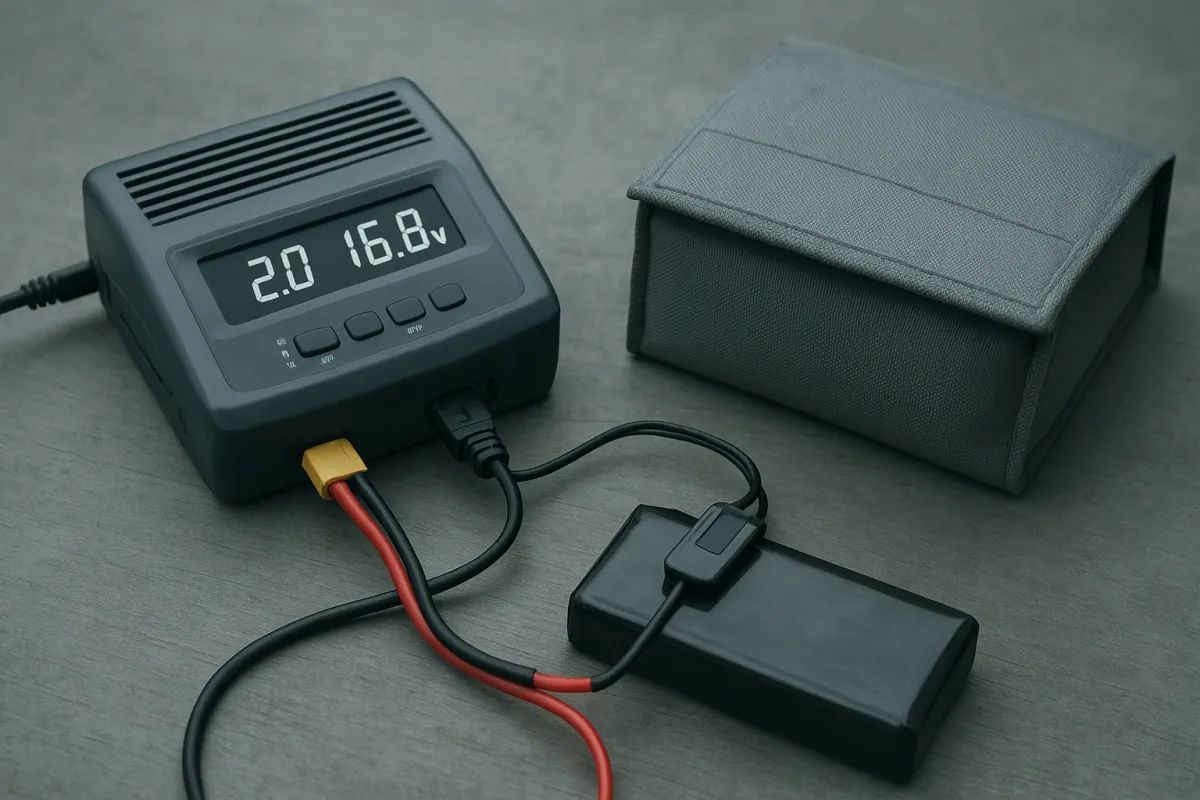
The number on the charger: C-rate
The charger screen says 5.0A, your 2S hardcase LiPo label says 5000mAh, and the pack needs to be ready before the next heat. Those two numbers determine almost all of the charging-time conversation.
C-rate is the relationship between battery capacity and charging current. A 1C charge means supplying current equal to the pack's rated capacity expressed in amp-hours. For a 5000mAh, or 5Ah, LiPo, 1C is 5A. [3][13]
Set that same 5000mAh pack to 2.5A and you are charging at 0.5C. Set it to 10A and you are charging at 2C. The battery did not become larger or smaller, only the rate at which energy enters it changed. [3][4]
For most RC LiPo packs, 1C is the baseline we would use. It gives you predictable timing, works with the standard recommendation for safe, efficient charging, and avoids making every turnaround between runs a high-stress event for the cells. [5][12]
A pack labeled 5000mAh 50C can confuse newcomers because that large C number is usually a discharge rating. It describes how aggressively the pack can deliver power, not automatically how fast you should charge it. [2][12]
The pack's label and manufacturer guidance still control. If a battery specifies a maximum charge rate, do not exceed it. A charger capable of 10A or 20A does not make that setting appropriate for every 1/10-scale short-course truck or 1/8-scale buggy pack. [5][7]
Calculate time before you plug it in
The basic calculation is straightforward: battery capacity in mAh divided by charger current in mA equals the ideal charge time in hours. A 5000mAh pack charged at 5000mA works out to one hour. [3][4]
Real charging is not perfectly efficient, so add roughly 10 to 20 percent. The charger also slows near the top of the cycle as it completes the pack safely, particularly when balance charging a multi-cell LiPo. [3][4]
That turns the 5000mAh example into roughly 66 to 72 minutes instead of exactly 60. If your charger reports a little over an hour for a normal balance charge, that is not automatically a problem. [3][13]
A 6000mAh 2S race pack at 1C needs a 6A setting. At that rate, plan on about an hour plus the normal overhead. At 3A, a 0.5C charge, expect approximately two hours before losses. [3][4]
The same math explains why a basic wall charger feels slow. A 3000mAh NiMH stick pack on a low-current charger may take around five hours, while a properly configured LiPo charger can fill a similarly sized LiPo in roughly an hour at 1C. [3][13]
Charging time is therefore not a fixed property of “an RC battery.” Capacity, chemistry, charger output, and selected current all matter. A 5000mAh 2S LiPo, a 5000mAh 3S LiPo, and a 5000mAh NiMH can require very different settings. [3][11]
Chemistry changes the timetable
NiMH remains common in ready-to-run vehicles and beginner models because it is familiar and comparatively forgiving. Under standard charging, NiMH packs commonly take four to six hours, with a 3000mAh example taking about five hours on a basic charger. [3][13]
LiPo is the common performance battery in modern 1/10 electric racing, bashers, and larger electric classes. A 5000mAh LiPo charged at its 1C rate of 5A generally takes about one hour before allowing for the charger’s final overhead. [3][12]
LiFePO4 packs occupy a smaller part of the RC field, but they use another charging profile. Typical charging times reported for a 3000mAh LiFePO4 pack are around two hours, with one to three hours being a normal range. [3][13]
Do not select a charge mode by connector, pack shape, or the vehicle it came from. Select it by chemistry, cell count, and the battery’s own specification. Charging a LiPo as NiMH, or using an incorrect cell-count setting, creates an overcharge risk. [5][6]
A suitable charger recognizes the chosen chemistry and helps stop the process at the proper voltage. For LiPo cells, charging beyond 4.2V per cell is overcharging, while discharging below 3.0V per cell can also damage the pack. [5][12]
Why faster is not always better
Fast charging has an obvious attraction at the track. A 5000mAh LiPo charged at 5A takes around an hour, while the same pack charged at 1A can take more than five hours once normal losses are included. [3][4]
The cost of that time saving appears when charging current rises beyond the standard 1C approach. High charge rates can raise cell stress and shorten the useful life of a battery, even when the pack accepts the charge and runs normally afterward. [1][12]
A September 2023 paper published on arXiv found that lithium-ion cells charged at 4C experienced capacity fade and lithium plating. Lithium plating is a damaging condition in which metallic lithium deposits where it should not, reducing long-term cell performance. [1]
That study examined lithium-ion cells under fast charging, not a specific 2S shorty pack or 4S truggy battery. Still, the finding supports a conservative RC rule: use speed when you need it, but do not make maximum-rate charging your default habit. [1][5]
We would charge at 1C for routine use, especially for packs you want to keep through a season. A lower rate takes longer but may be gentler, while a higher rate is best reserved for a genuine turnaround problem and only within the pack’s rating. [1][5]
An expensive high-output charger does not repair worn cells or make a damaged pack safe. Its value is control: selectable current, chemistry-specific programs, automatic shutoff, and balance charging that give you a repeatable process. [5][11]
Heat changes both charge time and pack life
A LiPo coming out of a 10-minute buggy main may feel warm, especially after a high-current run. Put it aside until it cools before charging. Charging a hot pack is a common avoidable mistake. [5][6]
Cold weather changes the other side of the equation. Battery performance can lose up to 30 percent of effective capacity below 10 degrees Celsius, so a pack can feel flat sooner even if it was fully charged. [10][13]
Do not respond to cold-weather runtime by forcing a higher charge rate. The charger setting does not create capacity that temperature has temporarily taken away. Keep batteries in a suitable environment and let them reach a normal temperature before charging. [5][10]
Heat is also hard on stored batteries. Avoid storing packs above 35 degrees Celsius, because higher temperatures accelerate degradation. A hot car trunk or garage shelf in summer can do more harm over time than many drivers expect. [8][9]
Humidity is less clear-cut. High humidity can bring condensation and corrosion risks around connectors and electronics, but detailed figures tying humidity to RC charging time or battery degradation are not established in the available guidance. [6][13]
Set up a charging routine you can repeat
Start by inspecting the pack. Do not charge a swollen, punctured, leaking, damaged, or otherwise suspect battery. Look at the case, leads, connector, and balance plug before plugging anything into the charger. [5][6]
Use a non-flammable charging surface and keep the battery attended throughout the cycle. A LiPo safety bag adds another layer of containment, but it does not replace correct settings, a sound pack, or supervision. [5][6]
Connectors and charge leads need to match the pack and charger. Improvised or incompatible cables can create poor connections, heat, or polarity mistakes. Leaving batteries connected unnecessarily after use also adds risk and can drain packs. [5][7]
For a LiPo, set the correct battery type, verify the cell count, set 1C, and use balance charging when the charger and pack support it. Then check the displayed cell count before starting, not halfway through. [5][12]
For a 5000mAh 2S LiPo, that sequence means LiPo mode, 2S selection, and 5.0A for a 1C charge. The pack voltage tells the charger it is two cells in series, while the 5000mAh rating sets the appropriate current. [3][12]
Battery size also matters physically. A pack can have the right plug and voltage yet be too large for the vehicle’s battery tray, or its leads may not suit the vehicle. Confirm fit before buying multiples for race day. [7][11]
Storage is part of charging management
A charged pack left on the bench after race day is still part of your battery-management problem. LiPos are commonly stored at 60 to 70 percent charge, often cited as about 3.8 to 3.85V per cell. [5][12]
The exact storage-voltage figure varies among recommendations, so follow your charger’s storage program and the battery maker’s instructions if they differ. The main point is to avoid long-term storage at either full charge or a deeply discharged state. [5][12]
Use the charger’s storage function when a pack will sit. It can discharge a full pack down toward storage level or charge a low pack upward, giving you a safer starting point for the next garage session. [5][11]
A predictable routine saves more frustration than chasing the fastest charger specification. Cool the pack, inspect it, charge at 1C, balance it, run it, and return it to storage charge when you are done. [5][6]
Frequently Asked Questions
How do I calculate RC car battery charging times?
To estimate charging time, divide the battery capacity in mAh by the charger current in mA, then add 10 to 20 percent to account for inefficiency and the final balancing stage. For example, a 5000mAh battery charged at 5000mA (5A) ideally takes one hour, but realistically about 66 to 72 minutes.
What affects the charging time of an RC car battery?
Charging time depends on battery capacity, charger output current, battery chemistry, and the selected charging current. Higher charger current reduces charging time but may increase stress on the battery, while lower current extends charging time but can be gentler on battery health.
How long does it take to charge a 5000mAh LiPo RC battery?
Charging a 5000mAh LiPo battery at the recommended 1C rate (5A) takes about one hour plus 10 to 20 percent extra time for charger inefficiency and balancing, totaling roughly 66 to 72 minutes.
What is the recommended charging current for RC car batteries?
For most RC LiPo packs, charging at 1C, meaning the charging current equals the battery capacity in amp-hours, is recommended. This rate balances charging speed with battery safety and longevity.
How do different battery chemistries affect RC battery charging times?
Charging times vary by chemistry: NiMH batteries typically take 4 to 6 hours to charge, LiPo batteries about 1 hour at 1C, and LiFePO4 batteries generally require 1 to 3 hours. Chargers and settings must match the battery chemistry to ensure proper charging and safety.
How we researched this
This article was assembled from 13 cited references.
Nothing here is based on hands-on testing. Where a figure or finding appears, it belongs to the source cited beside it, and the writing says so rather than implying otherwise. Every source is listed below so you can check it.
Sources
- Lithium plating induced degradation during fast charging of batteries subjected to compressive loading
- What mAh Means on an Rc Car Battery, Drive Smart Tools
- How Long to Charge an RC Car Battery
- How Long to Charge an RC Car Battery | Shock & Servo
- How to Charge an RC Car Battery Safely and Correctly in 2026 -
- RC Battery Safety
- How to Charge an RC Car Battery? - Rc Things
- 5 things you didn't realize were damaging your Dyson vacuum's battery
- Why does battery life get worse over time?
- How Long Does RC Car Battery Last? LiPo Guide 2026 | FUNYAT
- Everything You Need to Know About RC Car Battery Charger - unitechautomotive.com
- RC Car Battery Guide: LiPo, NiMH and Safety
- How Long to Charge RC Car Battery: Complete Timing Guide for NiMH, LiPo & Li-ion Batteries | EuroRC.com
Related Articles
How to Charge RC Car Batteries Safely and Effectively
Learn how to charge RC car batteries safely with correct settings, balance charging, and tips for NiMH and LiPo packs.
2S vs 3S RC Car Batteries: Which Offers Longer Runtime?
Compare 2S and 3S RC car batteries to learn which provides longer runtime and better performance for your vehicle's needs.
RC Car Battery Safety Rules
Learn essential RC car battery safety rules including charging, handling, and voltage limits to race safely and comply with regulations.
Choose RC Car Battery Charger
Learn how to choose an RC car battery charger by matching chemistry, cell count, charge rate, and wattage for safe and efficient charging.