
Choose RC Car Battery Charger
Learn how to choose an RC car battery charger by matching chemistry, cell count, charge rate, and wattage for safe and efficient charging.
Inventory the packs you already own
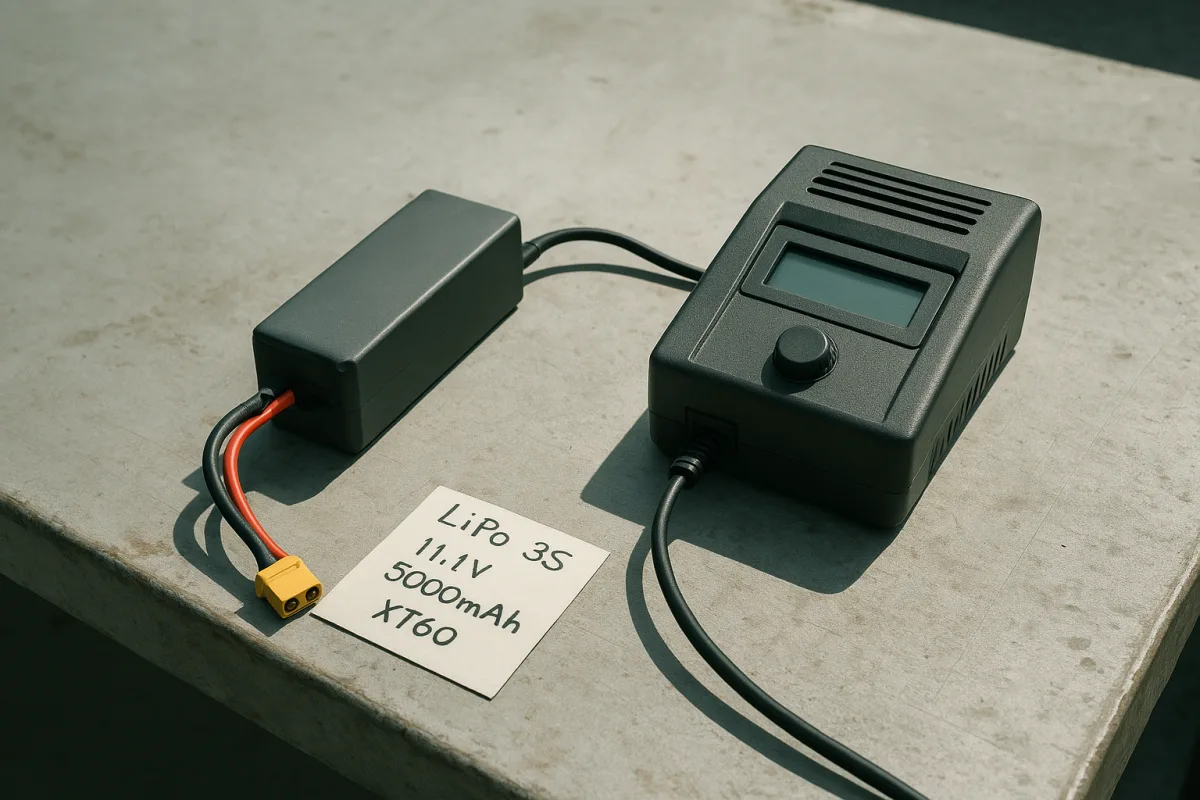
Start at your battery tray, not the charger shelf. Read every pack label and write down its chemistry, cell count, capacity in mAh, connector, and stated maximum charge rate.
A 2S LiPo is 7.4V nominal, a 3S LiPo is 11.1V, and a 6S pack is 22.2V. LiPo and Li-Ion cells are nominally 3.7V each, while LiFe cells are 3.2V each. [1]
That sounds basic, but it prevents the mistake that ruins more batteries than an inexpensive charger ever will, selecting the wrong chemistry program. If you run both a 1/10 2S short-course truck and a 1/8 4S or 6S buggy, your charger needs to cover both ends.
NiMH packs need a different charging routine from lithium packs. Common NiMH and NiCd packs use 1.2V cells, while lithium batteries need a charger program built for their chemistry and cell count. [1]
The Duratrax Onyx 235, for example, supports one to 10-cell NiCd and NiMH packs, plus one to four-cell LiPo and Li-Ion packs. That makes it a workable fit for many 1/10 electric cars, but it cannot charge a 6S 1/8-scale pack. [1]
We would not buy a charger based on what comes in your current ready-to-run box alone. Buy for the next class you realistically expect to run, but do not pay for 6S capability if you will only ever charge a single 2S hardcase pack.
Choose the correct chemistry and cell-count range
Once you know your packs, look for the charger’s supported battery menu. A charger may handle LiPo but not LiFe, or it may charge lithium packs only through 4S when your next vehicle needs 6S.
For a 2S or 3S LiPo racer, a charger supporting LiPo through 4S covers today’s pack and leaves room for a 4S setup. For 1/8 electric buggy, truggy, monster truck, or larger 6S vehicles, choose one rated through 6S.
The SkyRC D100neo balances LiPo, LiFe, and Li-Ion batteries through 6S. Its rating suits a hobbyist who runs several lithium chemistries or has 1/8-scale packs alongside 1/10 equipment. [2]
Do not try to make a charger’s display agree with the pack by guessing. Select the battery chemistry first, then verify the cell count shown on the screen matches the label before you press start. Incorrect chemistry settings are a recognized charging error. [15]
A 3S LiPo must be charged on the LiPo 3S program, not as a 2S pack because its connector happens to fit, and not as Li-Ion because both use a nominal 3.7V cell. The program controls the charging limits.
Make balance charging non-negotiable
If your battery has more than one lithium cell, buy a charger with balancing capability. The main discharge plug sends charging current into the pack, while the balance plug lets the charger monitor and equalize individual cells.
Without balancing, one cell can finish at a different voltage from the rest. The pack may look acceptable as a total voltage number while one cell has been pushed harder than its neighbors. Balance charging addresses that uneven charging risk. [9]
A 2S race pack needs a charger with a 2S balance connection. A 4S 1/8 buggy pack needs 4S support, and a 6S setup needs a balance system rated for all six cells.
Use the balance board or direct balance port specified for the charger, and inspect it before use. A balance charger cannot correct a connection that is loose, damaged, or plugged into the wrong socket.
We would skip a basic peak charger for lithium race packs, even if it is cheap and promises quick charging. A balance-capable unit is the feature to spend money on before dual outputs, color screens, or app control.
Calculate the charge current from capacity
Battery capacity tells you the current to enter. At 1C, the numerical charge current in amps matches capacity expressed in amp-hours, so a 5000mAh pack charges at 5.0A and a 2200mAh pack at 2.2A.
At that 1C rate, a fully depleted 2200mAh LiPo takes roughly one hour to charge. A 3000mAh LiFe pack at 3A also takes about one hour. [5]
For a 3000mAh NiMH battery, a 1A charger takes about three hours, 2A takes about 1.5 hours, and 5A takes about 36 minutes. [4] Those figures show why a tiny included wall charger becomes frustrating after a full club day.
Treat 1C as the baseline setting unless the battery maker states otherwise. A 2C charge cuts the approximate time for a 2200mAh LiPo from one hour to 30 minutes, but 2C requires manufacturer approval. [5]
The same conditional rule applies to LiFe packs: a 3000mAh pack can take about 30 minutes at 6A, or 2C, only where its manufacturer approves that rate. [5] Fast charging is not a default button.
Your charger’s maximum current must reach the rate you intend to use. The Onyx 235 offers adjustable charging current up to 5A, enough for 1C charging a 5000mAh pack, but not for 1C charging a 6000mAh or 8000mAh pack. [1]
Check wattage before buying a high-amp charger
Amps alone do not tell you whether a charger can deliver the rate printed on its face. Charger output power, measured in watts, must cover both the pack voltage and your chosen charge current.
This catches a common 1/8-scale buying mistake. A 6S 5000mAh LiPo needs about 150W of charger capacity for proper charging, according to HobbyGradeRC. [14]
A low-watt charger may offer a high current setting, then reduce actual current as pack voltage climbs. You may still charge the battery, but you will not get the planned one-hour turnaround between mains.
For a single 2S 5000mAh 1/10 pack, extreme wattage is not the priority. We would put the budget into accurate balancing, safety protections, and a charge rate that reaches 5A before chasing a large headline number.
Dual-output charging makes sense if you regularly charge two packs, such as matched race packs for a 1/10 buggy or two separate 2S packs for a 4S vehicle. Buy enough total power for both outputs, not merely two sockets.
Match the charger to where you charge
Decide whether charging happens only on the garage bench or also at the track. AC input lets you plug into household power, while DC input allows use from an appropriate field power source.
The HPI Reactor 500 accepts 100 to 240V AC and 11 to 18V DC input. That range lets one charger work at home and from a DC supply away from the wall outlet. [3]
An AC/DC charger reduces the need for separate home and field equipment. But do not assume every charger includes the DC power source you need for track use, because the charger’s input rating and the power supply are separate parts of the setup.
If your racing is limited to backyard running and a local indoor track with wall outlets, an AC charger may be enough. If you spend race days outdoors, choose AC/DC input before paying extra for convenience features.
Match plugs without creating a weak link
Look at both ends of your charging lead. RC packs commonly use XT60, Deans or T-plug, EC3 or EC5, and Traxxas iD connectors, with Traxxas iD being proprietary. [17]
The charger does not need the same connector permanently built into its case, but you need a proper charge lead from its output to every battery connector you own. Do not make connector compatibility an afterthought at checkout.
Typical RC charging leads measure around 10 to 20 cm. Shorter leads reduce resistance, but the lead still needs enough length to reach the battery safely in your charging area without pulling on the connector. [17]
We would standardize charge leads around the connector already fitted to your batteries, not immediately re-terminate every pack to suit a charger. Rewiring can be worthwhile later, but it is not the first answer to a charging problem.
Check polarity each time you use an adapter lead. Reverse-polarity protection is a feature worth having, and the Duratrax Onyx 210 includes reverse-polarity and overload protection. [6]
Pay for safety controls before convenience features
A charger should stop charging automatically and protect against overload or incorrect polarity. Microprocessor control is intended to prevent overcharging, as used in the HPI Reactor 500. [3]
Temperature monitoring, voltage regulation, overcurrent protection, and battery-management controls all help keep charging within limits. They do not replace your attention, so never leave a battery unattended while it is on charge. [20]
Charge LiPo packs between 15 and 25°C, or 59 and 77°F, where possible. [13] Cold packs from a winter race day need time to warm before charging, and hot packs need time to cool.
Do not charge a LiPo below 0°C, or 32°F, because of lithium-plating risk. Between 0 and 10°C, or 32 to 50°F, reduce charge current and warm the battery before charging. [11][12]
Avoid charging above 45°C, or 113°F, because high temperature accelerates battery aging. [11] If a pack is warm after a hard 1/8 truggy run, put it aside first. A faster turnaround is not worth a shortened pack life.
Set up a repeatable charging routine
Put the charger on a stable, nonflammable surface with the pack where you can see it. Connect the main lead, connect the balance lead for multi-cell lithium packs, select chemistry, confirm cell count, then enter capacity-based current.
Before every start, read the screen as if you were checking steering endpoints before a qualifier. A LiPo 2S setting for a 3S pack, or a 5A setting for a pack approved only for lower current, is a setup error.
Avoid parallel charging packs with different cell counts. Combining mismatched packs can create dangerous current surges, so keep any parallel setup limited to batteries that are properly matched. [9]
Do not rely on a charger to fix a damaged or badly neglected battery. Monitor pack voltage and follow the battery manufacturer’s charging guidelines to avoid overcharging or undercharging. [16]
After racing, do not leave lithium packs full or fully depleted for storage. Store them at approximately 40 to 50 percent charge. [21] A charger with a storage-charge mode makes that routine easier, especially if you own several race packs.
Spend according to the packs you run
Entry-level chargers run about $35 to $70 in 2026. The Spektrum S100 is listed at $34.99, while the Traxxas EZ-Peak Plus is listed at $69.95. [7][9]
These are the choices for a newcomer with one compatible battery format and modest charging needs. Check their chemistry, cell-count, connector, and balance capabilities against your exact pack before assuming a brand-matched charger covers everything.
The broader middle category runs about $70 to $150, although the ISDT Q6 Plus is listed around $55 to $65 and sits below that usual band. The Spektrum S1100 G2 is listed at $124.99. [9]
High-end chargers start above $150. The ISDT K4 is around $220, while the Spektrum S2200 G2 is listed at $319.99. [9] Those prices buy capacity and features, not better results from the wrong battery program.
For one 1/10-scale car with 2S packs, we would choose a balance charger that runs from AC power, reaches your desired 1C rate, and includes the right charge lead. For 1/8 racing or multiple cars, step up to 6S support and enough wattage first.
Frequently Asked Questions
How do I choose the right RC car battery charger?
Start by inventorying your battery packs to know their chemistry, cell count, voltage, capacity, and connector type. Then select a charger that supports the chemistry and cell count range of your packs, including any future upgrades you expect. Avoid buying a charger based only on what comes with your current RC car, and ensure it can handle the packs you realistically plan to use.
What charger features are essential for RC car batteries?
A balance charger is essential for any multi-cell lithium battery to equalize individual cells and prevent uneven charging. The charger should support the correct chemistry and cell count of your batteries and have adjustable current settings to match your pack’s capacity. Safety features like overcurrent and reverse polarity protection are also important but balance charging is the top priority.
How to match charger to battery chemistry and cell count?
Always select the charger program that matches your battery’s chemistry and verify the cell count displayed matches the pack label before charging. For example, a 3S LiPo must be charged on the LiPo 3S setting, not as a 2S or Li-Ion pack. Using the wrong chemistry or cell count setting can damage the battery or cause unsafe charging.
Why is balance charging important for RC lithium batteries?
Balance charging monitors and equalizes the voltage of each cell in a multi-cell lithium pack, preventing one cell from being overcharged or discharged compared to others. Without balancing, the overall pack voltage might appear normal while individual cells could be damaged, reducing battery life and safety. Using the balance port every charge is necessary to maintain pack health.
What charge rate should I use for my RC battery?
Use a 1C charge rate as the baseline, meaning the charge current in amps equals the battery capacity in amp-hours (e.g., a 2200mAh pack charges at 2.2A). Charging at 2C can cut charge time in half but only if the battery manufacturer explicitly approves it. Always set the charger’s current limit to match the intended charge rate and never exceed manufacturer recommendations.
How we researched this
This article was assembled from 21 cited references.
Nothing here is based on hands-on testing. Where a figure or finding appears, it belongs to the source cited beside it, and the writing says so rather than implying otherwise. Every source is listed below so you can check it.
Sources
- Duratrax Onyx 235 AC/DC Advanced LCD Charger
- SkyRC D100neo RC Battery Charger 2x200W Black
- HPI Reactor 500 Charger - RC Car Action
- How Long Does It Take To Charge A NiMH RC Battery?, RaceNRCs
- LiPo Charge Time Calculator, RC Battery Charging Guide | AllRCGuide
- RC Battery Safety & Charging Guide | TECH1RC
- RC Battery Chargers | LiPo Battery Chargers | NiMH Battery Chargers
- RC Gear - Battery Chargers - King Kong Hobbies
- Best RC Car Battery Charger Under $100: Top Picks for 2026 - HobbyGradeRC.com
- RC Chargers, Shankill Radio Flying Club
- Charging LiPo Batteries Safely: The Ultimate Guide - Hanery
- Battery Temperature Correction Chart, Capacity vs Temperature | Battery Calculators
- Lithium Batteries at Extreme Temperatures: Cold, Heat & Ageing | Hellpower Energy
- 8 Best LiPo Battery Chargers for RC Hobbyists (November 2026) Verified Reviews
- Your Charger: What Every Number on the Screen Means
- How to Choose a Marine Battery Charger | West Marine
- RC Car Battery Connector Types Explained | Shock & Servo
- Types Of RC Car Battery Connectors: Traxxas, IC5, XT60, Deans, JST
- RC Battery Connector Chart: XT60, XT90, EC5, Deans And Traxxas ID
- Charging Process Guidelines | Phoenix LiDAR Systems User Manual
- Battery charger
Related Articles
RC Car Battery Types Explained: LiPo vs NiMH and More
Learn about RC car battery types, including LiPo and NiMH, voltage, capacity, and C-ratings to choose the right battery for your RC car.

How to Choose RC Car Tires for Different Surfaces
Learn how to choose RC car tires by surface, tread, compound, and size for optimal grip and performance on asphalt, dirt, gravel, and grass.

How to Choose RC Car Tires for Different Surfaces
Learn how to choose RC car tires for asphalt, dirt, grass, and more to maximize traction and handling on every surface.
How to Set Up RC Car for Beginners: Complete Starter Guide
Learn how to set up your RC car for beginners with tips on battery, tires, suspension, and motor for a smooth first drive.