
How to Choose RC Car Tires for Different Surfaces
Learn how to choose RC car tires for asphalt, dirt, grass, and more to maximize traction and handling on every surface.
How to Choose RC Car Tires for More Traction on Every Surface
First, identify what the tires are actually driving on
The first problem is usually misidentifying the racing surface. “Dirt” can mean loose dusty loam, blue-groove hardpack, a rough outdoor track, or damp grass. One tire pattern will not cover all of those well.
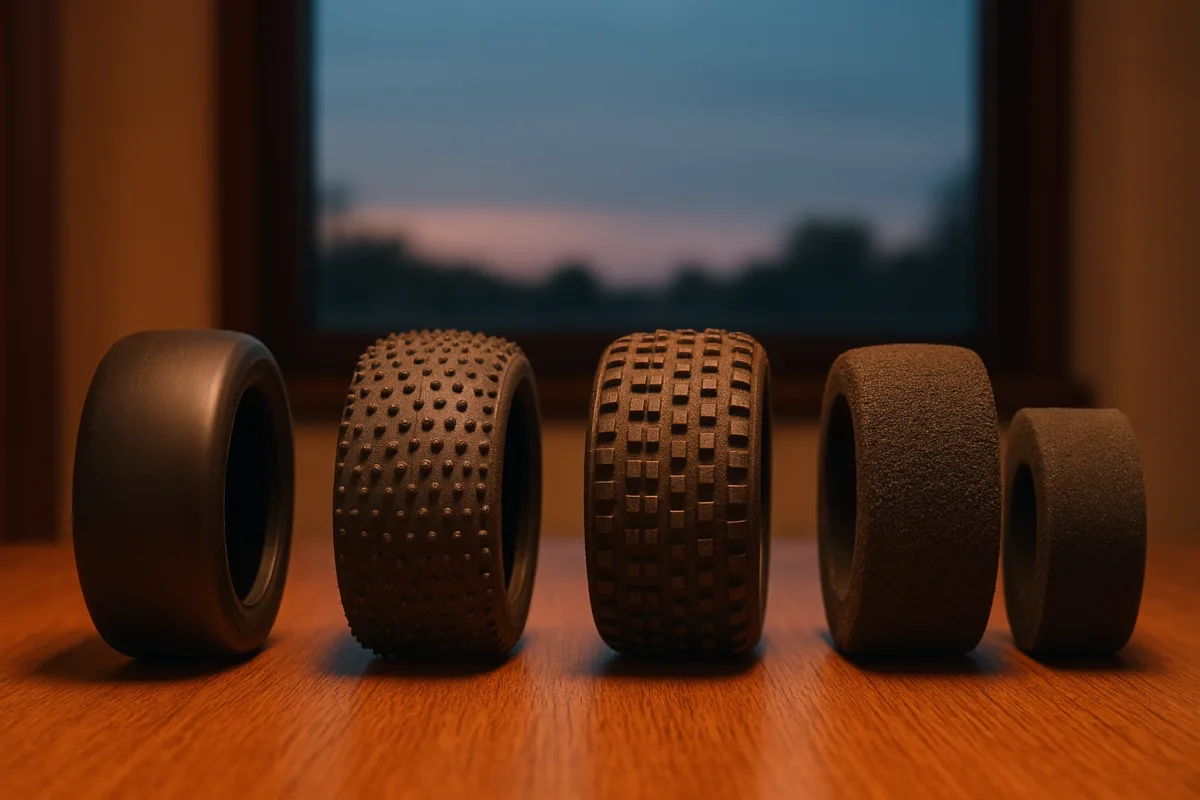
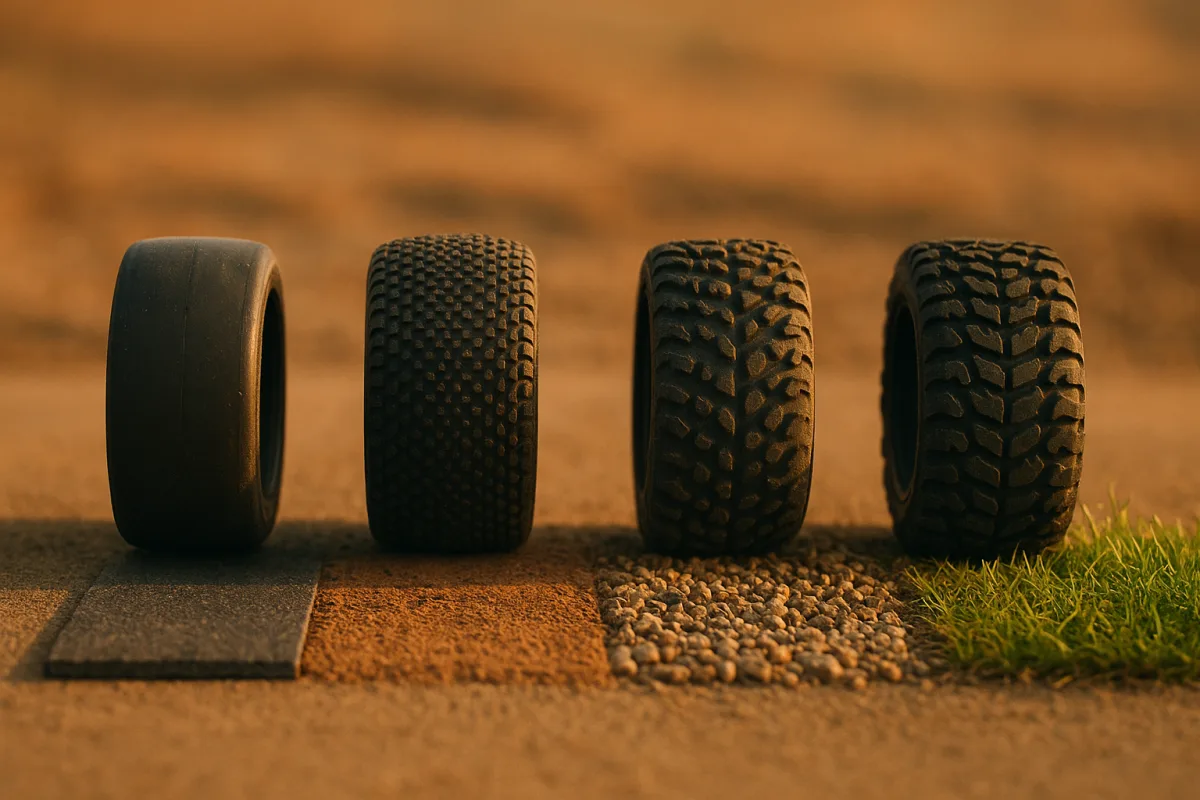
For clean, dry asphalt, start with a slick. TopRC identifies slicks as the traction choice for clean asphalt because uninterrupted rubber puts the largest usable contact patch onto the surface. [1] That is the logical baseline for an on-road car.
When the asphalt is less clean or conditions are mixed, move to a semi-slick rather than forcing a full slick to work. Semi-slicks retain a relatively broad contact patch but offer tread features better suited to debris or variable pavement. [1]
That distinction matters most for 1/10 touring cars, pan cars, and other low-slung on-road classes. A 1/8 truggy with tall off-road tires has completely different carcass, wheel, and clearance requirements, so do not copy a touring-car tire setup onto it.
For loose dirt and dusty tracks, use a pin tire. Minutes of Thunder and VRX Racing both identify pins as the appropriate tread family for loose dirt, where the tread can key into the surface rather than skating across it. [2][3]
On hard-packed dirt, step-pin tires are the more useful starting point. They balance traction with durability better than an aggressive loose-dirt pin layout, which matters once the racing line becomes smooth and abrasive. [2][3]
A slick on dirt is not a tuning choice, it is a surface mismatch. RaceNRCs specifically flags mismatching tire type to the track, including slicks on dirt, as a direct cause of reduced performance. [10]
Solve the car’s first handling complaint
Once you have the correct basic tread family, pay attention to what the car says on track. If it spins the rear tires on corner exit, pushes through the middle, or feels nervous over bumps, those symptoms point toward different tire decisions.
A car that breaks traction on loose dirt needs the tire to conform to the surface. Artexio recommends soft 30 to 35 Shore A compounds for loose dirt, where the softer rubber can generate grip rather than ride on top of dust. [5]
For wet grass, Artexio places the useful range at soft to medium, around 30 to 40 Shore A. [5] That is a compromise between grip and wear, which makes sense because grass can consume soft tread quickly.
Smooth pavement calls for a different compromise. Artexio recommends hard compounds of 45 Shore A or higher for durability and stability on smooth pavement. [5] A pavement tire that wears too quickly or feels imprecise is not automatically too narrow or underpowered, it may simply be too soft.
Do not assume Shore A numbers transfer perfectly from one manufacturer to another. Artexio notes that hardness ratings vary by brand, so a 35 Shore A tire from one line should not be treated as identical to another maker’s 35. [5]
That is why the sensible approach is to compare compounds within one manufacturer’s range first. If the same tread is offered in several compounds, you can isolate the compound change instead of guessing whether different tread geometry caused the improvement.
Pick diameter and width for the amount of grip
The next problem shows up after the car has basic traction. It may now have plenty of forward drive but traction-roll, bicycle onto two wheels, or feel inconsistent from one corner to the next.
RC Tech forum guidance points to larger rear tire diameters, around 43 to 44 mm, as a way to gain lateral bite on low- to medium-traction surfaces. [7] That can be useful when the rear of a 1/10 on-road car will not hold a long sweeper.
A larger tire is not a free upgrade. It changes the effective rollout, so the motor sees a taller gear ratio. On a gear-restricted racing class, check motor temperature and acceleration after fitting a larger diameter rather than assuming the previous pinion remains correct.
Wider tires can increase the contact patch and improve consistency, according to RC Tech forum discussion. [7] But wider rubber can also add rolling resistance, so it is not automatically faster on a low-power or tightly geared car.
When grip is already high, narrower tires can be the better tool. RC Tech cites roughly 22 mm width as a stabilizing choice on high-traction surfaces because reducing available traction helps prevent traction rolling. [7]
This is where racers often buy suspension parts unnecessarily. If a 1/10 touring car traction-rolls on high-grip carpet, a narrower tire or firmer insert may address the cause more directly than immediately fitting stiffer springs, anti-roll bars, or aluminum suspension mounts.
Choose a tire profile that fits the track texture
Tread gets the attention, but profile changes how the contact patch behaves under load. This is especially noticeable when the same basic surface has both smooth sections and broken, rutted sections.
A square-profile tire presents a larger contact patch and offers strong forward traction on smooth surfaces, according to RC Tech. [7] That makes it a sensible direction when acceleration and braking traction are the main limitations.
The trade-off is that square profiles can be less predictable on rough tracks. [7] If the car darts, catches edges, or changes direction abruptly in ruts, more forward bite may not be the cure.
A rounded profile gives more predictable cornering on rough or rutted tracks, though it sacrifices some forward traction on smooth surfaces. [7] For a rough 1/10 off-road buggy layout, predictability can be worth more than the last bit of punch off the corner.
Do not mix profile decisions with compound changes all at once. Fit a profile suitable for the track first, then adjust compound if the car still lacks grip or wears too quickly. Otherwise, you will not know what actually fixed the handling.
Do not throw away traction with the wrong inserts
The tire is only half the assembly. Foam inserts control how much the carcass supports itself, how quickly it responds to steering load, and whether the tread can conform to bumps.
On a low-grip surface, softer inserts generally improve traction because they let the tire conform more readily. On high-grip surfaces, firmer inserts help maintain the tire’s shape and steering precision. [6][9]
Closed-cell inserts are denser and hold their shape more consistently. Minutes of Thunder describes them as suitable for firmer high-grip setups, while softer closed-cell options can still be used where lower grip requires more compliance. [2]
Open-cell foam is more flexible and is preferred for bumpy or low-grip tracks, according to RCTeam. [8] If the car skips across rough dirt despite having an appropriate pin tire, the insert may be too firm for the surface.
Dual-stage inserts combine a firmer inner layer with a softer outer layer. ModelPress describes the intended result as steering precision from the inner support and compliance from the outer foam. [9]
That said, the practical advantage of dual-stage foam is less thoroughly documented than the general soft-versus-firm insert principle. [9] Treat it as an option to test after basic tire, compound, and insert firmness are already correct, not as a magic fix.
Fit matters as much as foam type. RCTeam and RCCrashCrew both warn that inserts degrade over time, changing the way the car handles. [6][8] A tired insert can make a previously reliable tire feel inconsistent even when the tread still looks usable.
Build a usable setup sequence for changing conditions
For clean dry asphalt, begin with a slick and a hard compound suitable for pavement, 45 Shore A or above in Artexio’s guidance. [1][5] Use enough insert support to keep the tire stable, particularly if the car has high grip already.
For dirty or mixed asphalt, begin with a semi-slick rather than a pure slick. [1] If the car feels nervous rather than simply lacking traction, do not immediately go softer, first check whether the insert is allowing excessive tire movement.
For loose dirt, begin with pin tires, soft 30 to 35 Shore A rubber, and a compliant insert. [2][3][5][8] That combination follows the basic requirement: tread that digs, rubber that conforms, and foam that lets the carcass work.
For hard-packed dirt, start with step pins. [2][3] If the surface is smooth and the car needs drive, a squarer profile can help forward traction, while a rounded profile remains the safer direction when the lane develops ruts and broken patches. [7]
For high-traction carpet, start with a slick or purpose-made carpet tire. Minutes of Thunder notes that carpet-specific tires use optimized compounds and tread arrangements for that surface. [2] If the chassis traction-rolls, consider a narrower tire near 22 mm before chasing expensive setup changes. [7]
Avoid the mistakes that make new tires feel worse
Do not run one compound everywhere. RCCrashCrew identifies using the same compound across all surfaces as a common cause of poor grip or poor durability. [6] A hard pavement tire and a soft loose-dirt tire are solving opposite problems.
Do not ignore wear. TinyRacer warns that overlooked wear patterns create inconsistent handling. [11] Check all four corners after a run, because an inside edge wearing faster than the rest can explain a sudden push, loose rear end, or inconsistent turn-in.
Avoid mixing tire brands casually on the same car. TinyRacer notes that different brands can create inconsistent performance. [11] Even if two tires look similar, carcass shape, compound scale, insert fit, and overall diameter may not match.
Clean the wheel and bead before gluing. RaceNRCs warns that neglected rim and bead preparation, along with poor gluing, can lead to tire separation and lost grip. [10] A tire that slips or partially detaches is not a suspension setup issue.
Finally, do not build a tire plan around seasonal temperature or humidity assumptions. The available research did not provide reliable guidance on those effects for RC tires. Keep notes on surface condition, tread, compound, insert, and wear instead.
Frequently Asked Questions
How do I choose RC car tires for asphalt versus dirt?
For clean, dry asphalt, slick tires provide the best traction due to their large, uninterrupted contact patch. If the asphalt is less clean or conditions vary, semi-slick tires offer better performance with some tread features. For loose dirt, pin tires are recommended to key into the surface, while step-pin tires work better on hard-packed dirt by balancing traction and durability.
What tire compounds work best on wet grass for RC cars?
Soft to medium compounds in the range of 30 to 40 Shore A are best for wet grass. This range balances grip and wear, as grass can quickly wear down softer treads. Using a compound in this range helps maintain traction without sacrificing tire life excessively.
Why are foam inserts important for RC car tire performance?
Foam inserts affect how the tire conforms to the surface and maintain its shape under load. Softer inserts improve traction on low-grip surfaces by allowing the tire to conform better, while firmer inserts maintain shape on high-grip tracks for stability. Proper fitment and maintenance of foam inserts are critical because degraded inserts can negatively impact handling and traction.
What tread patterns are best for loose dirt or hard-packed dirt?
Pin tires are best suited for loose dirt as their tread can dig into the surface for grip. For hard-packed dirt, step-pin tires are preferred because they provide a good balance between traction and durability on smoother, abrasive surfaces. Using slick tires on dirt is not recommended as it causes a mismatch that reduces performance.
How we researched this
This article was assembled from 12 cited references.
Nothing here is based on hands-on testing. Where a figure or finding appears, it belongs to the source cited beside it, and the writing says so rather than implying otherwise. Every source is listed below so you can check it.
Sources
- Which tires are best for asphalt / off-road / grass?
- Best RC Car Tires: Compounds, Treads & What to Buy for Every Surface | MinutesofThunder
- How to Choose Tires for RC Car Models: The Ultimate Guide to Grip and Performance - Riverhobby Tech (Shenzhen) Co., Ltd.
- What Are Tire Compounds on an RC Car? Setup & Tuning Guide | So Dialed
- 1:8 RC car tires explained – Shore hardness, foam rubber vs. hollow ch – Artexio
- Tires: Compounds, Tread, and the Foam Inserts Nobody Explains
- R/C Tech Forums - why 24mm rubber touring car when rules allow wider.
- Get the Most Out of Your RC Tires with the Best Foam Inserts
- How to Choose RC Car Tires for Racing
- Why and How to Change RC Car Tires | RaceNRCs – RaceNRCs
- 5 RC Drift Tire Tuning Mistakes to Avoid – TinyRacer
- How to Choose Off-Road Pickup Tires — 2026 Guide
Related Articles
How to Choose RC Car Tires for Different Surfaces
Learn how to choose RC car tires by surface, tread, compound, and size for optimal grip and performance on asphalt, dirt, gravel, and grass.

How to Choose RC Car Tires for Racing
Learn how to choose RC car tires for racing by matching compound, tread, and size to your track surface and conditions for optimal grip and performance.
How to Set Up RC Car for Beginners: Complete Starter Guide
Learn how to set up your RC car for beginners with tips on battery, tires, suspension, and motor for a smooth first drive.
Best Locations for RC Car Off Road
Discover the best locations for RC car off road and how surface type affects your car’s performance and setup.