
Best RC Car Racing Tracks: Choosing the Right Venue
Discover how to choose the best RC car racing tracks based on surface, schedule, facilities, and costs for your class and car type.

Start with the racing you can actually attend
You have found a highly rated RC track, loaded the car, and driven an hour. Then you learn it runs 1/8 nitro on Saturdays, your 1/10 electric buggy class only once a month, and the surface needs tires you do not own.
That is why the best RC racing track is not automatically the biggest facility or the venue with the highest online score. It is the place whose schedule, surface, rules, and cost fit the car you already race, or the class you intend to enter.
Track ratings are still a useful first filter. HUGE R/C Circuit in Bangkok, HobbyTown USA HobbyPlex in Omaha, Nebraska, LCRC Raceway in Pennsylvania, Thornhill Racing Circuit in Texas, and JCP RC Tracks in Indianapolis are among venues carrying racer ratings in the 4.8-to-4.9-star range. [1][2]
Those scores point toward established venues with repeat customers, but they cannot tell you whether a track has a weekly 1/10 stadium truck class, whether it permits your battery connector, or whether race day conflicts with your work schedule.
We would choose access before prestige. A nearby club where you can practice, ask questions, and make every race is usually a better first home than a famous circuit you can visit twice a season.
The key number is your usable race days
A track is a facility, but for a racer it is also a calendar. The number that determines its value is not lap length or social-media followers, it is how many days you can run your class under conditions you can count on.
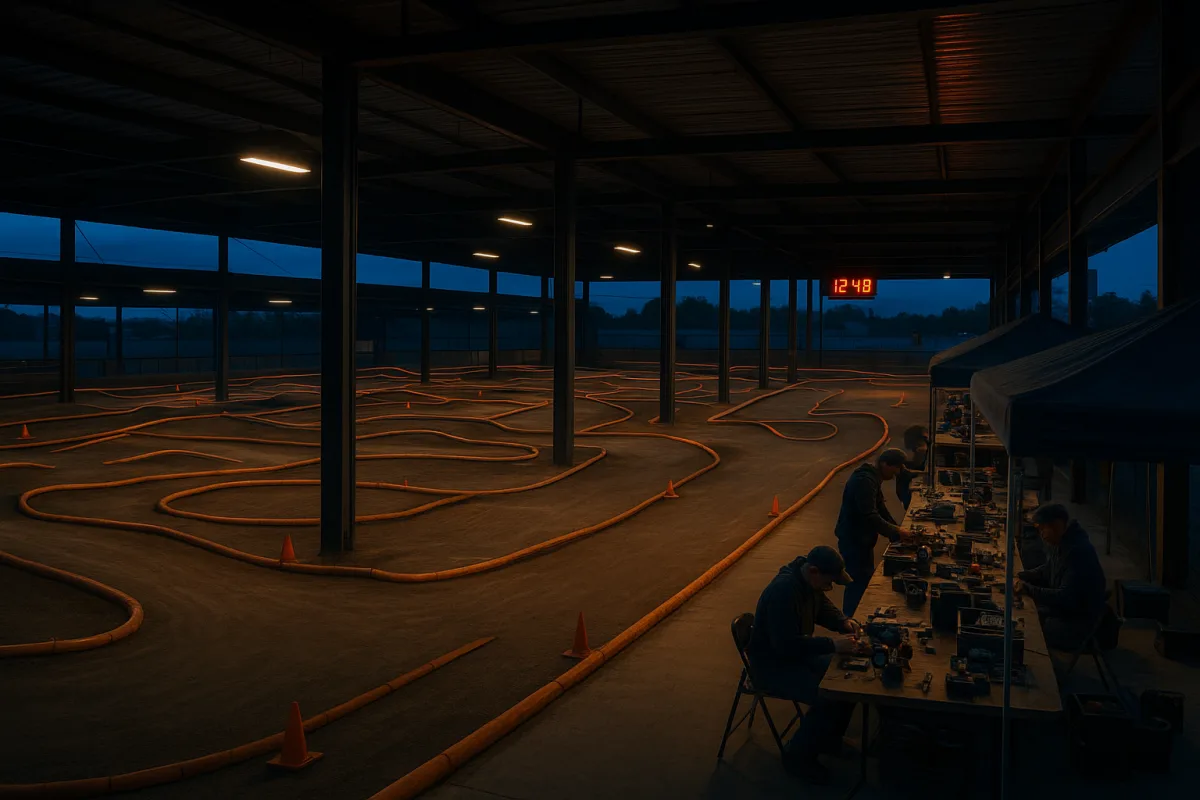
Indoor tracks make that number easier to predict. They provide year-round racing and more consistent conditions because rain, wind, and seasonal temperature changes are outside the driving surface and pit area. [13]
That consistency is valuable when you are new. You can return with the same car, compare changes, and learn whether your driving or your setup moved the lap time, without a rain-softened dirt section changing the whole balance.
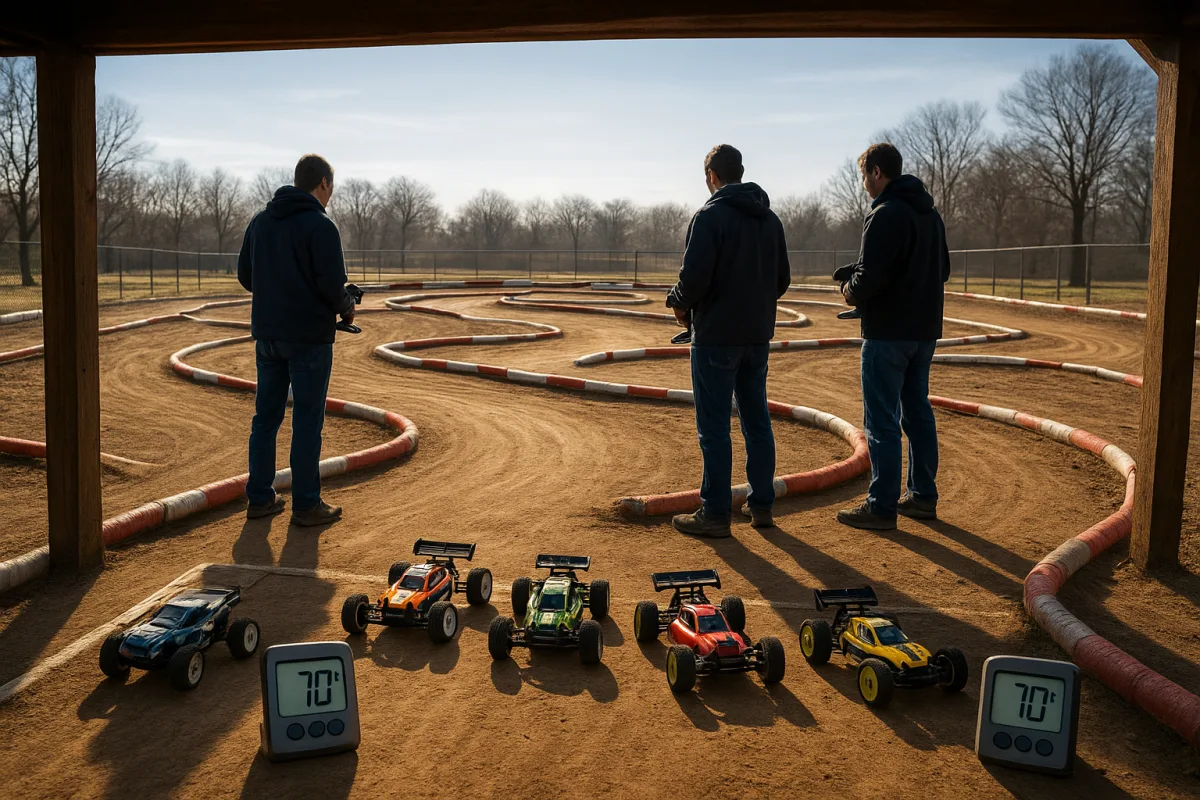
Outdoor tracks work differently. In temperate climates, outdoor club racing may be seasonal, commonly operating from May through September, because weather determines whether the surface and facility are usable. [6]
The outdoor calendar can still be excellent if your local club races regularly during that window. A seasonal dirt track with a strong turnout, organized marshaling, and a maintained layout can give you far more racing than an indoor building that offers little for your class.
Weather also affects preparation. An outdoor venue can mean packing shade, water, a canopy, and spares for dirt and dust, while an indoor venue may trade that uncertainty for fixed pit space, house rules, and a crowded race program.
Surface decides whether your car belongs there
Before you look at lap videos or trophy cabinets, identify the surface. The common mistake is choosing a track because it looks fast, then discovering that its surface and your vehicle type are a poor match. [13]
On-road standards published under the European Federation of Radio Operated Model Automobiles, EFRA, call for unsealed asphalt or a coarse-finish surface with smooth joints. [13] That specification describes a different environment from a loose outdoor dirt course or an indoor carpet layout.
The layout then adds straights, 90-degree and 45-degree corners, and sometimes banked curves. [3] Those elements are familiar, but their size, grip, and sequence decide whether a track rewards clean corner exits, precise braking, or confidence over uneven dirt.
For a typical 1/10-scale off-road club facility, a track around 30 by 50 meters is a useful reference point. [3] That gives organizers room for a real lap with jumps, turns, passing opportunities, and a driver stand view of the whole course.
A backyard layout can be only about 10 by 15 meters. [3] That can be great for practicing steering control or testing whether a repair works, but it is not a substitute for learning traffic, racing starts, marshaling, or a full club race format.
Do not assume a particular surface tells you exactly which shock oil, motor, battery, or differential fluid to run. Published venue information does not establish track-specific setup prescriptions, and buying upgrades before you know the local surface is an expensive way to guess.
We would first ask the race director or regular racers which tire compounds and classes are currently used. Tires are a surface decision. A high-dollar motor or aluminum option part will not fix a tire choice that does not match the track.
Indoor versus outdoor is a commitment choice
The indoor-versus-outdoor decision is really a choice between repeatability and seasonal variety. Neither format wins everywhere, but the wrong one can leave your RC car sitting on the shelf for months.
Indoor racing is the stronger choice if you need dependable access through winter, live where rain frequently closes dirt facilities, or want to practice in stable conditions. The cost may be higher, but regular seat time has a direct value.
Outdoor racing suits you if the local club has a healthy schedule and you enjoy a changing layout and conditions. You need to accept that weather can cancel practice, race days, and maintenance plans. [6]
A serious venue can soften either compromise with its facilities. Powered, covered pit areas let you charge and work on the car; air compressors help with cleaning; and a hobby shop on site can rescue a race day when a suspension arm breaks. [13]
Timing matters, too. Systems such as MyLaps record laps and organize heats, which turns a busy race day into something you can follow. [13] Food service, internet access, rental options, and organized pit space also make a long day easier for new racers and families.
These details are not luxury extras if you race regularly. A powered pit can save you from arriving with a fully charged pack but no practical place to maintain the car, while an on-site shop may save the entry fee you would lose to one broken part.
What regular racing costs
The entry price is only one layer of the venue decision. Membership, race entries, consumables, travel, and breakages determine whether you can keep showing up after the first exciting month.
Published examples show how widely facility pricing can vary. Chargers RC in Australia lists annual membership from $40 to $110, while Race Place RC in the United States has monthly pricing from $100 to $150. [5]
Race entry examples run from $5 to $25, depending on membership status and class. [5] An entry fee buys your place in that race program, but it does not generally cover your transportation, battery charging equipment, replacement parts, or tire wear.
Read every price as a local figure, not a worldwide benchmark. The cited examples come from Australian and U.S. venues, and track fees can change with rent, insurance, indoor utilities, club structure, and the number of classes you enter. [5]
For a new racer, a club membership can be the better deal if it reduces repeated race fees or includes practice access. It is a poor deal if the club barely runs your class, so ask for the current schedule before paying an annual fee.
Also ask whether a race day uses one entry per driver, one fee per class, or separate practice and race charges. A racer who enters two classes can face a very different total from someone running one car.
Rules and local classes decide your path
Tracks do not operate as open pavement or dirt all day. They organize classes, heat sheets, vehicle inspections, marshaling, battery rules, and driving etiquette so several racers can share the course safely and fairly.
In North America, the Radio Operated Auto Racing organization, ROAR, sets a regional framework for racing rules and classes. Europe uses EFRA standards for comparable regional organization, including track guidance. [10][13]
Those bodies help make racing recognizable from one club to another, but the local track still controls its program. A venue may have strong turnout for one scale and no active racers at all for another.
This is where newcomers lose money. They buy a popular kit online, then find their nearest circuit runs a different class, a different tire rule, or a battery specification that requires another purchase.
Ask four questions before committing: Which classes run weekly, what vehicles are legal, what tires are required or commonly used, and what time does technical inspection close? Write the answers down, because each affects what you bring and buy.
You should also learn the local driving and marshaling routine. Fast racers still need marshals after flips and crashes, and a friendly club remembers the driver who helps turn marshals over and keeps the program moving.
How to use ratings without being fooled by them
There is no comprehensive worldwide ranking that can name one definitive best RC car racing track. International Federation of Model Auto Racing events and racer reviews provide reference points, but user ratings remain subjective and coverage is uneven. [1]
North America holds 34.65 percent of the hobby radio-control market in 2025, followed by Asia Pacific at 29.63 percent and Europe at 28.15 percent. [11] That concentration helps explain why North American venues are easier to find in English-language directories.
It does not mean the best racing exists only there. HUGE R/C Circuit in Bangkok is one of the highly rated examples, while the other listed venues show the depth of established racing facilities in the United States. [1][2]
Use a high rating as an invitation to investigate, not as the final answer. Look for recent activity, a clear schedule, active class listings, photos of the pits and driver stand, and evidence that the venue maintains the track between events.
Thornhill Racing Circuit is a good example of a named destination facility, but your decision should still begin with whether its schedule serves your class and travel radius. [2] A track cannot become your home venue if getting there makes regular practice impossible.
Visit on a race day before you commit
The fastest way to find your best track is to visit during a normal club race, not only during a quiet weekday practice. You will see the real parking situation, pit crowding, race pace, turn marshal system, and the classes that actually draw entries.
Bring your car only after you know it is eligible, or bring nothing and ask questions. Watch what racers run on the surface, how they clean and maintain cars, and which parts the on-site shop carries when something breaks.
Pay attention to the facility’s working systems. A covered pit with power, reliable timing, an organized driver stand, and clear announcements can make a long race day run smoothly even if the track is not the largest in your region. [13]
We would skip the urge to buy an expensive upgrade after one visit. Start with the venue that has a healthy class for your scale, a schedule you can keep, and a surface your car is built to race.
Frequently Asked Questions
What factors make a good RC car racing track?
A good RC racing track reliably runs your scale and class and has a layout and surface you can practice on regularly. The track’s schedule, surface type, local rules, and available pit facilities are key factors to consider before judging its quality. Access and usability for your specific car and class are more important than prestige or online ratings.
How do indoor and outdoor RC tracks differ?
Indoor tracks offer consistent year-round racing with stable conditions protected from weather, making them ideal for regular practice and predictable performance. Outdoor tracks are often seasonal, typically operating in temperate climates from May through September, and can provide a larger community and varied conditions but require preparation for weather and dirt.
What should I consider before choosing an RC racing track?
Before choosing a track, confirm that it regularly runs your class and check the local rules and calendar to ensure race days fit your schedule. Consider the surface type to match your car and tires, and visit on race day if possible to see the environment and confirm details before investing in tires or setup changes.
How does track surface affect RC car racing?
The track surface determines tire choice and vehicle setup; for example, on-road tracks often use unsealed asphalt or coarse finishes with smooth joints, while off-road tracks may be dirt or carpet. Using tires and setups suited to the surface is essential, as even expensive upgrades won’t compensate for poor tire selection on an incompatible surface.
What are typical costs associated with regular RC racing?
Regular racing costs include club membership fees, race entry fees, tires, maintenance parts, and travel expenses. Entry fees can range from $5 to $25 per race depending on membership and class, and memberships vary widely from monthly fees around $100 to annual fees between $40 and $110.
How we researched this
This article was assembled from 13 cited references.
Nothing here is based on hands-on testing. Where a figure or finding appears, it belongs to the source cited beside it, and the writing says so rather than implying otherwise. Every source is listed below so you can check it.
Sources
- RC Tracks USA, Official Business Directory for RC Race Tracks & Hobby Shops
- Thornhill Racing Circuit, Adrenaline Racing Live
- How to Design an RC Car Track: Layout Ideas for Backyard, Car Park & Club Tracks, RaceTrackDesigner.com
- TMAC 2026 Track - Tamiya Mini 4WD Track Layout
- Track Fees | AMain Tracks / Silver Dollar RC Raceway
- DirtRunners RC Car Club, Outdoor Track - RCGuides
- WE R RC
- MHOR R/C Raceway - RC Car Place
- Tracks - Meatball Racing
- ROAR Racing Explained: Rules, Classes, Membership | RC Cars Guide
- Worldwide Hobby Radio Control (R & C) Market 2026, PW Consulting
- MHOR R/C Raceway RC Track in Aurora, Colorado - RCTracks.io
- The Ideal Track, RC Car Action
Related Articles

Best Locations for RC Car Off Road
Discover the best locations for RC car off road and how surface type affects your car’s performance and setup.
Best Locations for RC Car Events: Venue and Track Guide
Discover the best locations for RC car events, including venue size, track layout, pits, and weather considerations for successful races.

RC Car Scale for Racing Tracks: Choosing the Right Size
Learn how to choose the right RC car scale for your racing track size, local classes, and power needs to optimize your racing experience.
Best Time for RC Car Racing: Optimal Seasons and Conditions
Discover the best time for RC car racing with tips on ideal temperatures, seasons, and regional factors for outdoor events.