
RC Car Racing Rules: Stock Class, Motors, Batteries & Setup
Learn RC car racing rules covering stock class motors, batteries, blinky mode, and tuning to compete legally and effectively in races.
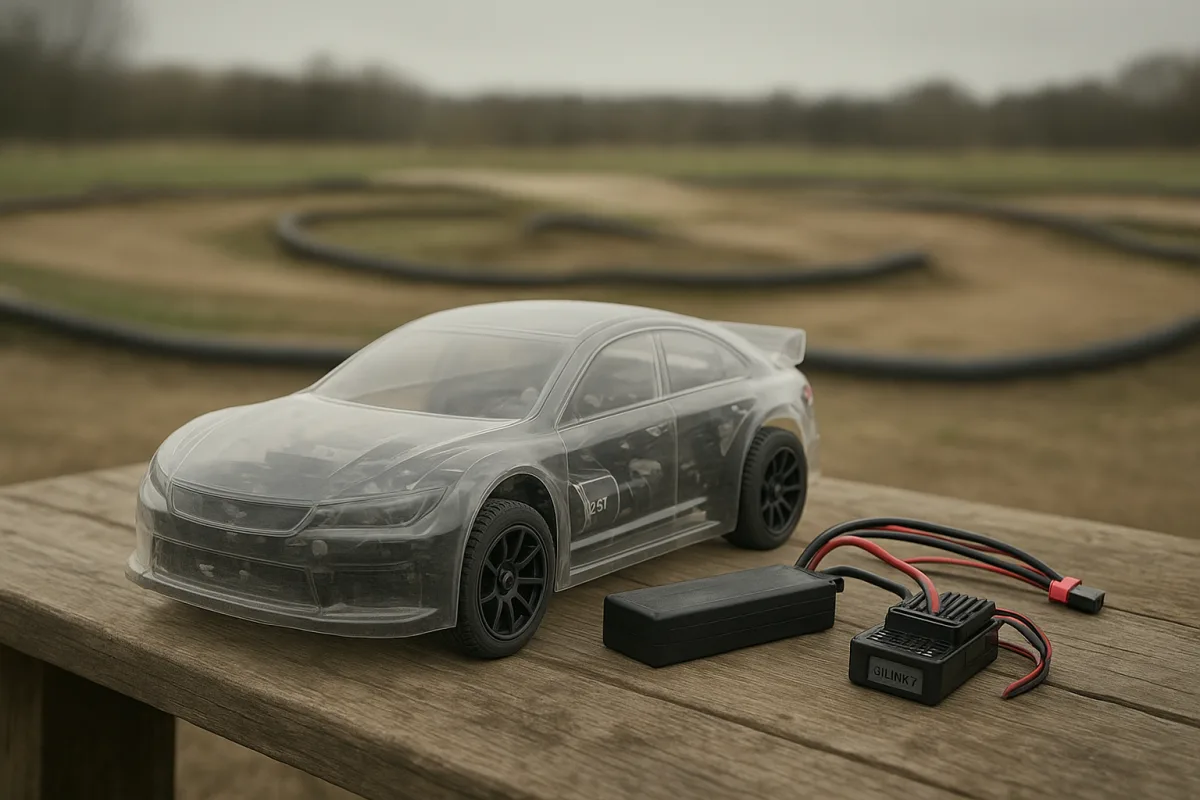
The rule that matters most: the controlled performance envelope
The competition standard worth understanding is not simply “run a 17.5T motor” or “bring a 2S pack.” It is the controlled performance envelope: a set of rules that limits how much electrical power and electronic timing can reach the drivetrain.
That sounds dry until a racer arrives with a quick car that cannot be scored. In electric RC racing, battery voltage, motor wind, rotor specification and ESC programming work together. Change one piece, and the car may no longer belong in the class.
Stock racing exists because equal-ish power makes driving, setup and consistency matter more. It does not make everybody equally fast. A calm rear diff, sensible roll-centre choice and shocks that keep the tyre loaded will still beat a box-stock car with the wrong setup.
ROAR stock rules make the principle unusually clear. The RC Crash Crew explanation of ROAR stock racing identifies 17.5T and 13.5T spec motors, blinky-only ESC operation and 2S LiPo batteries as the core controls. [2]
That package is not four separate suggestions. It is one system. The motor turn count limits the motor’s basic character, the specified rotor limits part of its torque and rpm potential, the battery limits supply voltage, and blinky mode removes programmable timing advance.
Why motor turns are only part of the rule
A brushless motor marked 17.5T has 17.5 turns of wire around its stator. In broad terms, more turns mean lower rpm per volt and usually a softer power delivery than a lower-turn motor, assuming comparable construction.
That is why a 17.5T motor suits a controlled stock class better than an open modified motor. It puts a ceiling on the motor’s likely speed range, rather than asking a newcomer to manage a full modified power system from day one.
But the label alone is not enough. ROAR stock specifications cited by RC Crash Crew include a 12.5 mm rotor requirement for the 17.5T class. [2] Rotor dimensions affect magnetic strength, torque and how aggressively the motor pulls under load.
This is the bit new racers often miss while browsing motors online. A motor can say 17.5T on the can and still be wrong for a particular rules package if its approved rotor, timing arrangement or homologation status does not match.
Do not assume the same detailed motor standards apply everywhere. The available material clearly defines ROAR’s stock setup, but does not provide equivalent detailed IFMAR or EFRA motor specifications. That is a gap in the available information, not permission to infer the rules.
For a club running under a different body, get the current class sheet before spending money. The sensible question is not “is this a good 17.5?” It is “is this exact motor and rotor legal in the class I will enter?”
Blinky mode is a horsepower rule
Blinky mode is the ESC restriction that makes a stock motor actually behave like a stock motor. Under the ROAR rules described by RC Crash Crew, it means no electronic timing advance or boost. [2]
Electronic timing can increase motor rpm, particularly once the car is already moving. Manufacturers give this feature several names, including boost and turbo timing, but the competitive effect is simple: it adds performance beyond the basic motor specification.
A blinky ESC signals its compliant mode through its indicator light, hence the name. The important part is not the light itself. The important part is that timing functions are disabled, so two racers cannot hide a substantial power advantage in programming.
ROAR Modified is different. RC Crash Crew notes that Modified permits open motor choice and ESC tuning. [2] That makes modified a genuine equipment-and-setup class, while stock is deliberately a restricted-power class.
Neither format is automatically better. Modified rewards throttle discipline and careful drivetrain temperatures. Stock makes a driver work harder for lap time through corner speed, braking placement and usable gearing, because there is less power available to cover a poor exit.
The common mistake is treating blinky as a beginner setting that can be switched off once confidence grows. It is a class rule. If the class says blinky, enabling boost is no different in principle from installing a motor outside the permitted specification.
Why 2S versus 3S changes the whole car
Voltage is the other half of the envelope. A 2S LiPo is nominally 7.4V, while a 3S LiPo is nominally 11.1V. That difference is large enough to transform motor speed, heat load, gearing needs and the car’s controllability.
For ROAR stock classes, the battery cap is 2S LiPo and the maximum charged voltage is 8.4V, according to RC Crash Crew’s summary. [2] A legal 2S pack is therefore not merely conventional, it is a fixed boundary around the class.
Do not carry that boundary into every rulebook. The track-rules comparison published by Chasing Grip reports that IFMAR and BRCA permit up to 3S LiPo in comparable classes, while ROAR restricts stock racing to 2S. [8]
That distinction can catch out racers who watch overseas events or buy used equipment from another region. A 3S setup may be perfectly normal under one organiser’s standard and completely illegal in a ROAR stock heat.
It also explains why advice from the wrong scale or class becomes nonsense fast. A 1/10 electric touring car on a controlled 2S stock system needs a different gearing and cooling strategy from a 1/8 truggy built around much higher power demand.
Battery capacity is not a free speed upgrade either. HobbyKing’s discussion of larger packs points out the practical trade-off: more capacity generally adds weight. [10] In a six-minute off-road race, extra runtime is useless if the added mass makes the buggy lazy in direction changes.
C-rating deserves the same sober treatment. A bigger printed C number promises greater current capability, but it does not override the voltage rule, motor rule or ESC mode. Buy a legal pack that fits the tray, meets runtime needs and has a credible connector and condition.
Gearing is where legal cars become competitive
Once motor, ESC and battery are controlled, gear ratio becomes one of the most useful legal tuning tools. Final drive ratio tells you how many motor revolutions are required for one wheel revolution after the spur, pinion and internal transmission reductions.
A smaller pinion gives a numerically higher final drive ratio. That normally improves punch and reduces motor load, but caps top speed earlier. A larger pinion lowers the numerical ratio, extends top speed and increases motor, ESC and battery stress.
On a short, technical 1/10 buggy track, the racer generally wants enough acceleration to clear jumps and leave tight corners cleanly. On a flowing touring-car layout, more rollout may be useful if the motor stays inside safe temperature limits.
The rules do not usually choose your pinion for you, but they shape every gearing decision. A 17.5T blinky 2S car cannot be geared like a boosted setup, because it needs mechanical ratio to obtain speed rather than electronic timing.
That is why expensive hop-ups are often not the fix. Before fitting a fancy motor or lightweight drivetrain piece, check for a slipping slipper clutch, tight diff, dragging bearing, overheated motor and gearing that does not suit the straight.
The race format makes compliance matter
Rules define more than hardware. Typical club formats use two or three qualifying rounds of roughly five to seven minutes, followed by mains labelled A, B, C or D, with bump-ups available from lower mains in some programs. [4][5]
Qualifying commonly uses staggered starts and timed runs, rather than a full-grid drag race. That means a racer is chasing total time or laps against the clock, so a clean six-minute drive often matters more than one spectacular fast lap. [4]
Mains are often mass starts, which changes the value of setup. A car that is brilliant alone but snappy in traffic can lose positions in the first corner. A stable car that can take a bump and still rotate is usually easier to race.
Formats vary by discipline. The general rules collected by DirtRunner’s R/C Car Club identify six-minute off-road races, while oval events may specify mains by laps, such as a 50-lap A-main and 40-lap B-main. [5]
The implication for batteries is practical. Build for the race duration with margin, not for the longest pack you can physically squeeze into the chassis. A heavy pack that finishes with half its capacity unused may cost more lap time than it saves.
The organiser controls the track as well as the car
Competition standards also reach into the circuit. Chasing Grip’s comparison says EFRA on-road rules require a minimum 200 m track length, alongside defined width and marshal-post spacing requirements. [8]
ROAR’s 1/10 electric off-road standard is much more directly concerned with usable racing lanes. The same comparison cites a minimum eight-foot lane width. [8] That sounds like venue detail, but it affects passing, jump placement and what counts as a safe racing line.
Do not turn those figures into universal construction rules. An eight-foot off-road lane requirement and a 200 m EFRA on-road minimum describe different disciplines and governing systems. They are not interchangeable standards for every club carpet track, dirt track or parking-lot layout.
Vehicle size and weight deserve similar caution. Many classes operate around a 1,350 g minimum weight, but the supplied material does not establish definitive official limits for every 1/10 or 1/8 category. [12] Check the current class rulebook, not an old forum post.
What a new racer should check before practice
Start with the sanctioning body and exact class name printed on the entry list. “Stock,” “17.5,” “sportsman” and “blinky” can overlap at one club and mean materially different things at another, particularly where local rules fill gaps.
Then inspect the complete power system. Confirm the motor turns and rotor, set the ESC to the required mode, verify battery cell count and charged voltage, and make sure plugs, wires and solder joints are in sound condition.
Finally, ask the race director about local procedures. RC3 Racing notes that breakout lap times can change when the layout changes, while Coral Springs RC Track states that weather can lead to adjusted race durations. [6][11]
Those are venue decisions, not a standardized seasonal rulebook. The disciplined approach is simple: bring a legal, maintainable car first, then tune springs, oil, diff fluid and gearing around the actual surface and format.
That is the real value of competition standards. They keep the question focused. Instead of asking which expensive part will make the car faster, ask whether the car is legal, free-rolling, correctly geared and stable enough to deliver six clean minutes.
Frequently Asked Questions
What are the key rules for stock class RC car racing?
Stock class rules define a controlled performance envelope that includes limits on motor specifications, battery voltage, and ESC settings. For example, ROAR stock classes require a 17.5T or 13.5T motor with a specified rotor, a 2S LiPo battery, and an ESC running in blinky mode. These rules ensure power and speed remain within a manageable range to emphasize driver skill and setup.
How does blinky mode affect RC car racing rules?
Blinky mode is an ESC restriction that disables electronic timing advance or boost, preventing any programmed performance gains beyond the motor’s base specifications. In ROAR stock classes, blinky mode ensures all racers have equal power delivery by removing timing adjustments, making it a fundamental class rule rather than a beginner setting.
What battery types are allowed in ROAR stock class racing?
ROAR stock class racing limits battery voltage to 2S LiPo packs, which have a nominal voltage of 7.4V and a maximum charged voltage of 8.4V. This voltage cap is a key part of the performance envelope and differs from other sanctioning bodies that may allow 3S LiPo batteries.
Why is motor turn count important in RC racing rules?
The motor turn count, such as 17.5 turns, limits the motor’s rpm per volt and power delivery characteristics. It helps cap the motor’s speed and torque, making it suitable for controlled stock classes. However, the turn count alone is not sufficient; rotor size and homologation status also affect legality and performance within the rules.
How do RC car racing rules differ between ROAR and IFMAR?
ROAR stock classes strictly limit battery voltage to 2S LiPo, specify motor turns and rotor size, and require ESCs to run in blinky mode. In contrast, IFMAR and BRCA may permit higher voltage batteries such as 3S LiPo and have less publicly detailed motor specifications. Because of these differences, setups legal under one sanctioning body may be illegal under another.
How we researched this
This article was assembled from 13 cited references.
Nothing here is based on hands-on testing. Where a figure or finding appears, it belongs to the source cited beside it, and the writing says so rather than implying otherwise. Every source is listed below so you can check it.
Sources
- RC Touring Car Guide: Everything About On-Road Racing (2026) | RC Cars Guide
- ROAR Stock Class: Blinky Mode, Spec Motors and the 2S…
- Racing Rules 2026 – Rc Hotwheels
- The basics of R/C Racing - R/C Tech Forums
- General Rules / Procedure – DirtRunner's R/C Car Club
- RC3 Racing - FAQ
- RC Car Sizes Explained: The Ultimate Guide to RC Scale Sizes (1/8, 1/10, 1/16, 1/18, 1/24) - Riverhobby Tech (Shenzhen) Co., Ltd.
- On-Road Track Rules — EFRA, IFMAR, ROAR, BRCA — Chasing Grip knowledge base
- Best Tamiya Chassis for Racing, and Tuning Mistakes
- Blog - Why Bigger Batteries Don’t Always Help RC Cars
- Track Rules | Coral Springs RC Track
- Understanding RC Car and Truck Racing Rules
- ISTC Touring Cars | Geelong RC Racers
Related Articles

RC Car Safety Regulations
Learn about RC car safety regulations, radio compliance, and best practices for batteries and equipment in the US, UK, and EU.
Common RC Car Motor Mistakes: KV, Battery & Setup Tips
Learn common RC car motor mistakes including KV misunderstandings, battery matching, and setup tips to avoid overheating and poor performance.

RC Car Scale for Racing Tracks: Choosing the Right Size
Learn how to choose the right RC car scale for your racing track size, local classes, and power needs to optimize your racing experience.

Best Locations for RC Car Events: Venue and Track Guide
Discover the best locations for RC car events, including venue size, track layout, pits, and weather considerations for successful races.