
RC Car Scale Comparison for Racing: 1/10 vs 1/8 Explained
Compare RC car scales for racing, focusing on 1/10 vs 1/8 size, track fit, costs, and performance to choose the right scale for your racing needs.
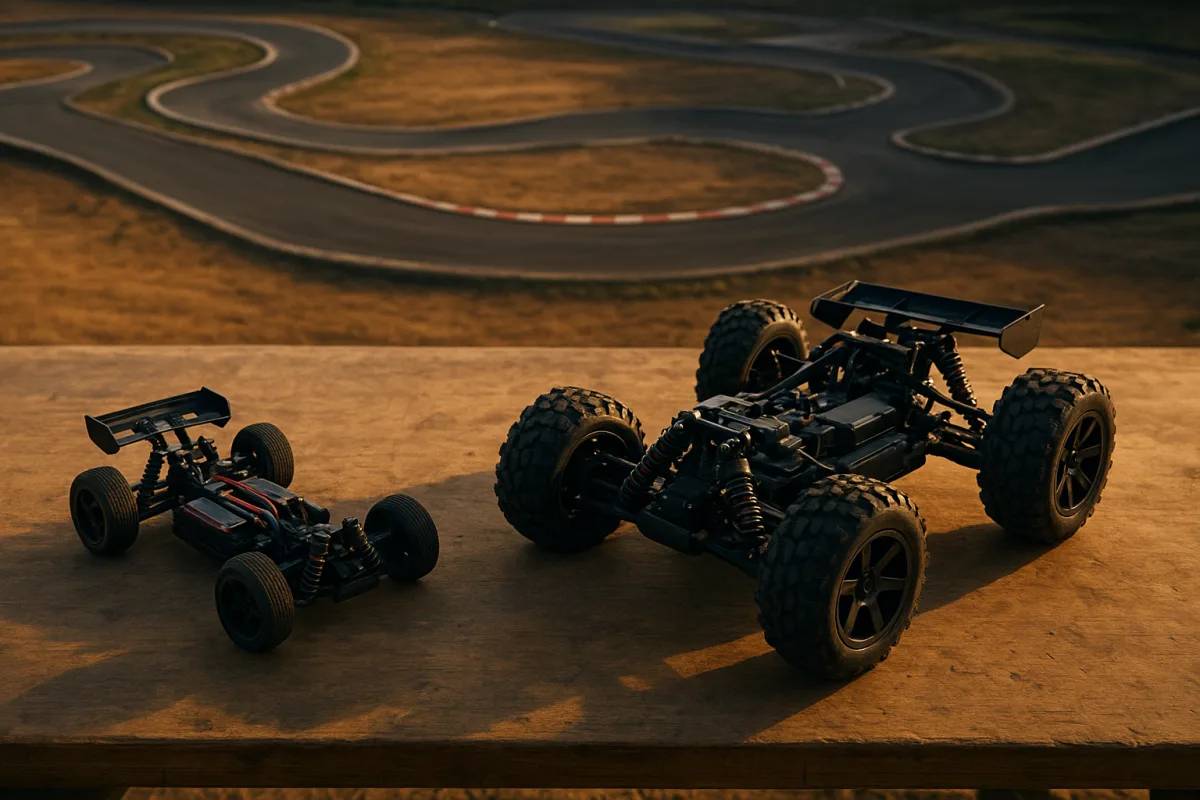
Scale is the racing decision that sets everything else
You are standing at the track with a budget, a parking spot at the drivers’ stand, and a local class list. Before you choose a body style, motor, or expensive aluminum option, choose the scale that belongs there.
For competitive racing in 2026, the two scales with the strongest presence are 1/10 and 1/8. [1][3] They are not interchangeable versions of the same experience, because their size determines the track they need, the battery voltage they carry, and the cost of getting race-ready.
Scale describes the model’s size relative to a full-size vehicle. A 1/10 car is roughly one-tenth the size of its real-world counterpart, while a 1/8 car is larger in every dimension. [2][4] That sounds like a catalog detail, but it controls what happens every lap.
A larger car has more physical space, more mass, and more speed potential. It also needs a wider racing line, more room to stop and turn, and a track surface that does not make a small section feel oversized.
This is why the best RC car scale for racing is not a universal answer. For most new racers, we would pick 1/10 because it is the lower-cost, widely supported route into organized competition. [1][6][13]
The exception is clear. If your club’s competitive off-road program is built around 1/8 cars and runs on a large, rough layout, buying 1/10 because it is cheaper puts you in the wrong class from day one. [12][13]
What your scale buys in physical size
A typical 1/10-scale RC car measures about 17 to 22 inches long and weighs roughly 3 to 5 pounds. [6] That size works across a wide range of terrains and track types, which is a large part of why 1/10 is so common.
The same flexibility helps when you are learning racecraft. Standard tracks and smoother surfaces suit 1/10-scale cars, while limited-space layouts also favor smaller models. [12][13] You need less room to make the car feel correctly sized for the course.
A 1/8-scale car is usually about 22 to 26 inches long and weighs approximately 5 to 9 pounds. [6] Put one beside a 1/10 car in the pits and the difference is obvious, but the important difference arrives when both are moving.
The 1/8 has the size and weight for larger off-road courses and rougher terrain. [6][12] A layout with bigger jumps, open straights, and uneven ground gives the car room to use its strength without feeling crowded.
That extra scale changes the consequences of a poor choice. A 1/8 car on a small standard track can make every corner feel compressed, while a 1/10 car on a very large rough course can lack the presence the layout expects.
Do not mistake physical size for automatic performance. A car that is too large for the available track is not a faster racing solution, because the space limits its ability to turn, brake, and carry speed cleanly.
The class list decides who you race
The local racing class is the first number you should check, before clicking Buy Now. RC Mods, Model Press, and RC Saver all identify ignoring local racing classes and parts availability as common mistakes for new buyers. [13][15][17]
Racing needs other drivers using the same basic format. A well-supported 1/10 class means fellow racers, compatible event structure, and a reason for shops and clubs to carry parts for that scale. [1][3]
A car can be impressive on paper and still be a poor race purchase if nobody at your club runs it. You would spend money on a model with no clear class, no regular competition, and potentially weak local parts support.
This is also where “best” separates into two answers. The best entry scale for a racer without a club commitment is 1/10. The best scale for a racer joining an established 1/8 field is 1/8, because matching the class gets you on the grid.
Check the club schedule, watch what racers place on the pit tables, and ask which classes receive regular entries. Then assess whether the track itself is standard and smooth, or large and rough enough to favor 1/8. [12][13]
There is no published evidence here that your region or the season changes the preferred scale. The deciding factors are the space, the racing type, your budget, and the classes operating where you intend to race. [12][13][17]
Battery voltage follows the scale
Battery choice is where scale becomes a mechanical commitment. Racing packs must provide power for a short, hard run without adding so much weight that the car becomes less manageable, and typical race runtime is around five minutes. [8][11]
For 1/10 racing, the common battery specification is a 2S, 7.4V LiPo pack. Recommended capacity falls in the 3000 to 5000mAh range, with a 50C or higher rating cited for the power demands of these cars. [8][9]
The 3000 to 5000mAh figure is not a license to choose the biggest pack every time. Capacity affects runtime, but battery size and weight also affect handling, so the pack must fit the car and suit the balance you need. [11]
That is the recurring tradeoff in racing scale choice. More battery capacity can extend runtime, but extra battery weight changes what the chassis carries through corners, bumps, and direction changes. [11] A heavier pack is not automatically the better race pack.
A 1/8 racer typically uses a 4S, 14.8V LiPo battery. [10] That higher-voltage setup fits the scale’s performance and larger-track role, but it also makes the battery system a more serious part of the purchase and maintenance budget.
Specific mAh recommendations for 1/8 racing are not established in the available guidance. The emphasis is on fitting the battery tray, balancing power against weight, and choosing a pack appropriate to the car rather than chasing one universal capacity figure. [10]
Do not buy a 1/8 car assuming a battery recommendation from 1/10 will transfer across. The voltage requirement differs, and the available guidance does not support a single 1/8 capacity number that works for every chassis. [9][10]
Cost is bigger than the chassis price
A 1/10-scale car commonly costs about $200 to $500 or more, while a 1/8-scale car is commonly listed from $500 to $1,000. [6] Those figures describe the car itself, not the complete cost of joining a racing program.
You still need compatible LiPo batteries, and the scale determines whether you are buying 2S or 4S packs. [8][10] You also need the replacement parts that follow inevitable racing wear, particularly if your local store supports one scale better than another. [13][15]
The larger car costs more up front and carries higher maintenance costs. [6][10] That does not make 1/8 a bad value, because its intended environment is rougher and larger, but it does mean you should enter with a realistic budget.
Speed figures show why the two scales belong in different environments. Typical 1/10 cars are listed at 30 to 60 mph or more, while 1/8 cars are listed at about 50 to 70 mph. [6] Neither figure tells you which scale will race better on your track.
A small course does not reward headline speed if you cannot use it. For racing, a car that fits the track, has available parts, and runs in a healthy class offers a better experience than a faster model that constantly feels oversized.
Why 1/10 is the starting point we would choose
For a new racer deciding without a firm local class requirement, we would choose 1/10. It is the scale repeatedly recommended as the starting point, combining broad racing support, lower purchase cost, manageable size, and versatility across track types. [1][6][13][17]
Its 17-to-22-inch size makes storage and transport less demanding than 1/8, while the common 2S battery format keeps the electrical system within the established 1/10 racing pattern. [6][8] You can focus on learning the class instead of solving a scale mismatch.
That learning phase matters because beginners commonly buy a scale that is too large for their available space or skill level. [13][15][17] The expensive upgrade is rarely the answer when the car does not fit the circuit or the local entry list.
Start with the track. If it is a standard layout with a smooth surface, 1/10 is the natural first choice. [12][13] If it is a limited-space venue, moving down in scale can make more sense than forcing a large car into a tight course. [13]
A 1/12-scale car provides a specialized example. It is smaller, runs around 25 to 50 mph, and excels on smooth indoor tracks, though its components are more delicate. [5] Choose it for that specific indoor setting, not as a substitute for every 1/10 class.
When 1/8 is the better race car
Choose 1/8 when the track gives it the room and surface it needs. Large off-road facilities, rough terrain, and layouts where high speed can be used make the bigger car’s size, durability focus, and 4S power system appropriate. [6][10][12]
A 1/8 purchase also makes sense when that is where your club’s active racers are. The higher initial price, larger battery requirement, and added maintenance are easier to justify when they buy entry into a regular class with available competition. [10][13]
Do not buy 1/8 solely because it is bigger, faster, or looks tougher. Those qualities are strengths on the correct track, but they do not solve a cramped layout, a missing local class, or a budget that only covers the bare car.
Your first change, if the racing experience feels wrong, should be to recheck the class and track match. Scale determines the whole system: chassis size, battery voltage, running costs, parts support, and the kind of circuit where the car can race well.
Frequently Asked Questions
What are the differences between 1/10 and 1/8 scale RC cars for racing?
1/10 scale RC cars are smaller, typically 17 to 22 inches long and weighing 3 to 5 pounds, while 1/8 scale cars are larger, about 22 to 26 inches long and 5 to 9 pounds. The 1/8 scale cars run on higher voltage (4S) batteries, are faster, and better suited for large, rough tracks. In contrast, 1/10 scale cars use 2S batteries, are less costly, and fit standard tracks and smoother surfaces better.
How does RC car scale affect track compatibility and racing performance?
The scale determines the size and speed of the car, which influences the type of track it can race on. Smaller 1/10 scale cars perform well on standard and smaller tracks with smoother surfaces, requiring less space to maneuver. Larger 1/8 scale cars need wider racing lines, bigger jumps, and rougher terrain, making them suitable for large off-road courses but less compatible with small or tight tracks.
Which RC car scale is better for beginners entering racing?
For most beginners, 1/10 scale is recommended because it is lower cost, widely supported in organized racing classes, and compatible with standard tracks. It uses common 2S battery packs and offers a broad entry point into competitive racing. Beginners should also consider the scale their local club races to avoid being in the wrong class.
What factors should I consider when choosing RC car scale for racing?
Consider the racing classes your local club supports, the size and surface of your available track, your budget, and maintenance capabilities. A 1/10 scale car suits smaller, standard tracks and lower budgets, while a 1/8 scale car fits large, rough tracks but requires more investment in batteries, spares, and space. Choosing the correct scale for your environment and racing goals is crucial.
How does scale influence cost and maintenance in RC car racing?
Larger scales like 1/8 increase the cost of the car, batteries, and spare parts, and also raise the maintenance workload due to their size and power requirements. Smaller 1/10 scale cars are generally less expensive to buy and maintain, making them more accessible for newcomers. Budgeting for batteries, spare parts, and track space is important regardless of scale.
How we researched this
This article was assembled from 18 cited references.
Nothing here is based on hands-on testing. Where a figure or finding appears, it belongs to the source cited beside it, and the writing says so rather than implying otherwise. Every source is listed below so you can check it.
Sources
- RC Car Scales Explained (1/10 vs 1/8 vs 1/16) | RC Car Compare
- RC Car Sizes Explained: Guide to 1/8, 1/10, 1/16, 1/18, 1/24 Scales | VRX Racing
- RC Car Scales Explained: Which Size Is Right for You?, ToylandEU™
- RC Car Scale Sizes Explained (With Chart) | Shock & Servo
- 1/10 vs 1/12 RC Cars: Which Scale is Right for You? - RC Ratings
- Understanding RC Car Scale Sizes: A Comprehensive Guide [Infographic] - RC Superstore
- 10 Best 1/10 Scale RC Cars for Racing (November 2026) Verified Reviews
- Why LiPo Batteries Are Standard in RC Cars and Boats - Hanery
- How to Choose LiPo Batteries for RC Racing | Speed World Raceway
- What Battery Do I Need for 1/8 Scale RC Racing?
- RC Battery mAh Explained: Runtime, Size and Weight | RC Setup Lab
- How to Design an RC Car Track: Layout Ideas for Backyard, Car Park & Club Tracks, RaceTrackDesigner.com
- RC Car Scale for Racing Tracks: Choosing the Right Size
- How to choose your first RC car · RC Paddock
- RC Car Scale Sizes Explained (1/8, 1/10, 1/18, and More) | RC Saver
- How to Choose Your First RC Car: Buggy, Truck, or Crawler? Beginner’s Guide, RC Models Hub
- RC Car Scales Explained: 1/24 to 1/5
- RC Car Scales Explained, 1:8, 1:10, 1:12, 1:18, 1:24 | RCUK
Related Articles
RC Car Scale for Racing Tracks: Choosing the Right Size
Learn how to choose the right RC car scale for your racing track size, local classes, and power needs to optimize your racing experience.
Best RC Car Racing Tracks: Choosing the Right Venue
Discover how to choose the best RC car racing tracks based on surface, schedule, facilities, and costs for your class and car type.
Best Locations for RC Car Events: Venue and Track Guide
Discover the best locations for RC car events, including venue size, track layout, pits, and weather considerations for successful races.
What Size Motor for RC Car: Choosing the Right Can and KV
Learn what size motor fits your RC car scale and how to match KV rating for optimal performance and reliability.