
RC Car Maintenance Schedule: Routine Checks & Cleaning Tips
Learn an effective RC car maintenance schedule with post-run checks, weekly tasks, and battery care to keep your vehicle reliable and ready to run.
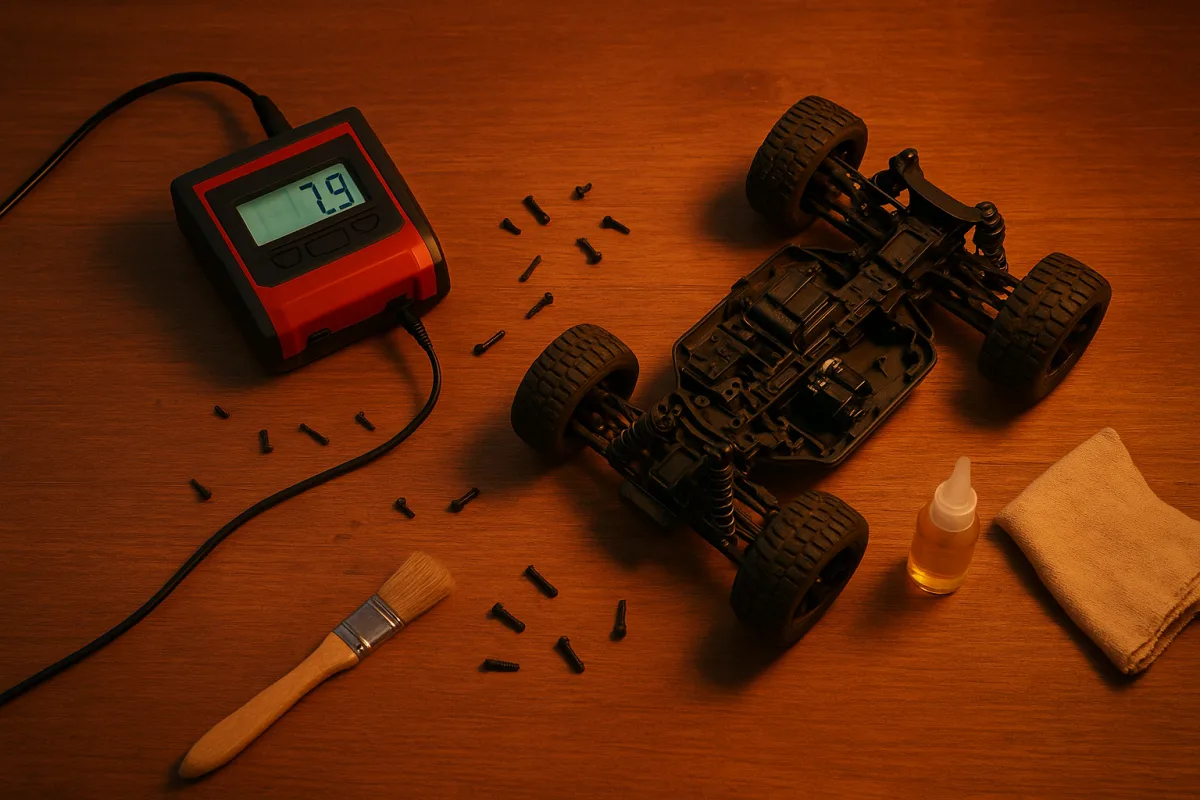
The useful maintenance schedule is based on contamination
The most useful way to think about RC car maintenance is not daily, weekly and monthly as fixed dates. It is a contamination schedule: how much dirt, moisture, heat and drivetrain load did the car see since you last checked it?
A clean 1/10 electric buggy running on a sealed indoor carpet track does not need the same teardown as a 1/8 electric truggy launched through wet grass and loose soil. Same basic parts, completely different amount of abrasive grit.
That distinction matters because dirt is not just cosmetic. Dust works into bearings, hinge-pin areas, driveshaft cups and steering links. It adds drag, makes suspension movement inconsistent and eventually turns a $5 bearing into a hot motor or stripped spur gear.
Speed World Raceway specifically recommends cleaning after every run and paying attention to bearings and suspension arms. [2] That is the right starting point, but the amount of cleaning should match what the car actually did.
If the chassis came home dry with a light coating of dust, use a soft brush and compressed air. If it came home muddy, remove the body shell and wheels first, then clean the chassis and suspension with mild detergent and a soft brush. [7][10]
Do not start by blasting the whole car with water. EuroRC advises avoiding direct water on electronics, and TinyRacer says to remove the battery before cleaning. [8][7] That sounds obvious, but leaving a LiPo installed while washing a chassis is a shortcut to corrosion or electrical trouble.
The post-run check is where reliability is won
For a racer or regular basher, the after-run check is the real maintenance schedule. Weekly and monthly work matters, but those jobs only work if you catch damage before the next pack turns it into a bigger repair.
Start with the wheels off the ground. Spin each wheel and listen. A smooth bearing is nearly silent and lets the wheel coast. A gritty bearing, clicking noise or wheel that stops immediately needs attention before the next run.
Do not automatically strip and solvent-clean every bearing after every pack. Appliance Electronics warns that over-cleaning can remove useful lubrication, even while recommending cleaning and lubrication after dirty or muddy runs. [23] The sensible line is simple: inspect every run, service when roughness or contamination says so.
Next, flex each suspension arm and inspect around the hinge-pin holes, shock mounts and steering knuckles. Speed World Raceway specifically calls out arm cracks after running. [2] A partially cracked arm can still finish a run, but it changes camber and toe under load.
That is a handling problem before it is a breakage problem. On a 1/10 buggy, a bent front turnbuckle or loose ball cup can look like poor steering response. On a heavier 1/8 truggy, it can become a violent twitch when the suspension loads up.
Then check screws, but do not go at them like you are tightening wheel nuts on a full-size car. Goodies RC recommends checking fasteners for snugness, while EuroRC warns that overtightening can damage plastic parts. [3][8]
The important screws are motor-mount hardware, wheel nuts, shock screws, steering hardware, skid-plate screws and anything retaining a hinge pin. If a screw repeatedly loosens, inspect the threaded hole and the part around it rather than simply applying more force.
Finally, look at the battery before it goes back on the charger. Goodies RC recommends checking for swelling, physical damage and pinched wires. [3] A puffed LiPo is not a pack to squeeze back into a battery tray and hope for the best.
Why a weekly check catches the expensive failures
The weekly interval is not about cleaning what is already clean. It is for systems that can wear gradually without making themselves obvious during one short run: gear mesh, shock consistency, bearings, steering and driveshaft wear.
Start with gear mesh. Goodies RC identifies incorrect mesh as a cause of binding or slipping, while RC Models Hub recommends checking that the drivetrain turns smoothly. [3][5] A stripped spur is often blamed on a weak gear, but mesh is usually the first thing to inspect.
With a spur-and-pinion setup, the pinion should not clamp the spur so tightly that the drivetrain feels notchy. It also should not be so loose that the teeth climb and shred under acceleration. The correct setting is free-running with a small amount of backlash.
For a 1/10 buggy with a plastic spur gear, a too-tight mesh loads the motor and raises temperatures. For a 1/8 truggy with much more rotating mass and larger tires, bad mesh can punish the motor mount, spur, pinion and center drivetrain much faster.
Check the CVD or universal-joint cups at the same time. RC Models Hub recommends lubricating CVD driveshaft cups weekly. [5] Use only a small amount of suitable lubricant, because excess oil becomes grinding paste once it picks up track dust.
Bearings deserve the same restraint. Use bearing-specific oil or grease, not general household oil, and apply it sparingly. Toyllo recommends bearing-specific products, while RC Tech Tips warns that excessive lubricant attracts dirt. [18][20]
Shock service belongs in the weekly inspection, even if a full rebuild does not. Look for oil around the shaft, damaged shaft coating, loose spring collars and uneven rebound. RC Models Hub recommends checking shock oil level and seals, refreshing them as needed. [5]
A 1/10 buggy that suddenly hops over small bumps may not need aluminum suspension mounts or a new chassis. It may have one shock low on oil or a bent shaft. Most handling complaints are setup and maintenance complaints first.
Check steering with the radio on and the car unloaded. Goodies RC includes steering and servo function in its weekly list. [3] Watch for a servo that chatters, a horn that moves on its spline, or a saver that is so loose the wheels do not return consistently.
Monthly means inspect the systems you cannot see
Monthly work is best understood as inspection of enclosed or slow-wearing systems. The exact interval changes with use. A race vehicle run several times a week may reach this point sooner than a casual vehicle used once a month.
Open the gearbox or access covers far enough to remove trapped grit and inspect the gears. Cartoys.pk recommends a deeper gearbox clean monthly. [6] Look for rounded teeth, chipped teeth, melted plastic around a spur and dark grease full of abrasive debris.
There is a useful distinction in the conflicting gear-lubrication advice. Cartoys.pk warns against oiling toy-grade gears because oil attracts dust. [6] EuroRC and RC Cars Guide recommend a thin film of RC-specific gear grease after cleaning RC drivetrains. [8][4]
Both ideas can be true. Do not drip oil into an exposed toy-grade gearbox and call it maintenance. In a serviceable RC gearbox, clean the old contaminated grease away, then apply only a thin film of suitable grease where the manufacturer’s layout calls for it.
Check differential seals and fluid during this deeper service. Goodies RC recommends inspecting diff fluid and seals and replacing or refilling according to the manual. [3] Diff fluid is setup, not just lubrication: changing it changes how torque is shared across the axle.
A leaking or inconsistent diff can make a 1/10 buggy push on power or make the rear feel unpredictable. In a 1/8 truggy, thickened or depleted fluid can make the vehicle land poorly and stress tires harder under acceleration.
If you run a brushed motor, monthly inspection includes brushes. RC Cars Guide recommends checking and replacing motor brushes as needed. [4] The research brief does not give an equivalent brushless-specific service schedule, so brushless motors should be assessed by noise, heat and performance instead.
Hobby Etc lists overheating, reduced power, unusual noise and a burnt smell as motor replacement indicators. [22] There is no credible fixed replacement interval for either motors or gears, because runtime, gearing, cooling and dirt decide their lifespan.
Clean the ESC fan and heatsink fins monthly, then inspect for damaged wires or swollen capacitors. RC Cars Guide specifically recommends this inspection. [4] A clean fan is not a cure for over-gearing, but blocked airflow makes any gearing problem worse.
Radio failsafe and binding should be checked too. RC Cars Guide includes both in monthly work. [4] A failsafe is easy to ignore until a receiver loses signal and the car continues toward a curb, marshal or road at full throttle.
Battery maintenance is part of keeping the car reliable
Battery care has its own clock because battery chemistry does not care whether the chassis is clean. LiPo packs should be charged with a balance charger at 1C and should not be discharged below 3.0V per cell. [13]
For practical running, Model Nexus recommends setting the ESC low-voltage cutoff around 3.2V per cell. [13] That gives the pack some margin, rather than repeatedly driving it to the point where voltage collapses under load.
For storage, AllRCGuide gives a LiPo range of 3.75V to 3.85V per cell and identifies about 3.8V per cell as the target. [12] A 2S pack therefore belongs near 7.6V stored, while a 4S pack belongs near 15.2V.
Do not store a LiPo fully charged after a race day just because it is ready for next weekend. AllRCGuide estimates LiPo life at roughly 150 to 400 cycles depending on care. [12] Storage voltage, heat and avoiding over-discharge all influence where a pack lands in that range.
NiMH packs are less fussy about exact storage voltage, but Tech1RC recommends storing them partially charged rather than flat. [15] EuroRC gives a broad NiMH life estimate of 150 to 300 cycles. [8]
Store either chemistry somewhere cool and dry. Cayote recommends 0 to 25°C and humidity below 75 percent for long-term battery storage. [14] Charge on a non-flammable surface or in a LiPo-safe bag, and never leave charging unattended. [13]
Let temperature and conditions change the interval
A maintenance schedule has to tighten when conditions get worse. Dust calls for more thorough cleaning because it accelerates wear, humidity raises moisture risk, and hot weather reduces the margin for motor and ESC temperatures. [2][16][17]
Radiocontrolinfo recommends monitoring motor and ESC temperatures to avoid exceeding 60°C. [17] If temperatures climb, do not assume a bigger fan is the answer. Check gearing, drivetrain drag, bearing condition, mesh and blocked airflow first.
Tires also follow condition, not a rigid calendar. RacenRCs says heavily used tires may need replacement in one to one-and-a-half months, while casual use can stretch to a year. [18] Cracking, hardening and lost tread matter more than the date.
The cheap, repeatable habit is this: clean enough to expose problems, inspect the parts that carry load, and correct drag before adding upgrades. A clean bearing, properly meshed pinion and healthy battery will do more for reliability than most aluminum parts ever will.
Frequently Asked Questions
What is the best maintenance schedule for RC cars?
The best maintenance schedule is based on contamination rather than fixed dates. Perform a post-run inspection every time to catch dirt, grit, or damage early. Weekly tasks should focus on catching developing issues like rough bearings and loose parts. Replace parts such as gears and motors based on wear rather than a set interval.
How often should I inspect my RC car after running?
You should do a five-minute post-run inspection every time you run your RC car. This includes checking bearings for smoothness, inspecting suspension arms for cracks, and verifying that screws and fasteners are snug but not overtightened. Early detection prevents costly failures.
What maintenance tasks should be done weekly on an RC car?
Weekly maintenance includes inspecting and lubricating bearings if they feel rough or noisy, checking gear mesh for smooth operation, lubricating CVD driveshaft cups, inspecting shock oil levels and seals, and testing steering and servo functions. These tasks help catch developing issues before they worsen.
How does running environment affect RC car maintenance frequency?
The running environment greatly affects maintenance needs. A car run on a dusty, muddy, or wet surface requires more frequent and thorough cleaning and inspection than one used on a clean indoor track. Dirt and moisture accelerate wear on bearings, suspension, and drivetrain components, increasing the need for maintenance.
How do I properly store RC car batteries between runs?
LiPo batteries should be stored at about 3.8 volts per cell to maintain health, while NiMH batteries are more forgiving but should not be stored fully discharged. Always remove batteries before cleaning your car to avoid damage, and monitor battery condition regularly to prevent swelling or other issues.
How we researched this
This article was assembled from 23 cited references.
Nothing here is based on hands-on testing. Where a figure or finding appears, it belongs to the source cited beside it, and the writing says so rather than implying otherwise. Every source is listed below so you can check it.
Sources
- Car's Basic Maintenance – Escape RC
- How to Maintain Your RC Car After Every Run | Speed World Raceway
- RC Car Maintenance Checklist: A Practical Guide to Keeping Your Vehicle Fast, Reliable, and Ready to Run -
- RC Car Maintenance Guide: Routines That Actually Keep Your RC Running (2026) | RC Cars Guide
- RC Car Maintenance and Cleaning: A Beginner's Guide – RC Models Hub
- RC Car Maintenance Checklist — After Every Run, Weekly, Monthly
- How to Clean an RC Car After a Muddy Run – TinyRacer
- RC Car Maintenance Tips: Keep Cars Running Strong | EuroRC.com
- Best cleaner for rc cars | Top cleaning products and tips
- Make your RC car shine and boost its performance
- Comment nettoyer sa RC CAR | Guide RC Car Avignon
- Caring for LiPo Batteries: Storage & Lifespan | AllRCGuide
- RC LiPo batteries: charging and storage
- CAYOTE RC Car LiPo & LiHV Racing Battery Maintenance Guide
- How do I maintain an RC car?
- Putting an RC Away: Storage That Doesn't Destroy It
- Brushless RC Cars - RCexplained
- RC Car Maintenance Guide: Tips to Last Longer | Toyllo
- How to Maintain an Off-Road RC Car: Cleaning and Care Guide
- How to Clean Your RC Car: Complete Maintenance Guide - RC Tech Tips
- How To Clean Your RC Car: Complete Guide with Pro Tips | EuroRC.com
- RC Car Maintenance Checklist: A 5-Minute Post-Run Routine | Gearhead's Gazette | Hobby Etc
- RC Model Shop | How to Repair RC Car Problems Fast
Related Articles
RC Car Tire Maintenance: How to Clean and Extend Tire Life
Learn effective RC car tire maintenance tips to clean, dry, and care for your tires to extend their lifespan and improve performance.
How to Clean RC Car Parts: Safe and Effective Methods
Learn how to clean RC car parts safely with tips on brushes, cleaners, and electronics care to keep your car running smoothly.
Best RC Car for Winter Conditions: Top Picks and Setup Tips
Discover the best RC car for winter conditions with top models, tire advice, battery care, and setup tips for snow and cold weather driving.

Best RC Car for Off Road: ARRMA Granite vs Traxxas Slash
Compare the best RC car for off road use: ARRMA Granite vs Traxxas Slash. Get expert advice on terrain fit, battery, and maintenance.