
RC Car Tire Maintenance: How to Clean and Extend Tire Life
Learn effective RC car tire maintenance tips to clean, dry, and care for your tires to extend their lifespan and improve performance.
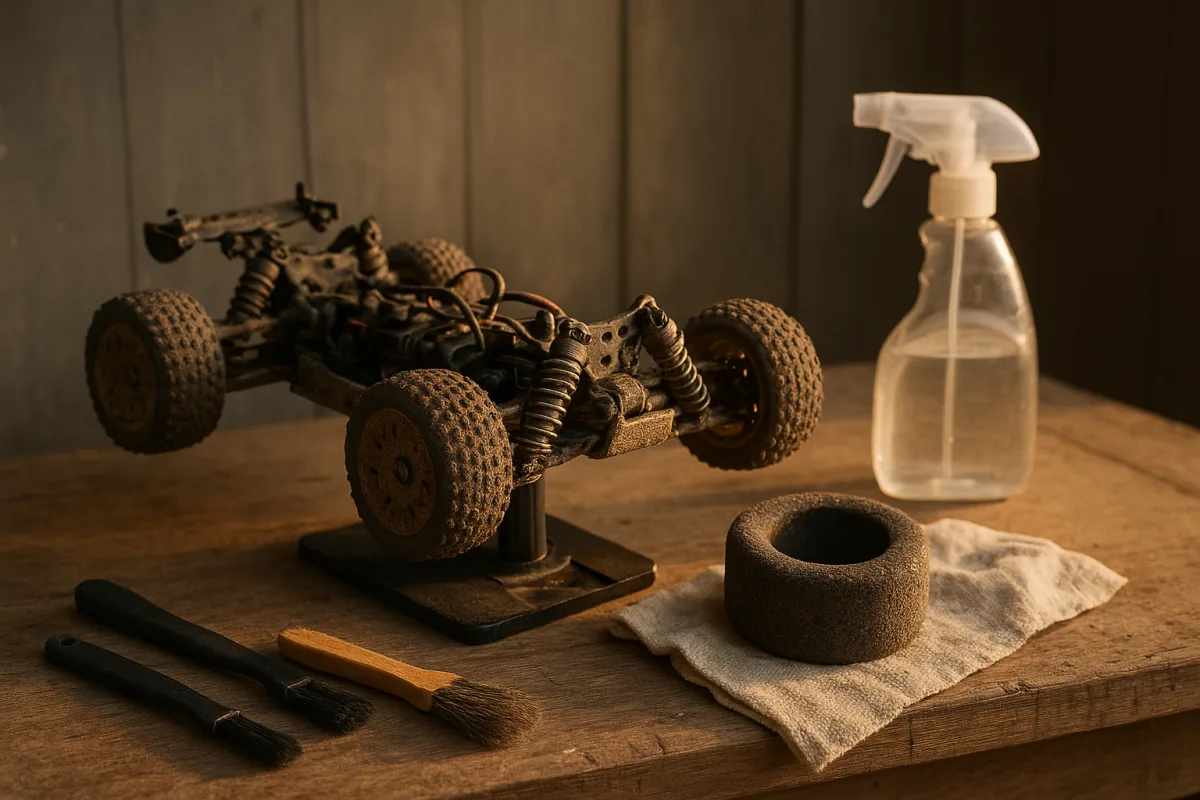
Tire life starts before the first lap. The fastest way to burn through a set is to fit a compound that is wrong for the surface, then keep driving after the tire has gone away. That applies whether you are running a 1/10 touring car on carpet, a 1/8 buggy on abrasive hardpack, a crawler on rock, or a drift car on polished concrete.
I have not run every tire class or kit mentioned in the research behind this guide, so treat this as a maintenance routine built from the cited guidance, not a claim of personal testing. The main point is simple: most worn-out RC tires are not a mystery. They are the result of dirt left in the tread, heat cycles ignored, foam inserts soaked, or rubber stored badly between race days.
Before you run: fit the tire to the surface, not the photo
Start with the surface. A tire that has lots of initial grip can still be the expensive choice if it disappears in one afternoon.
Hard plastic drift tires are intended for smooth indoor surfaces, where they can last hundreds of sessions. A set is commonly under $50, according to RC Cars Guide’s 2026 drift-track guide. Rubber drift tires work better on carpet and rougher asphalt, but they wear faster because the rubber is doing the gripping rather than sliding on a hard plastic contact patch. [6] If you are building a 1/10 drift car for polished concrete, a plastic tire is a lifespan play. Put that same tire on rough asphalt and you are asking it to do a job it was not made for.
For off-road and racing tires, compound choice matters more than trying to save a few dollars by running one set everywhere. So Dialed’s compound guide notes that softer rubber generally creates more grip, while harder rubber is more durable. [7] On a high-grip 1/10 carpet track, a soft tire might be necessary to make the car work, but it will not have the lifespan of a hard compound. On a 1/8 buggy running abrasive outdoor hardpack, using a tire that is too soft for a long final can mean the center pins round off before the race is done.
Do not copy a 1/8 buggy tire choice straight onto a 1/10 stadium truck, and do not take crawler advice as race-buggy advice. Scale, vehicle weight, motor power and surface load are different. A 1/8 e-buggy on 4S or 6S puts far more load into its tires under acceleration and braking than a mild 2S 1/10 buggy. A soft crawler tire is another category entirely. The research estimates roughly a year of weekly trail runs before significant wear for soft crawler tires, while EVA foam-rubber tires in their intended ride-on application can last three to five years even under heavy daily use. [10] Those numbers are not interchangeable, but they make the point: material and use case set the baseline.
During the run: do not cook a good tire
Heat is tire life. Once you understand that, the habit of choosing compound by temperature starts to make sense.
Above 30°C, or 86°F, rubber and asphalt soften. That can raise grip, but it also increases the load on the tire and adds stress to the motor and ESC. Below 10°C, or 50°F, rubber hardens and grip falls away. [7] If your 1/10 touring car suddenly pushes in the morning and gains rear grip after lunch, do not immediately reach for an expensive sway bar or a new chassis. The tire compound may simply be operating in a different temperature window.
Heat cycles also matter. As rubber repeatedly gets hot and cools, its chemistry changes and grip declines even when the tread still looks acceptable. One maintenance guide estimates soft compounds at one to two effective heat cycles, medium compounds at three to five, and hard compounds at five to eight before the loss of grip becomes noticeable. [8] Those are not universal lap-count rules for every RC brand and class, but they are a useful warning against judging a tire only by tread depth.
For race tires, mark the set. A paint pen on the wheel can identify the car position and the cycle count. For example, mark LF, RF, LR and RR, then add a small dot or number after each race day. That is not about being precious with inventory. It lets you see whether a car is wearing the outside front faster, whether the rear is overheating on power, or whether one corner has been exposed to a different surface.
If the car starts behaving badly late in a run, inspect tires before buying parts. A 1/10 2WD buggy that suddenly lacks rear drive may have rounded rear pins. A 1/8 truggy that feels edgy in bumps may have a torn sidewall or a foam insert beginning to break down. A drift car that starts gripping inconsistently may have picked up debris or developed an unevenly worn tire. The expensive upgrade is usually not the fix when the contact patch is the problem.
After the run: remove dirt before it becomes wear
The useful time to clean tires is right after the run, before packed dirt dries hard around the bead, tread and vent holes.
For loose dust and dirt, remove the body and use compressed air at 100 to 120 PSI, holding the nozzle four to six inches away. This gets dirt out of the chassis and suspension without blasting the car at point-blank range. [3] Work around the wheel face, steering knuckles, arms and shock mounts before you focus on the tire. A stiff-bristle brush suits the chassis and suspension, while a soft detailing brush is the safer choice around electronics. [1]
Do not use a pressure washer or hose the car down. Running water and high-pressure water can force moisture into bearings, electronics and tire vent holes. [2] On a vented 1/10 buggy or 1/8 buggy tire, water inside the carcass can soak the foam insert. That adds imbalance, changes how the tire supports the car and can shorten the life of the insert and adhesive bond.
For ordinary grime, use warm soapy water and a damp brush. Keep the brush damp rather than flooding the tire, especially around vent holes. [4] Wipe the tire with a microfiber cloth after brushing. Keep separate microfiber cloths for the dirty first pass, cleaner wiping and final drying. That sounds fussy until you scrub fine grit back into a soft rubber tire with the same rag you used on the chassis.
For greasy dirt, a foaming degreaser can be applied for three to five minutes before brushing. [1] Use a plastic-safe cleaner. RC Tech Tips identifies Muc-Off Nano Tech and diluted Simple Green as suitable examples, while warning against acetone and brake cleaner. [1] Acetone and brake cleaner are not “stronger tire cleaners” in a useful sense. They can damage plastics and are a poor gamble around glued tires, wheel finishes and nearby suspension parts.
Dry it properly: foam inserts and bearings do not like shortcuts
After cleaning, dry the tire and wheel thoroughly. The important part is not making the outside look clean. It is making sure water has not stayed inside a vented wheel.
Inspect the inside of the wheel if you suspect water got through a vent. If the tire feels unusually heavy, has a visible wobble, or the car develops vibration after a wet clean, stop and address it before the next pack. Do not assume a stronger motor, different pinion or thicker diff oil will mask a wheel that is carrying water.
While the wheels are off, spin the bearings. Cleaning guidance recommends a light application of bearing oil after washing to prevent rust and keep them smooth. [13] Use light oil, not a bath. Excess oil gathers dirt, and dirt around the hub is exactly what you were trying to remove.
This is also the best time to inspect the tire itself:
- Look for tears at the sidewall and around the glued bead.
- Check whether tread blocks are rounded, ripped or missing.
- Look for uneven wear across the tire width.
- Check that the wheel is not cracked near the hex or bead.
- Squeeze the tire lightly and compare it with the matching tire on the other side. A noticeably dead or lumpy feel can point to insert trouble.
For a 1/8 buggy or truggy, also check the glue joint carefully. Their heavier wheels, larger tires and harder landings put much more force on the bead than a light 1/10 buggy sees.
When wear is uneven: rotate only when the tires tell you to
There is no authoritative RC equivalent of “rotate every 5,000 miles.” Most RC tires are foam-insert, airless designs, not full-size road tires, and the available guidance does not establish a standard rotation interval. [5] Do not invent one.
Instead, monitor the pattern. If one corner is wearing faster, swap positions only if the tire design, tread direction and vehicle setup allow it. Some directional race tires cannot simply move side to side. On a 1/10 2WD buggy, rear tires may be consumed far faster than fronts, so front-to-rear rotation is not necessarily useful. On a drift chassis, matching tire diameter side to side matters more than blindly following a rotation schedule.
Uneven wear is also setup information. Excessive toe, camber that is too aggressive, a binding suspension arm, a slipping diff, or a bent wheel can all concentrate wear. Fix that first. Buying another four sets without finding the cause is how tire bills get silly.
Air-filled tires are the exception
Most hobby-grade RC tires do not need inflation because they use foam inserts or are otherwise airless. [5] For the uncommon air-filled tire, there are no reliable general pressure numbers in the available RC guidance. Follow the manufacturer’s specification if one exists. If it does not, begin at a moderate setting and make small handling-based adjustments. Do not import full-size automotive PSI rules into a 1/10 or 1/8 RC application.
Store your good sets like race inventory
Storage is where a perfectly usable tire can harden, distort or become contaminated without ever touching the track.
Keep tires in a cool environment, roughly 50°F to 80°F, or 10°C to 27°C, with moderate humidity around 40 to 60 percent. Keep them out of direct sunlight and away from UV exposure. [11] Sunlight and heat are especially bad for soft rubber compounds you are saving for a specific event.
Store mounted tires vertically where possible. Store unmounted tires upright, and avoid leaving them stacked flat for long periods. [12] Long-term flat stacking can distort the carcass or foam, particularly with softer tires. Keep the storage bin or rack elevated off a concrete floor, where moisture and chemical contamination are more likely. [11]
Finally, keep tires away from ozone sources and chemicals such as solvents, fuels and lubricants. [12] Do not store a fresh set in the same unsealed box as nitro fuel, brake cleaner, motor spray or oily shop rags. A tire that looks new but has been sitting in fumes and UV is not really new when it reaches the track.
The practical payoff is not complicated. Choose the right compound, clean dirt without soaking the inserts, dry and oil the bearings, inspect wear before it becomes a handling problem, and store spare sets away from heat and chemicals. That routine will extend tire life more reliably than another alloy option part.
Frequently Asked Questions
How do I clean and maintain RC car tires?
After a run, remove loose dirt with compressed air at 100-120 PSI held 4-6 inches away, avoiding blasting the car directly. For grime, use warm soapy water and a damp soft brush, taking care not to let water enter tire vent holes to protect foam inserts. Avoid pressure washers or running water to prevent moisture damage to electronics and bearings.
What is the best way to extend the life of RC car tires?
Choose the correct tire compound for the surface and temperature conditions to avoid rapid wear. Avoid overheating tires by understanding how temperature affects grip and wear, and mark tires to track heat cycles and wear patterns. Clean tires promptly after use to prevent dirt from packing into tread and causing damage.
How should I dry and store RC car tires after use?
Store tires in a cool (50°F–80°F / 10°C–27°C), moderately humid (40–60%) environment away from direct sunlight and ozone sources. Keep mounted tires vertically and unmounted tires upright without stacking flat long-term. Avoid exposure to chemicals and elevate tires off the ground to prevent moisture and chemical damage.
How does temperature affect RC car tire wear?
Temperatures above 30°C (86°F) soften rubber and asphalt, increasing grip but also stress on tires and motors, accelerating wear. Below 10°C (50°F), rubber hardens and grip decreases. Repeated heat cycles chemically degrade rubber compounds, with soft compounds lasting fewer cycles than hard ones before grip declines noticeably.
Sources
- How to Clean Your RC Car: Complete Maintenance Guide - RC Tech Tips
- RC Car Maintenance and Cleaning: A Beginner's Guide – RC Models Hub
- How To Clean Your RC Car: Complete Guide with Pro Tips | EuroRC.com
- Comment nettoyer sa RC CAR | Guide RC Car Avignon
- 1:8 RC car tires explained – Shore hardness, foam rubber vs. hollow ch – Artexio
- How to Find an RC Drift Track Near You (2026 Guide) | RC Cars Guide
- What Are Tire Compounds on an RC Car? Setup & Tuning Guide | So Dialed
- Kart Tire Maintenance: Storage, Heat Cycles & Longevity | kart.tires
- Is This Why RC Tires Are So Expensive? -
- Plastic vs Rubber (EVA) Tires for Ride-On Cars: Which is Better?
- Tire Storage Made Easy: Expert Tips For How To Store Tires
- How to store tires — tire storage tips for winter… | TireFitLab
- RC Car Maintenance Tips: Keep Cars Running Strong | EuroRC.com
Related Articles
RC Car Winter Storage Maintenance Checklist and Tips
Learn a detailed RC car winter storage maintenance checklist to clean, dry, oil, and prepare your car and batteries for off-season protection.
RC Car Maintenance Schedule: Routine Checks & Cleaning Tips
Learn an effective RC car maintenance schedule with post-run checks, weekly tasks, and battery care to keep your vehicle reliable and ready to run.
How to Clean RC Car Parts: Safe and Effective Methods
Learn how to clean RC car parts safely with tips on brushes, cleaners, and electronics care to keep your car running smoothly.
Best RC Car for Winter Conditions: Top Picks and Setup Tips
Discover the best RC car for winter conditions with top models, tire advice, battery care, and setup tips for snow and cold weather driving.